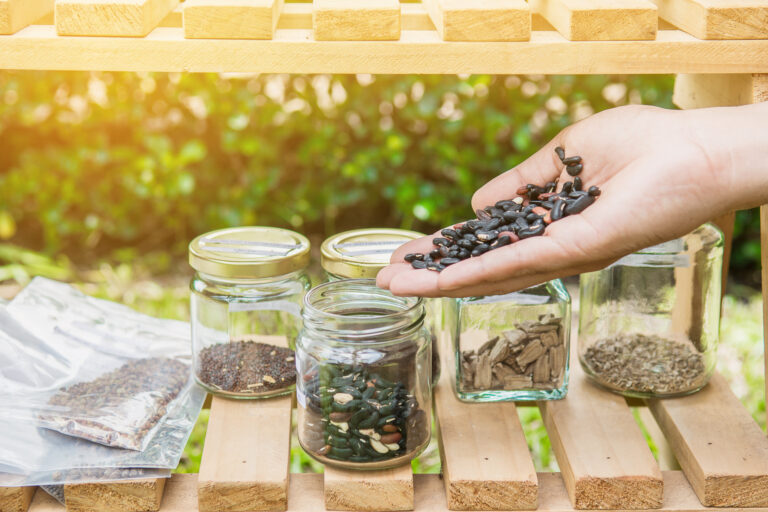
Why is seed saving important? Saving seeds can help gardeners save money, grow better crops and become more self-reliant. Learn how to save heirloom seeds.
When you save your own seeds, you are joining a chain of farmers, gardeners and seed savers that dates back to the Stone Age. All domestic crops were once wild plants that early humans selected to feed themselves or, later, their livestock. Today, gardeners save seeds for many reasons.
- Money Savings. Every time you buy a seed variety, you invest in your future. For example, I just bought some expensive ‘Midori Giant’ soybean seed, and I feel better about the high price tag because I know I’ll have the variety as long as I continue saving seeds from my plants. (With soybeans, you simply let the last picking dry on the plant and you have next year’s seed.)
- Seed Security. Hundreds of excellent plant varieties have been discontinued as big corporations have consolidated the seed industry and focused on more profitable hybrids. If you save your own seed, however, you control the supply. I save seed for ‘Miragreen’ and ‘Blizzard’ peas, ‘Lutz Green Leaf’ beets, and ‘Scarlet Keeper’ carrots because these varieties all grow well here in Maine but have become difficult to find in seed catalogs.
- Regional Adaptation. This is where saving vegetable seeds can get exciting. Most commercially available seed has been selected because it performs fairly well across the entire country if given synthetic fertilizers. (Several companies now offer seeds selected specifically to perform well in organic conditions — but this isn’t the norm.) When you save seed from the best-performing plants grown on your own land and with your unique cultural conditions, you gradually develop varieties that are better adapted to your soil, climate and growing practices.
- Consistent Quality. To keep their prices competitive when producing open-pollinated (OP) seed crops, large seed suppliers rarely “rogue” the fields to pull out inferior or off-type plants. This means the OP seed they sell to retail seed companies may have a lot of off-types in it. For gardeners and market farmers, that translates to loss of production per foot of row. To avoid this loss, either save your own seed, or pay more for premium seed produced by small, organic producers whose seeds cost more because they properly select for uniformity and rogue out any plants that aren’t true to type. (See our Seed Company Directory for profiles of more than 100 seed companies, some of which do their own variety trials and follow careful selection practices.)
- The Joy of Learning. Some people are drawn to the science of seed saving because they want to take their gardening experience to a higher level. The more seeds you save, the more you inevitably learn about botany and the plant kingdom.
- Explore Heirloom Varieties. Some folks like to grow heirloom varieties because doing so gives them a connection to our garden heritage. Others choose non-hybrid seeds because they don’t want to support the industrial agriculture system that increasingly controls our food supply. Plus, some older, open-pollinated varieties produce more nutritious crops than do modern hybrids bred mostly for high yields and long shelf life.
- Influence Crop Traits. Gene pools are incredibly elastic. By carefully observing your plants, you can save seed from those plants that best meet your needs for germination, ripening time, yield, specific fruit shape, flavor, storage qualities, less seediness, better disease resistance, bloom color, or other unique traits within the variety. With time, most of the plants you grow will have your desired traits. For instance, I obtained ‘Elka,’ a Slovakian poppy seed traditionally used before walnuts became commercially available. The Slovaks saved seeds from only the seed heads with the smallest vents — the little holes below the cap that allow the precious nutty seeds to disperse — until eventually their variety had all unvented heads that shed no seed. When I first grew ‘Elka,’ only two-thirds of its seed heads had no open vents. I started selectively saving seed only from the poppy heads that had closed vents. Within three years, all of my plants had seed heads with no open vents, and I didn’t lose any more seed.
Know Your Seed-Saving Goals
Think ahead and create specific goals as you save seed. If you’re saving an heirloom, are you trying to keep it true to its original traits? Are your seed-saving practices changing the plant? If you save seed from the first lettuce plant to bolt, you are selecting for lettuce that bolts early — not a good trait in lettuce. If you save seed from your tomato plants that did not succumb to late blight, you are selecting to improve that variety’s disease resistance.

When I started growing ‘Czech Black’ hot peppers, the fruits varied greatly in shape, from fat peppers with large seed cavities to slender ones with almost no seed. Most were medium-sized fruits that came to a blunt point. If I’d just wanted to save the most seeds with the least amount of work, I could have saved the fat peppers that had the most seeds. But I was trying to produce a seed crop to sell and it needed to be true to the plant type, so I saved seed from the medium-sized peppers growing on the sturdiest, highest-yielding plants. After four years, the peppers were uniform in fruit size and heat — plus, the plants were sturdier and more productive.
Seed-Saving Tips
You should always choose open-pollinated varieties for seed saving. Open-pollinated (OP) plants are non-hybrid plants with seed that is true generation after generation. A hybrid is the offspring of a cross between two parent varieties. Its seed will not be true to type if saved and replanted. Hybrid varieties will be labeled in catalogs and on seed packets as “Hybrid” or “F1.”
There are two main types of open-pollinated varieties: self-pollinating and cross-pollinating. The easiest crops to save seed from are peas, beans, tomatoes and peppers, all of which are self-pollinating crops. Self-pollinating plants pollinate themselves, usually before the flowers open. The seed that you save from these plants and grow the next year will yield plants just like the original ones. To maintain the plant’s genetic diversity, you should ideally grow and save seed from 20 or more plants. If you save seed from only one self-pollinating plant, the plant will reproduce, but you are narrowing its genetic diversity.
Unlike self-pollinating plants, cross-pollinating plants, such as brassicas, corn, carrots, beets, squash, cucumbers and melons, must receive pollen (usually via wind or insects) from other plants of the same variety to produce viable, true-to-type seed. Cross-pollinating seed crops need to be isolated from other varieties of the same species. The simplest solution is to grow only one variety of a given species. You can save seeds from just one or two plants, but to maintain long-term health and vigor, you should buy new seed every few years unless you can collect from much larger populations than the 20 plants recommended for self-pollinators. Grow a minimum of 50 to 100 plants, and at least 200 for corn. Keep an eye out for plants that seem off-type (like my fat ‘Czech Black’ peppers), and don’t include them when you collect seed. (Go to the Seed Savers Exchange’s Planting and Seed Saving Instructions for details on isolation distances and other specifics for dozens of crops.)

To save seed from legumes, such as self-pollinating peas and beans, simply allow some pods to dry on the plant. Save the leftover seed at the end of your picking stage, or cordon off a section of the row. As the plants will need to be in the garden longer than the “green” stage, allow for this in your garden plan. Different varieties grown right next to each other will have minimal or no cross-pollination, but ideally you should separate varieties by 20 feet to avoid rare cases of cross-pollination.

If you want to save seeds for several varieties of a cross-pollinated crop in the same garden, a physical barrier such as a screen cage or row cover can keep the seed crops isolated. I use wire hoops and row covers on some seed crops to keep them pure. I also alternate years, growing one variety one year and another the next. My ‘Lutz’ beet seed crop produced enough seed to last five to 10 years, leaving me free to produce other beet seed crops in the interim.
If you’re growing a crop for seed, think ahead of time about spacing. Tomato, pepper or bean plants don’t need more space as seed crops, but biennial beets and carrots do because of how large the seed-producing plants will be in their second year. Beet plants that I set out the second year from roots I stored in my root cellar grew to 3-foot-wide plants. As large seed crops grow, also think about feeding them. I give my seed crops extra nitrogen and minerals during seed production.
When saving seeds, good record keeping is essential. Label your seedlings, your planted rows and your stored seed. I keep a map as a backup record, too, in case a critter makes off with a row marker or weather washes away a label’s ink.
If you spot an interesting off-type, you can save seed and grow it out the next year to see what happens. You may be on your way to creating a new variety — or at least embarking on a little botanical adventure.
Seed crops are harvested at different times than food crops. I often tie off an entire section of a row with ribbon and save all of the seed from that section, leaving it long after the rest of the plants have been removed. Watch plants that produce pods; when the pods are dry but not shattering, they are ready to harvest. I find handpicking pea pods easiest, at least on a small scale. I harvest entire bean and soybean plants and hang them until they are completely dry, then thresh them in a clean bucket. Blow off the chaff using wind or a fan, or sift it through a screen.

Flower heads are usually hand-harvested as they dry. Morning glories and vine crops often mature their bottom seed husks or pods first and progress up the vine as the season goes on. Spread the seed heads out to dry, rub them back and forth between your hands to free the seed, and then winnow or screen away most of the chaff.
Tomatoes, peppers, eggplant and cucumbers can be picked as individual fruit. Let the fruit become very ripe to overripe to ensure mature seed. Leave cucumbers on the vine until they mature past the yellow blimp stage. Eggplant should be starting to brown and rot. Tomatoes and peppers need to be very ripe or just past ripe, or picked close to ripe, and then stored until fully ripe to overripe (a process called “after-ripening”).
Tomatoes and cucumbers are “wet” seeds: They have a gel sac around each seed that hinders germination and, in rare cases, can harbor disease. They need to be soaked to remove the gel sac. Squeeze the tomatoes or scrape the seed from the tomato cavities into a labeled container, covering it to keep out flies. Allow the seed to soak for 24 to 48 hours. Add more water after soaking. The good seed will sink while the immature seed will float along with the pulp. Pour off the pulp. Add more water and continue to pour off the pulp until all that remains is clean seed on the bottom. Pour this seed into a strainer to drain off all liquid, and then spread the seeds out to dry in a cool, airy place. I spread my seed on newspaper. Paper plates also work, but paper towels are too fibrous and will stick to the seeds. Label the newspaper or paper plate with the variety name. When the tomato seed is half-dried, stir it to make it less clumpy. After seeds have completely dried, break up any remaining seed clumps and pack the seeds for storage.

To save eggplant seed, grate the fruit or put it through a food processor, and then add it to water. The seed will sink and the pulp will float. Peppers are even simpler: Just cut fruits open and remove and dry the seed. For much more on seed-saving procedures for different crops, see the books Saving Seeds by Marc Rogers and The Complete Guide to Saving Seeds by Robert and Cheryl Moore Gough.
Store dried seed in glass jars, plastic bags or paper envelopes. Glass is best, as it does not allow moisture into the seed. Store seeds in a cool, dry place — ideally at less than 50 degrees Fahrenheit and at a relative humidity level of less than 50 percent. In general, for every 10 degrees colder the storage conditions, seed longevity doubles, so it’s best to keep seed in a covered container in a refrigerator. As long as the seed is very dry, it will last longest if you keep it in a freezer. All seed should be dried to a brittle state, ideally to less than 14 percent moisture (the level at which ice crystals won’t form on seeds if stored in the freezer). When you’re ready to use seeds that have been in freezer storage, allow the storage jar to come to room temperature before opening it to avoid condensation on the seed.

Different types of seed have different life spans. Many retain good germination for only a few years, while others stay viable for an impressively long time. Some classic one-year wonders are parsley, parsnip and onions. They may last a second year, but germination and vigor will be much lower. In general, pepper seeds maintain good germination rates for two years; legumes and carrots, three years; squash, beet, eggplant, tomato and brassicas, four years; cucumber, five years; and lettuce, six years. Exact storage conditions affect longevity greatly, however, and seeds from some of these crops can last 10 years or more.
You can do a simple germination test by loosely rolling a few dozen seeds in a moist, white paper towel, keeping it covered with plastic wrap and slightly moist to sprout the seed. Most seed will sprout in four to 28 days. If it takes longer or if less than 50 percent of the seeds sprout, you should probably toss the seeds.
If you end up with more seed than you can use, find a local seed swap. You can trade or share your seed, and you’ll come home with new, locally adapted seed varieties as well as a head likely spinning from all of the knowledge you’ve gleaned from fellow gardeners who share a love of growing great food. Organize a seed swap near you, and have MOTHER EARTH NEWS help you get the word out.
Saving Seeds to Sell
If you’re interested in selling seeds that you produce, contact a seed company’s purchaser to inquire about which crops the company needs grown. Specify your areas of expertise. Most seed companies contract for specific strains or varieties one to three years ahead of time.
If you pitch your favorite variety to a seed company, the representatives will want a seed sample so they can trial or observe it for a year or two. Then, if they’re interested, they will contract with you. Some seed companies have tight legal contracts and deadlines. Some use just verbal commitments, however, and you can provide a contract if you want more insurance in such cases.
A small seed company may only need a few ounces of seed. Larger companies rarely deal in small lots, requiring 1 to 20 pounds of small seed, such as that of tomatoes. Inquire upfront about amounts needed.
The Organic Seed Alliance provides education and advisory services for seed savers and is an excellent resource.
Seed Saving Made Simple
Always save from open-pollinated (OP) varieties, not hybrids. There are two main types of OP crops:
- Self-pollinating (easiest to save), including peas, beans, tomatoes and peppers
- Cross-pollinating (require isolation), including brassicas, corn, carrots, beets, squash, cucumbers and melons
Roberta Bailey is a regular “Gardener’s Almanac” contributor. She lives on a 16-acre farm in Maine and often cans more than 1,000 quarts of food a year.
Originally published in the December/January 2012 issue of MOTHER EARTH NEWS magazine and regularly vetted for accuracy.