



Butterfly Gardening (Princeton University Press, 2018) by Jane Hurwitz helps beginners and exerts alike to transform their yard into a butterfly oasis. Hurwitz even breaks her guide down into regions, so that every gardener across the country can find the perfect plants for their specific location. In the following excerpt, she discusses what types of flowers attract different species of butterflies.
Just observing flowers in a garden on a warm, sunny summer day will show you which flowers attract butterflies. Since different species of butterflies are in flight at varying times over the course of the warmer months, a single visit to a garden or garden center will not give you the knowledge needed to plan an effective butterfly garden, but it can be a valuable exercise in fi ne-tuning your plant choices once you have established a basic garden.
Think like a butterfly and consider the following features of flower morphology when considering a nectar plant for your garden:
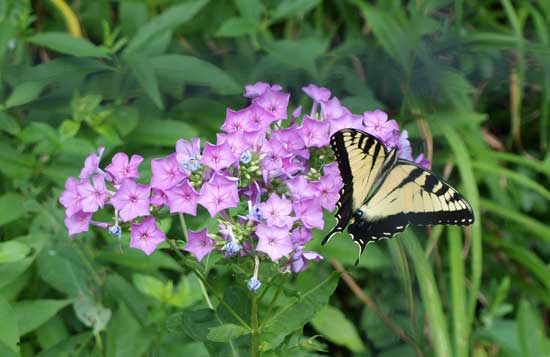
Flower shape and arrangement: Some flowers are shaped in a way that allows butterflies to reach their nectar, but not all. Butterflies with long tongues, such as swallowtails and many skippers, can access nectar from deep flowers. Smaller butterflies tend to have shorter tongues and will seek out shorter flowers. Flower heads that comprise many smaller flowers allow butterflies to land and drink without having to expend energy to fly to adjacent flowers. When planning a garden for butterflies, start by choosing plants that among them have a variety of different-shaped flowers, so that different-sized butterflies will be able to find nectar. Some of the most widespread and popular butterfly nectar plants include the following:
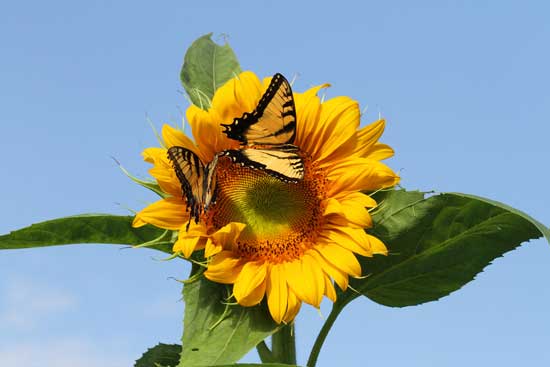
• Plants in the Aster Family such as purple coneflowers, blazing stars, goldenrods, and sunflowers. Plants in the huge Aster Family feature many small, nectar-producing flowers in each flower head. The small flowers, called florets, open in sequence so that any one flower head includes nectar-producing flowers at various stages from unopened (and not yet producing nectar) to beginning to open (and maybe not producing abundant nectar) to fully open, ready-to-pollinate florets (an irresistible feast of nectar), and finally to a pollinated floret (exhibiting an “expired sell-by date” to pollinators). When a butterfly lands on an Aster Family flower, it may be able to drink from many florets without having to move anything other than its tongue.
• Plants in the Mint Family, such as beebalms, giant hyssops, and mountainmints, are butterfly magnets. Unlike culinary mint, which can spread vigorously by underground stems, beebalms and mountain-mints tend to be slower in their colonization and are easy to pull out if they spread beyond their designated spots. Giant hyssops may spread by seed if conditions are right, but do not spread by underground stems. All three of these Mint Family plants bloom over a long period and produce many flowers per plant. Mountainmint flowers tend to be small and are a favorite with small butterflies such as hairstreaks.
Landing stage: Flowers that provide a stable landing platform where a butterfly can perch and sip nectar with minimum expenditure of energy are important to include in gardens. Observe butterflies nectaring on zinnias or purple coneflowers: to access nectar they merely move their tongues from floret to floret while having a stable base of petals on which to stand. Many butterflies will flutter their wings as they nectar but they are not flying while feeding; they have come to a stop, and this makes them vulnerable to predation.
Flower scent and condition: Fresh flowers that have recently opened are visually attractive to humans and often attractive to butterflies as well. But after a flower has been pollinated, various signals serve to decrease its attractiveness to butterflies and other pollinators: the flower’s color may become less vibrant, its scent may change or decrease, and its orientation can shift (by drooping or crumpling). These changes indicate to pollinators that they will earn no reward for visiting the already-pollinated flower.
It should be noted that floral scent for butterflies is not necessarily the same as an intense flower fragrance that gardeners might covet. Roses, for example, are completely ignored by butterflies! Some flowering plants, such as fall phlox, are both attractive to butterflies and have a very pleasant scent that will be noticeable in gardens, but floral scents that draw butterflies to nectar sources are more than pleasant smells. These scents communicate information from plants to butterflies––they can attract butterflies to flowers that are ready to be pollinated, but they can also be produced to repel egg-laying by butterflies whose caterpillars will harm the plant. The interrelationships between plants and butterflies are extensive and highly complex and provide a variety of levels of study and observation for those who are curious.
Nectar guides: Butterfly vision differs greatly from our own. When looking for flowers, flying butterflies recognize blocks of color, so massing one particular species of plant in a group increases the likelihood that passing butterflies will be attracted to your welcoming garden. Butterflies also see in the ultraviolet portion of the light spectrum (which is not detectable by human eyesight), allowing them to view flowers in a way that we cannot. Once butterflies get close to flowers, certain details in the light reflected in the ultraviolet range provide them with important clues about the avail-ability of nectar.
Many flowers have patterns on their petals that are visible only in the ultraviolet range. These patterns, which can consist of lines, dots, or differently colored petals, are called nectar guides and serve to direct butterflies toward the center of the flower where they can quickly access the flower’s nectar. These guides are obvious on fully open flowers that are producing nectar, while on flowers that have not yet fully opened or have started to wilt the nectar guides will not be visible, allowing butterflies to direct their foraging efforts as efficiently as possible.
Many garden flowers display lines, speckles, and color blotches that are visible to humans. When you examine the flowers in your garden, notice if there are color variations or markings that direct your eye to the center of the flower.
Excerpted from Butterfly Gardening: The North American Butterfly Association Guideby Jane Hurwitz. Copyright © 2018 by The North American Butterfly Association. Published and reprinted by permission of Princeton University Press.





