
Lee Fryer began fighting our overdependence on chemical,
fossil-fuel-based fertilizers in the days before many of us
had even heard of “organic” farming. And we’re pleased to
have this expert (a man who’s had decades of experience
working with benign soil aids) explain how to . . .
An agricultural consultant and president of Earth Foods
Associates, Mr. Fryer is the coauthor of a number of books
and—for several years—ran a large fertilizer
business that was based on converting seaweed, fish
by-products, chicken feathers, and other nutrient-laden
“waste” into farm- and garden-boosting products. We think
you’ll enjoy the following excerpts from his forthcoming
book. The Bio-Gardener’s Bible (scheduled for
publication by Chilton this fall).
First, we should decide what grade, or analysis, we need in
the mixed fertilizer. For example, in the case of a
fertile, well-manured garden, only moderate
nitrogen should be included. Phosphate
should be at least double the nitrogen content, and
potash should be about the same as the phosphate.
Such a 1-2-2 ratio is about right for a general-purpose
organic-based garden fertilizer.
In order to leave “room” for plenty of bulk organic
ingredients, we will deliberately make this a
medium-low-analysis product. So, we’ll settle on a 3-6-6
grade. This means the finished product will contain a
guaranteed analysis of 3% nitrogen (N), 6%
phosphate (P2O5), and 6% potash (K2O). Thus, as noted
above, the major plantfoods are provided in a 1-2-2 ratio.
To comply with these specifications, each 1,000 pounds, 100
pounds, and 10 pounds of this “model” fertilizer will
contain the following amounts of nitrogen, phosphate, and
potash.
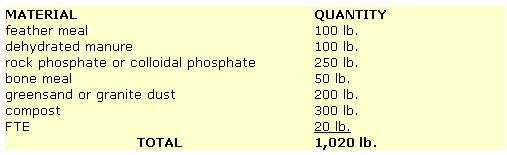
After looking over the available fertilizer materials in
our neighborhood, let us assume that the following
ingredients are selected for this “model” general-purpose
garden fertilizer.
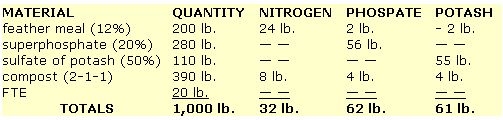
To meet the requirements of our 3-6-6 guaranteed analysis,
we may now prepare the following formula. It’s calculated
to yield 1,000 pounds. However, using simple arithmetic,
the quantities can be determined for 100- and 10-pound
batches.
NOTE: If materials are available, this fertilizer can be
improved by adding 50 pounds of seaweed meal and 30 pounds
of Epsom salts (magnesium sulfate). The quantity of compost
would be reduced to accommodate these extra ingredients.
Doing this will add seaweed’s large assortments of trace
minerals, and useful magnesium from the Epsom salts.
In accordance with good fertilizer practice, we’ve provided
enough materials to slightly exceed the requirements of the
formula. It is noted that 3% of 1,000 pounds equals the 30
pounds of nitrogen required. Six percent (6%) of 1,000
pounds equals the 60-pound requirements for phosphate and
potash, respectively.
In this simple home mixing operation, we would round off
the superphosphate quantity to 300 pounds, the potash to
100 pounds, and the compost to 400 pounds, revising the
total to 1,020 pounds.
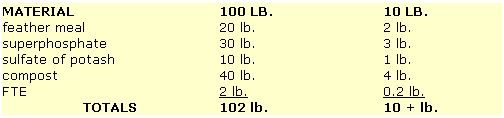
The quantities for smaller batches are as follows.
ADAPTATION FOR STRICT ORGANIC
GARDENERS
To adapt this formula in accordance with strict organic
principles, the following revisions are suggested. However,
other combinations of organic ingredients are also
possible.
This formulation does not fulfill the requirements of a
3-6-6 grade, in terms of available NPK nutrients,
since the phosphate and potash are not provided in readily
available forms. However, this is a practical organic-type
fertilizer for gardens, shrubs, berries, and fruit trees.
WEIGHING AND MIXING INSTRUCTIONS
When neighbors get together to blend and mix a large batch
of fertilizer, such as 1,000 pounds or more, any kind of
fairly accurate platform scales can be used. A sturdy box
can be preweighed to determine its tare, to be deducted
from gross weight. The proper amounts of the various
ingredients can then be weighed out and determined. (For
smaller batches, simply use any fairly accurate household
scale.)
I mix my fertilizers on a concrete driveway or auto parking
place, but any dry flat surface will do. Simply pour the
various materials on top of each other in a conical pile,
adding the small quantities last. Then mix everything with
a shovel by scooping material off the edges and pouring it
on top. Mix the pile thoroughly at least three times.
The finished fertilizer can be put into convenient-sized
bags or boxes. Poly liners are recommended, since some
fertilizer materials attract moisture. Store the containers
in a dry place.
HOW TO SHOP FOR FERTILIZER MATERIALS . . . DON’T
GET FRUSTRATED
At present, in most urban communities, local garden centers
offer packaged superphosphate, bone meal, sulfate of
potash, Epsom salts, and urea. Some of them cater to
horticultural-type customers and provide FTE and chelated
minerals. Dehydrated manure and compost are also widely
available. (You can do most of your shopping by telephone,
using the Yellow Pages.)
Also, resourceful gardeners may be able to obtain bulk
material supplies by finding a fertilizer mixer/distributor
someplace in the surrounding area. Such companies are
frequently willing to sell small quantities of materials to
pleasant people who call on them. They may even have such
often hard-to-get items as FTE, Sul-po-mag, and chelated
minerals.
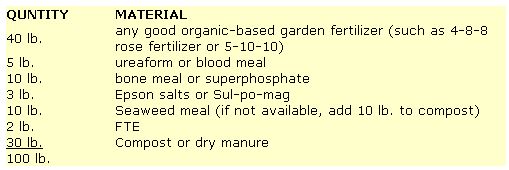
However, if the bulk NPK-type materials aren’t available, a
practical alternative is to buy a sack (or more) of a
fairly good, already mixed garden fertilizer . . . and
fortify and “sweeten” it with biotype materials
(organic-based rose fertilizer usually contains more potash
than do other varieties). Here is a recipe for 100 pounds
of Deluxe Garden Fertilizer, using an already mixed
fertilizer as a base.
The guaranteed analysis (grade) of this fertilizer is
approximately 4-6-6. This formula can be made strictly
organic by selecting a 100% organic mixed-fertilizer base
and eliminating the ureaform and superphosphate. Ground
rock phosphate and granite dust may be added.
EDITOR’S NOTE: More soil-care tips can be found on this
article .
SOME BIOLOGICAL FERTILIZER
INGREDIENTS
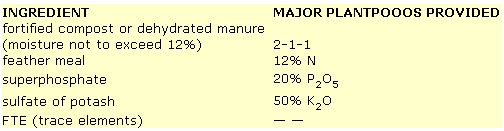
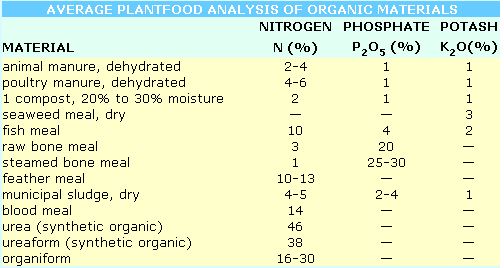
The information in the accompanying table will assist
you if you wish to prepare your own balanced fertilizer
mixtures containing the right amounts of major plantfoods.
Here are a few additional properties of several of the
commonly used organic-type fertilizer materials.
ANIMAL AND POULTRY MANURES
Animal manures are inherently low in actual plantfoods.
For example, dehydrated cow manure usually contains less
than one-sixth the amount of nitrogen found in sulfate of
ammonia (21% N). . . even though it smells stronger and
richer. However, we use the manure materials because they
also feed and stimulate the soil organisms that build
fertility and capture nitrogen from the atmosphere . . .
they improve the condition of the soil . . . and they
promote good air and moisture relationships.
As some gardeners already know, poultry manure has a
higher nitrogen content than animal manure, sometimes as
high as 4% to 6% in the dehydrated product. Compared with
popular commercial fertilizers, though, even poultry manure
is a low-analysis material. It contains about one-sixth the
nitrogen of ammonium nitrate (33% N) and one-tenth the
amount in urea (46% N).
It’s a sound practice to compost manure materials
before application. This increases their fertilizer
value.
COMPOST
Compost is biologically processed organic
matter, improved in this way for its use as fertilizer.
Even the bodies of the billions of bacteria and fungi that
perform the composting process add values to the
product.
The quality of the compost is dependent to a large
degree on its bulk constituents. A compost can be made with
manures, animal and poultry dressing wastes, feathers,
blood, fish, leaves, grass clippings, weeds, sawdust,
kitchen garbage, seaweed, sewage sludge, and any other
available biomass material.
However, compost is enhanced when animal, poultry,
and/or fish materials are included with the vegetable
materials. This provides readily available protein-type
food for the composting organisms, thus promoting their
activity and populations in the compost pile.
SEAWEED MEAL AND RAW SEAWEED
Again, an important principle must be kept in mind: We
do not use seaweed as a source of NPK-type plantfoods. In
fact, seaweed contains only a smidgen of nitrogen, a speck
of phosphate, and a morsel of potash. Its signal values are
in the excellent assortments of secondary and trace
minerals it provides, such as magnesium, sulfur, iron,
zinc, iodine, molybdenum, boron, manganese, and
copper.
Also, seaweed is a good soil conditioner, serving to
loosen and improve tough, cloddy soils. In addition, it
acts as a chelating agent to help plants glean minerals for
an adequate diet.
BONE MEAL
The bones of all animals are composed mainly of calcium
and phosphorus, in a compound called bone phosphate of
lime. When they are ground raw, portions of meat,
cartilage, and marrow are retained—adding to the
protein (nitrogen) content—and the product is called
raw bone meal. It contains from 2% to 3% nitrogen (N), 18%
to 20% phosphate (P2O5), and 28% to 30% lime (CaO). As
such, it is the finest form of phosphate fertilizer
available for use by gardeners and nursery growers.
Steamed bone meal is a white powder-type material. It
may contain 28% to 30% phosphate and only 1% or less of
nitrogen. It, too, is a good phosphate fertilizer but has a
lesser effect than raw meal as a biological stimulant.
FEATHER MEAL
As practical gardeners learned many years ago, feathers
are excellent fertilizer materials. This is because they
contain over 90% protein, thus providing 12% to 14%
nitrogen (dry basis).
Fertilizer manufacturers know how to use steam heat and
suitable reagents to process feathers into feather meal. It
contains 10% to 13% nitrogen, plus the various minerals
birds use in growing their feather clothing.
Feather meal may become available in local gardening
areas as the costs of other fertilizers rise to scandalous
levels. If so, it can be used as a nitrogen ingredient in
mixed fertilizers, or applied straight.