

MOTHER’S vegetable garden shares how to grow corn. Plan on a minimum of 10 to 15 plants per person. Don’t pick your corn till the pot boils.
How to Grow Corn
Corn ( Zea mays ) is more American than apple pie.
It’s believed that an early type of this member of the
grass family was grown in South America at least 4,000
years ago, and it’s known that corn was cultivated
throughout much of North America long before the time of
Christopher Columbus. He and his explorers are credited
with introducing corn to Europe, where it spread throughout
the continent and to Asia and Africa. Europeans still use
it primarily as a food for livestock. In the United States,
however–though 80% of our corn is fed to
animals–even growers with small gardens are likely to
plant this space-consuming vegetable, and for a very valid
reason: The sugar in most corn varieties starts changing to
starch as soon as it’s picked, so ears that go straight
from the stalk to the pot or freezer offer a succulent
taste that corn purchased from a market, or even a roadside
stand, can never match.
What Varieties of Corn to Plant
There are literally hundreds of cultivated varieties of
corn, but they fall into four classes: popcorn (Z.
mays praecox ), a low-calorie, nutritional snack;
dent, or field, corn (Z. m.indentata), used mostly for
animal feed but also popular in the South as a fried dish,
and the source of cornmeal; Indian, or flint, corn (Z
m. indurata ), with colorful ears that are used for
ornamental purposes (the inner pan of the grain that
remains once the hull is removed is called hominy, which,
ground up, becomes grits); and sweet corn (Z. m.
rugosa ), the popular choice for most home gardens.
Though sweet corn as we know it wasn’t developed until just
over a century ago (and the now-popular hybrids began
appearing 30 years later), today’s gardeners can choose
from early, midseason or late varieties that sport either
yellow or white kernels or a mixture of both. There are
also dwarf types as well as “skyscraper” varieties that
reach heights of 12 feet, and new offerings come on the
market every year.
Some popular early varieties of sweet corn, which take 58
to 70 days to mature, are Spring Gold (withstands cold and
damp soil and produces large ears), Seneca Explorer (also
popular in cold-weather areas), Silver Sweet (a white type
similar to the late-season Silver Queen but which matures
in 66 days), Butter Vee (ready in only 58 days with a high
sugar content) and Aztec (resists some strains of wilt and
tolerates smut). .
Midseason varieties, maturing about a week later than early
types, include the open-pollinated, low-starch Early Gold
Bantam, which retains its sweetness for a long time; Gold
Rush, a tender, sweet, yellow corn that adapts to most
climates; Mellow Yellow, which freezes well; Kandy Korn EH,
as sweet as its name and whose kernels can retain their
quality for up to two weeks on the stalk; Aristogold, which
grows well in dry conditions; Honey and Cream, a bicolor
with a tight husk that discourages earworms and other
insects and Platinum Lady, a delicious white variety.
Of the late season types. Country Gentleman and Golden
Bantam–both open-pollinated–have been favorites
since they were developed many decades ago. Seneca Pinto,
Sugar Dots and Silver-N-Gold are all sweet, bicolored
cultivars, and the very late and very popular Silver Queen
is a white corn that takes 92 days to mature but is well
worth waiting for.
Among the dwarf corn varieties. Golden Midget (58 days) grows on stalks
only 2½ foot tall, and its 4 inch long ears freeze well;
Honey Cream, with 6 inch to 7 inch ears, is another good choice for
a small garden.
For popcorn, try White Cloud or Japanese Hulless. Both pop
big and have no hulls. Then there’s the unique Indian
Ornamental Pop that’s both tasty and decorative. Ornamental
corn, however, requires hot weather and a long growing
season. Indian Ornamental, for example, takes 110 days to
mature, producing large ears in an endless array of colors.
Field corn, called “roasting ears” by those southern
gardeners who relish them, has to be picked early before it
becomes too tough to eat. Hickory King, which comes in both
yellow and white versions, is a popular field variety.
When to Plant Corn
Gardeners who are impatient for the first possible taste of
homegrown corn sometimes take the risk of planting two
weeks before the last frost date. Should you do this, be
prepared to risk losing your crop since corn is very
susceptible to frost. Other eager growers, particularly
those with short gardening seasons, start the seeds
indoors. Corn, however, doesn’t transplant well, so it
should be started in peat pots in order to disturb the
roots as little as possible when moving it to the garden.
It’s usually better to wait until all danger of frost is
past, and then, in order to have a long harvest, plant
early, midseason and later varieties at the same
time–or plant an early variety every two weeks for
six weeks or when the preceding crop is 3 inches tall. A
scarecrow might help keep birds from stealing the seeds
before they can sprout and from eating the small shoots.
Some people say a string stretched a few inches above the
row, especially if hung with foil pie pans, will also
discourage these thieves.
How to Plant Corn
Plant corn in a sunny but wind-protected spot. While it
will grow in almost any soil, the vegetable does best in
well-worked, fertile soil with good drainage and a pH of
6.0 to 6.8. Because it’s a heavy feeder, especially on
nitrogen, it’s best to plant corn where beans were raised
the previous season or in an area where other legume crops,
such as alfalfa or clover, have been cultivated recently.
(Some Native Americans bury a fish under each hill of corn
to help provide needed nutrients.) Work in generous amounts
of compost or aged manure, along with bone meal and wood
ashes, to a depth of 6 inches. If the soil is not very fertile,
you should probably side-dress the crop when it’s about 6 inches
tall and again at about knee-height. Blood meal or a
diluted fish-based fertilizer are good for this purpose.
For best germination, the temperature of the earth should
be approximately 60°F. If the weather stays
unseasonably cool, you can hurry the warming process by
covering your future corn patch with black plastic.
Since a stalk of corn typically produces only two ears per
plant (except for some dwarf varieties, which have four),
plan on a minimum of 10 to 15 plants per person.
Corn is wind-pollinated (each silk on the ears must receive
pollen from the tassels on top in order to produce a
kernel), so it generally does better planted in blocks
rather than rows. You can also put five seeds to a hill and
then thin to the three strongest plants.
Since corn has a 75% germination rate, plant the seeds 2 inches
deep, placing three kernels every 8 inches to 12 inches, and thin the
stalks to 10 inches to 12 inches apart. (Dwarf varieties are generally
planted 1inch deep and thinned to an 8 inch spacing.) Rows should
be 3 feet apart (2 feet for dwarfs). Use care when thinning plants
so as not to disturb the roots of those you keep. The seeds
should germinate in seven to ten days, and you’ll need to
keep the weeds away, since this grasslike plant doesn’t
compete well. Mulching with straw, leaves or grass
clippings can solve this problem and will also conserve
moisture. And corn does require a lot of water,
especially when the tops begin to tassel. (Don’t wet down
flowering tops, though, since that could wash off the
pollen.) Stop weeding at tasseling time to avoid damaging
the surface roots.
As the plants grow, they will put out side shoots, or
“suckers.” These don’t harm production, however, and
cutting them off might damage the roots.
Since corn takes up a considerable amount of space in the
garden, it only makes sense to intersperse it with another
crop. With medium-size varieties, you might want to plant
half-runner beans. With tall varieties, pole beans can
twine up the stalks. Pumpkins and squash are other good
choices.
What Corn Problems and Pests to Watch For
Stewart’s disease, a bacterial wilt that causes the plants
to become dwarfed and dried-up, can attack any type of
sweet corn but seems to favor yellow varieties. If you’ve
had this problem, choose a corn that’s resistant to the
malady. Because the ailment is spread by flea beetles and
cucumber beetles, which thrive in plant refuse, keep your
garden clean and burn infected plants.
Corn smut looks worse than wilt, but it’s usually less
damaging. It appears on the ear as a pale, shining, swollen
area that darkens and bursts, releasing powdery black
spores. It can be prevented with crop rotation and good
garden sanitation. Should it strike, cut off and dispose of
the galls before they open, and–if
necessary–destroy the infected ears or stalks to keep
smut from spreading to other plants. Once in the soil, it
can remain viable for five to seven years.
Corn earworms, which also attack tomato plants, can damage
the stalks but usually do the most harm to the ears
themselves, starting their mischief when the corn begins to
silk and continuing their destruction until harvest.
Earworms are striped, yellow-headed, about 2 inches long when
full-grown, and vary in color from yellow to green to
brown. You may first become aware of their moist castings
on the silks. Generally, they confine their damage to the
tips of the ears, which can be cut off when harvested.
Attack heavy infestations with Bacillus
thuringiensis , garlic/onion spray, rotenone or
pyrethrum, but be aware that such remedies are effective
only if applied as soon as you notice the castings and
before the worms have crawled too far inside the ear.
Another remedy is to put a few drops of mineral oil right
down into the top of each ear after the pollinated
silks have wilted and begun to turn brown. You can also use
this method to cope with 1/8 inch-long, black sap
beetles–which drill into ears.
European corn borers–1 inch-long, flesh-colored worms,
marked with fine black dots–overwinter as full-grown
larvae in the stems of weeds and cornstalks, pupating in
late spring. They emerge as yellowish-brown moths between
June and August and lay eggs on the undersides of the
plants’ leaves. When hatched, the larvae bore into the
leaves, stalks and ears of corn. To break this cycle,
destroy all cornstalks and weeds in the fall. Lady-bugs,
Bacillus thuringiensis , rotenone and hand-picking
of the pests are often effective against a corn borer
infestation.
Cutworms can be discouraged by putting paper collars around
the young shoots. Flea beetles can be fought with hard hose
sprays, sticky traps, garlic sprays, garden-quality
diatomaceous earth or wood ashes. Seed-corn
maggots–yellowish-white, ¼ inch-long burrowers
with pointed heads–are most likely to trouble deeply
sown kernels in cool soil. If these maggots are a problem,
plant more corn at a shallower level in warmer weather.
To foil raccoons, paint a mixture of bacon grease and
cayenne pepper on the husks just before they mature. If
birds try to harvest the crop, protect the ears with paper
bags.
How to Harvest and Store Corn
About three weeks after the corn silks appear, it’s time to
start checking the ears for ripeness–and with this
crop, picking at the peak makes all the difference. When
the kernels are growing, the silks will be moist and green.
Once they turn dark but remain damp, it’s time to harvest.
(An ear with a completely dry silk has been left on the
stalk too long.) The sheath should also be green and never
be allowed to turn yellow or a faded brown. The ultimate
ripeness test, however, is to pierce one of the kernels
with a thumbnail. If “milk” spurts out, you’re going to
have a delightful dish. Ears on the same plant will ripen a
few days apart.
There’s an old saying that “the pot should be boiling
before the corn is picked,” so don’t harvest your crop
until just before it’s needed in the kitchen. Should there
be any delay between harvesting and eating or preserving,
leave the husks on, refrigerate the ears and use them in no
more than two days. (Some extra-sweet varieties actually
improve rather than deteriorate for the first few hours,
and these must never be grown near other types, as
cross-pollination will affect their flavor.) The exceptions
to this rule, of course, are the field and ornamental
varieties and popcorns, which should be left on the stalks
to dry until the first hard frost, or–in poor
weather–the stalks can be cut and stacked in a
sheltered, airy spot.
Corn contains vitamins A and B and a number of minerals,
and to get its full nutritional value, it should really be
eaten raw. With many of the very sweet varieties, that may
be the best way to savor it, but don’t overdo, because raw
corn is a laxative.
To prepare corn on the cob, put the husked ears in rapidly
boiling water, cover tightly and cook for five minutes or
until it’s barely tender. Be careful not to overcook.
To roast corn, put the ears, with the husks still intact,
on the middle rack of a 300 degrees Fahrenheit oven and cook for 30
minutes. Then strip off the husks, brush the ears with
butter, sprinkle them with salt and serve immediately.
It takes a bushel of ears to yield only a few quarts of
kernels, but come next winter you’ll be delighted with
yourself if you take the trouble now to preserve some of
your crop. To freeze corn whole, husk the ears, clean off
the silks, wash the ears thoroughly, then blanch them for
six to eight minutes. Cool the ears, wrap them in foil or
plastic and freeze them. Follow the same procedure to
freeze kernels, cutting them off with a sharp knife (for
creamed corn, cut only halfway through the kernels and
press out the extra milk), before packing and storing them.
When canning kernels, use only pint jars. Corn is so low in
acid that authorities don’t recommend canning it in quarts.
After cleaning and cutting (but not blanching) the corn,
process it in sterile jars at 10 pounds of pressure for 55
minutes.
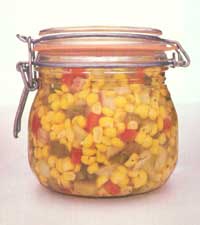
Corn Relish Recipe
2 quarts whole kernel corn, fresh (16-20 medium ears) or
frozen (6 10-ounce packages)
5 sweet red peppers, diced
5 green peppers, diced
1 bunch celery, chopped
1½ cups chopped onions
1½ cups sugar
1 quart white vinegar
2 tablespoons salt
2 teaspoons celery seed
2 tablespoons dry mustard
1 teaspoon turmeric
Defrost frozen corn if used. Mix peppers, celery, onions,
sugar, vinegar, salt and celery seed in 6-8-quart
non-aluminum pan. Boil uncovered for 5 minutes, stirring
occasionally. Combine mustard and turmeric and blend with
some liquid from boiling mixture; add, with corn, to
boiling mixture. Return to boiling and cook 5 minutes,
stirring occasionally. Pack into pint jars, seal and
process in a boiling water bath for 15 minutes. Makes 7
pints.
Note: If desired, relish may be thickened by blending
¼ cup flour with ½ cup water and adding the
mixture with the corn; stir frequently.






