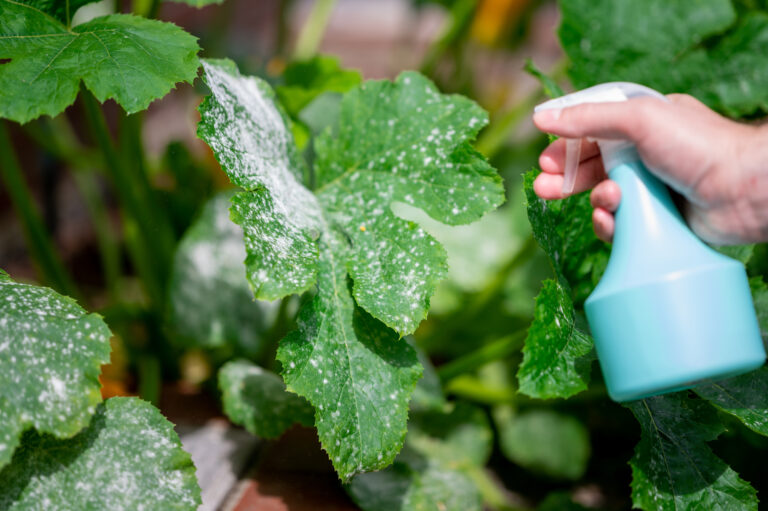
How do I treat powdery mildew? Managing white mildew on plants can be challenging. Learn a simple, natural way to keep it at bay with milk.
Question:
Late in the summer, I began noticing white, dusty blotches on the leaves of several herbs, which I fear is powdery mildew. It starts on the bee balm and then spreads to the rosemary. I eat these herbs, so I don’t want to use chemicals to control the problem. Is there anything else I can do?
Answer:
Older strains of bee balm (Monarda didyma) are famous for contracting serious cases of powdery mildew. Five types of fungi can cause powdery mildew on various plants, and even scientists have trouble telling the culprits apart. The two very similar strains of powdery mildew fungi that attack cucumbers and squash also can infect bee balm, basil, sage and rosemary.
Powdery mildew fungi have characteristics that help them prevail in late summer, when plants often are too tired to defend themselves. While most fungi only can spread when leaf surfaces are damp, powdery mildew fungi can blow about on humid winds, land on a dry leaf, and promptly gain access by melting cell walls with special enzymes. If they are successful, an outbreak is visible in less than a week. Left uncontrolled, spores and tiny threads of the fungi quickly spread to nearby leaves. Powdery mildew seriously weakens its victims, but it seldom kills them.
The good news is that powdery mildew is easier than ever to manage, thanks to the availability of mildew-resistant monardas and a novel cure of water and milk. In 1999, a Brazilian scientist reported success controlling powdery mildew in cucumbers by spraying infected plants with a mixture of milk and water — a folk remedy that dates back at least 200 years. Since then, gardeners and organic farmers from Australia to Arizona have begun using milk to control numerous fungal diseases. Last winter, I stopped powdery mildew in its tracks by spraying an infected rosemary plant once a week with a mixture of 1/4 cup fat-free organic milk and 3/4 cup water. Within a month, the mildew was gone.
Several theories might explain milk’s potency as a natural fungicide. When exposed to sunlight, a protein in milk (and other dairy products) might produce oxygen radicals, much as in a weak form of hydrogen peroxide. At the same time, salts in the milk help dehydrate the fungi. Milk treatment also provides calcium and potassium, which stimulate plants’ immune systems.
The mixture I made was strong. You could see good results with only 1 tablespoon of milk per cup of water. You can use whole, low-fat or fat-free milk. Begin the milk therapy as soon as you see powdery patches on your plants.

Preventing plant disease problems always is easier than curing them, so move your mildew-prone bee balm away from your other herbs. Good air circulation can help, so thin out one-fourth of the branches in early summer.
Better yet, replace your old bee balm with a variety that resists powdery mildew. Among robust 4-foot-tall varieties that have resisted this disease in multiyear trials are bright pink ‘Marshall’s Delight’, dazzling red ‘Gardenview Scarlet’ and deep purple ‘Violet Queen’. If you want a more compact variety, 15-inch-tall pink ‘Petite Delight’ is an excellent choice.
But even your resistant varieties can contract the disease if you overfertilize or plant in a site with more than a half-day of shade; both factors can lead to soft, floppy growth that encourages powdery mildew. Spores can survive winter in plant debris, so rake up old foliage and replace old mulch in early winter, after plants become dormant.
No garden can be made completely free of powdery mildew. Weeds serve as alternate hosts, and wind can carry spores into your garden. You can, however, demote the disease from a recurrent problem to a minor nuisance by growing resistant varieties; making sure your plants get plenty of sunshine and fresh air; and moving in when needed with a spray bottle loaded with milk and water.
Barbara Pleasant is a contributing editor to The Herb Companion and author of several books about gardening, including The Whole Herb (Square One, 2004).