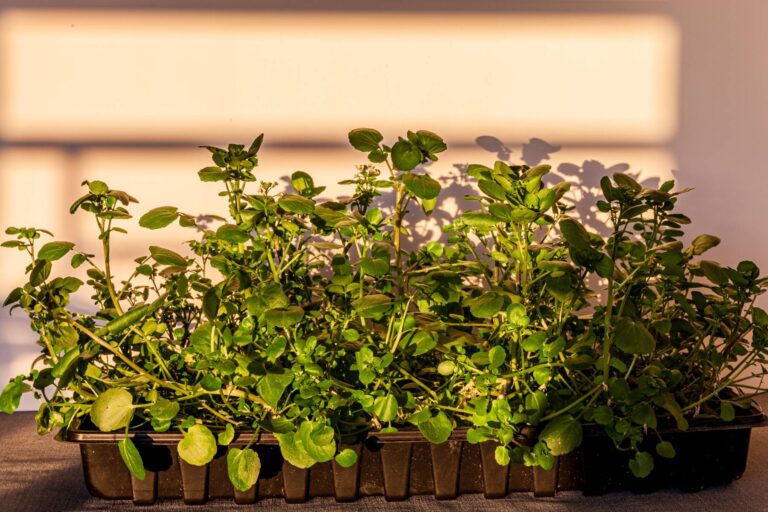
Learn how to grow watercress, indoors or outdoors, using the same methods gardeners have employed with heirloom watercress varieties since the 1870s.
A Brief History of Heirloom Watercress Varieties
Watercress (Nasturtium officinale) is a hardy perennial introduced from Europe in the eighteenth century. General Peter Muhlenberg recognized it growing wild in streams at Valley Forge in 1777 and recommended it for the army then encamped there. It was a much-sought-after salading in the early spring because its vitamin-rich leaves served as an antidote to winter diets lacking green vegetables, making the watercress plant highly valuable.
Historically, only one sort of watercress was grown in this country, the common green sort still found naturalized in some streams in eastern parts of the country. It had no commercial varietal name and was considered inferior to Erfurt Sweet Watercress, a German variety introduced into the United States in the early 1870s. In any case, it preferred cool, clear, running streams, and today, where it is still found, it may be used as a measure of water quality. Like trout, watercress will fail in water that is not free of pollution, which often leads gardeners to explore growing watercress at home instead.
Watercress can be obtained as seed, which is scattered at the source of a gravelly stream where the water is 2 to 3 inches deep. Once established, the cress will self-propagate, but if it chokes the stream, it must be lifted and the space cleared of mud and debris. In many parts of the country, especially near large cities, farmers in the last century constructed a system of shallow paddies along streams to create beds for watercress. This effort was repaid handsomely. As Peter Henderson pointed out in Gardening for Profit (1886 edition: 192), “Many a farmer in the vicinity of New York realizes more profit from watercress, cut from the margin of a brook running through his farm in two or three weeks in spring, than from his whole year’s hard labor in growing corn, hay or potatoes.” Today, many gardeners ask, is watercress hard to grow, and the answer depends on proper water and care conditions.
How to Grow Watercress Indoors
The development of farmland, pollution, and the diverting of streams from their natural courses has become a well-known environmental issue, but less understood is the devastating affect this has had on the culture of watercress. As a result, watercress is expensive and not always in ready supply. However, it is not necessary to be a farmer with an abundance of bottomlands to grow watercress successfully. In fact, many people now focus on growing watercress indoors or ask how to grow watercress indoors in limited spaces. It can be raised on a porch or under a tree, anywhere there is room for a large pot or tub, making growing watercress at home practical for most households.

The Victorians devised a system for raising watercress in flowerpots, a method that also produces a higher-quality cress than that grown in streams. Pot culture also keeps watercress in ready supply throughout the year and thus places it within the economic reach of anyone with the patience to keep it well watered. The engraving from the American Agriculturist (1876, 23) shows watercress in a 15-inch pot filled with pebbles, sand, and rich soil. The pot is set inside a deep clay saucer filled with 2 inches of water. Seeds or cuttings from watercress bought at a market can be planted in the pot and maintained the year around. The water should be bottled spring water and the whole kept cool by refilling the saucer daily. Evaporation will help keep the clay pot cool; a few ice cubes during excessively hot weather in the summer will preserve the cress from heat shock, to which it is quite sensitive. Instead of a flower pot, a plastic basket designed to hold fishpond plants can be used. It should be filled with a mixture of sand and peat moss.
To harvest the cress, merely prune it with scissors or a sharp knife as needed. Cut neatly, since breaking the stems injures the plants. The cress will send out new shoots, flower, and produce seed that can be sown in a second pot or basket. The number of pots can be increased as desired, but it is best to renew the pots every two years to change the soil and clean off any moss or algae that may have established itself. The pots can be moved indoors to a sunny windowsill during the winter or stored in a cold frame. If the watercress is frozen in the pots, it will go dormant and not revive until spring.
To locate mail order companies that carry these heirloom watercress varieties, use our Custom Seed and Plant Finder. Check out our collection of articles on growing and harvesting heirloom vegetables in Gardening With Heirloom Vegetables.
Heirloom Vegetable Gardening by William Woys Weaver is the culmination of some thirty years of first-hand knowledge of growing, tasting and cooking with heirloom vegetables. A staunch supporter of organic gardening techniques, Will Weaver has grown every one of the featured 280 varieties of vegetables, and he walks the novice gardener through the basics of planting, growing and seed saving. Sprinkled throughout the gardening advice are old-fashioned recipes — such as Parsnip Cake, Artichoke Pie and Pepper Wine — that highlight the flavor of these vegetables. The following excerpt on heirloom watercress varieties was taken from chapter 38, “Watercress.”
Frequently Asked Questions
Q. Can you grow watercress at home easily?
Yes, you can grow watercress at home quite easily if you provide constant moisture and cool conditions. It grows best in containers with water trays, making it ideal for small indoor setups or patios.
Q. How to grow watercress indoors successfully?
To grow watercress indoors, use a pot with rich soil placed in a water-filled tray. Keep the soil consistently moist, use cool temperatures, and provide indirect sunlight for healthy growth.
Q. Is watercress hard to grow for beginners?
Watercress is not hard to grow if you maintain proper water levels. The main challenge is keeping the plant consistently moist, but with the right setup, beginners can grow it successfully.
Q. What conditions does a watercress plant need?
A watercress plant requires cool temperatures, clean water, and partial sunlight. It thrives in moist or aquatic environments, which is why it grows well in containers with water trays.
Q. What is the best way for growing watercress at home?
The best way for growing watercress at home is using a pot-and-water tray system. This mimics its natural environment and ensures continuous hydration for optimal growth.
Q. Can you grow watercress indoors all year round?
Yes, growing watercress indoors year-round is possible if you maintain consistent moisture, cool conditions, and adequate light. During winter, placing it near a sunny window works best.