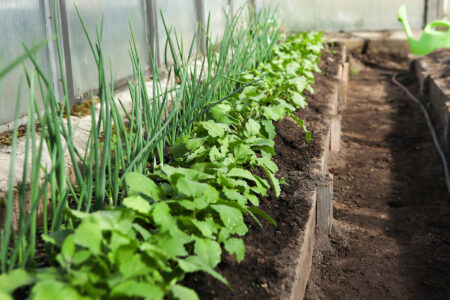
These heirloom cold-weather salad greens are easy to grow and can be used in a variety of ways.
Heirloom Vegetable Gardening by William Woys Weaver is the culmination of some thirty years of first-hand knowledge of growing, tasting and cooking with heirloom vegetables. A staunch supporter of organic gardening techniques, Will Weaver has grown every one of the featured 280 varieties of vegetables, and he walks the novice gardener through the basics of planting, growing and seed saving. Sprinkled throughout the gardening advice are old-fashioned recipes — such as Parsnip Cake, Artichoke Pie and Pepper Wine — that highlight the flavor of these vegetables. The following excerpt on heirloom cold-weather salad greens was taken from chapter 32, “Saladings, Cold Weather.”
| ‘Buckshorn Plantain’ ‘Chicory’ ‘Corn Salad’ ‘Endive’ |
‘Persian Broadleaf Cress’ ‘Rocket’ ‘Salad Burnet’ ‘Shallot Cress’ |
‘Shepherd’s Purse’ ‘Turkish Rocket’ ‘Winter Cress’ ‘Winter Pursane’ |
Check out our collection of articles on growing and harvesting heirloom vegetables in Gardening With Heirloom Vegetables.
A Brief History of Heirloom Cold-Weather Salad Greens
The convenience of supermarket vegetables the year around has led us to forget the dire shortage of green vegetables that many people suffered years ago. It has also made us forget that a well-planned kitchen garden can compensate for this seasonal ebb, for there are a great many cold-weather salad greens to choose from when thinking ahead toward winter. The list of greens that I have selected is admittedly short, yet I have tried to balance my choices with several overriding concerns: that the greens be easy to grow, that they not require a large amount of space in the garden, and that they provide a range of choices over the course of the season. Furthermore, my selections are compatible with all the winter lettuces in this book and can be combined creatively with fava greens, beet tops, and kales, which also serve as a source of winter greens. Lastly, none of the twelve saladings I have chosen look like one another; they are all visually distinctive, and if they are planted together, none of them will cross. For gardeners who have never dealt with winter gardening, yet who want to return to a seasonal diet, this will greatly simplify the task.
‘Buckshorn Plantain’
Plantago cornopus
Never given much notice in American garden books, this delightful heirloom is nevertheless a garden vegetable of considerable vintage in Europe. As far as I am concerned, of all the plantains this is the most delectable, and the most beautiful. It is the plantain corne de cerf of Vilmorin (1885, 103) and the Haaschhaan Selaat (hart’s horn salad) of the Pennsylvania Dutch. It is a plant that grows wild in Europe, especially in sandy areas along the coast, and when brought into cultivation, it is prolific and attains great size. But it must be kept well watered or it becomes tough, so it thrives best in the cool, damp weather of fall or early spring.

The narrow, grass-like leaves spread radially and are indented at irregular intervals in a pattern resembling the horn of a stag, hence the name. Sea plantain (Plantago maritima) was also called buckshorn plantain in this country, and in Philadelphia, New York, and Boston it was gathered in the wild and sold in green markets prior to the Civil War. Early Americans also used tumble mustard (Sisymbrium altissimum) as a substitute, whose tiny radial leaves are heavily indented and a rich green. But this can be tough unless cultivated during cool weather. None of these plants would have found a place in the market had there not been a need for lavish garnishes for “standing dishes,” large roasts and fancy meat dishes spread on sideboards as display pieces in nineteenth-century hotels and restaurants. The plantain is particularly attractive when tied into little bundles and used with poached ice beans and other miniature vegetables from the period. Furthermore, it retains its color when used in aspics.
Seed can be broadcast in April and the seedlings thinned for salads, leaving the strongest plants about 4 inches apart. The leaves should always be gathered when very young, since they toughen as they mature. For fall culture, follow the directions for shepherd’s purse.
‘Chicory’
Chicorium intybus

There are three cultivated forms of chicory grown for their leaves, all Chicorium intybus var. foliosum, and one form grown exclusively for its root, Chicorium intybus var. sativum. The leafy forms include loose upright heads resembling romaine lettuce, small crimped cabbaging heads like tiny lettuces, and the tightly wrapped heads of the Witloof or Belgian endive type. The Romans raised chicory as a medical plant. There is no evidence that they had developed it into varieties similar to those known today. In fact, all of the old herbals depict chicories that resemble the wild succory of colonial America.
Years ago, when American gardeners spoke of chicory, they meant wild succory, the perennial with a long taproot now naturalized in most areas of the United States and often seen blooming with bright blue flowers along roads during August and September. This plant was introduced from Europe in the seventeenth century as a spring salad green, but mostly, its roots were used as an adulterant in coffee or as a beverage in place of coffee. For this reason, it has gained a bad reputation.
New York marketman Thomas DeVoe (1866, 329) reported that of forty-two brands of coffee tested for purity by London examiners, thirty-one had been adulterated with chicory. Chicory is still added to some coffees, and in Louisiana, where the practice is common, this is considered a local

specialty and an acquired taste. German Americans also raised chicory as a source of ersatz coffee. The large rooted Braunschweig and Magdeburg varieties were developed during the 1760s specifically for this purpose.
Wild succory has another reputation which is more pertinent to the vegetable garden: it will cross with any of the cultivated forms, and therefore extreme care must be taken to ensure that it is at least half a mile from any seed-saving activity. This is further complicated by the fact that chicory is not self-fertile. Pollen from one plant must be transferred to another, and nature has endowed chicory pollen with an amazing ability to travel long distances in the wind.
The Venetian chicories that we know today as radicchio were not grown extensively in the United States until quite recently. Fearing Burr (1865, 324-25) listed several, but his material was lifted from Vilmorin seed books, not based on firsthand experience. His variegated or spotted chicory we would recognize as the variegata di Castelfranco, definitely

an eighteenth-century variety. The red chicory called rossa di Treviso also dates from the eighteenth century. The latter variety has become an invasive weed in my garden. Anyone who is prepared to save chicory seed had better like chicory, for it will spread faster than dandelions.
This overabundance of greens would be welcome if they were not also very bitter. Bitterness is one reason the leaves are used sparingly in salads, but the plants can also be blanched by covering them with straw or soil. Most of the Venetian varieties have been bred to form tight heads, which make them easier to blanch. This is also true of Witloof endive or Belgian endive, a chicory introduced commercially about 1830.
Cooking is another method for removing bitterness. The Venetians in the Marca Trevigiana have evolved many recipes for preparing radicchio. They are served as contorini, light dishes following the main course, but just as

appropriate as lunch fare. A glass of crisp pinot grigio is a good match for any of the cooked chicory dishes.
Growing chicories from seed is not difficult, but the secret to good chicory is planting it early. This means that seed should be started indoors or in cold frames so that large seedlings can be planted out as soon as the threat of severe frosts has passed. Light frosts will not damage chicory, but hot weather will certainly make it bitter. Fall plantings should be undertaken in late August. In areas of the country where winters are mild, chicory can even be planted in December. It overwinters in my garden, but maintains a better appearance if protected by straw.
‘Corn Salad’
Valerianella locusta
I collect corn salad. I do not know why, but it fascinates me, and what is very surprising, I think, is the large number of varieties that are readily available. All of them are different — different leaf shapes, different habits of growth, and slightly different flavors. If I had to liken the taste of corn salad to anything, I would say it tastes like peanuts, and not surprisingly, a well-flavored peanut oil will make a delightful salad dressing because it enhances that taste. Most Americans have come to know corn salad only quite recently under its French name mâche, but corn salad has been in American kitchen gardens since the seventeenth century. It is very easy to find it in old garden books under its antique name, fetticus.
Corn salad is definitely antique: seeds for two species have been found in the archaeological remains of the lake dwellings in Switzerland, so it was evidently well appreciated even in the late Stone Age. Unfortunately, the archaeological and historical record remains silent after that. It appears that corn salad was not so much cultivated in gardens as it was harvested from the wild, at least until the eighteenth century. In a painting from the 1500s called Spring, by Lucas Van Valkenborch, an Elizabethan gentlewoman is depicted sorting through baskets of spring greens, including lovage, smallage, Persian cress, and corn salad. The leaf of Van Valkenborch’s corn salad is long and narrow, a characteristic of the oldest varieties.
Our name for corn salad is equivalent to the German Feldsalat, meaning a green gathered from the fields–specifically, from wheatfields, for in England wheat is known as corn. The German garden writer Florianus mentioned in 1701 that in the spring corn salad should be dug up from the fields and brought into the kitchen garden. This is one of the earliest references to improving varieties through selection, but in Europe, even into the 1840s, most corn salad was gathered from the wild rather than cultivated. William Darlington (1837, II) reported that it was growing wild in certain parts of Chester County, Pennsylvania, where I live, obviously introduced from Europe. In fact, I recently discovered a patch of a very old variety naturalized along the Schuylkill River near Norristown, Pennsylvania. It resembles the leaf type depicted by Van Valkenborch.
There are two types of corn salad, the Italian (Valerianella eriocarpa) and the species discussed above. The Italian species grows very tall when it blooms, as much as 16 inches, and has large, hairy leaves. It was introduced commercially in 1827 because its flavor was considered milder than the common sort, it came to perfection earlier, and it made a respectable substitute for spinach, which is often difficult to grow. Unfortunately, the Italian species is not as hardy as the locusta, so it has never been popular in this country. Hardiness is a key factor; it is pointless to grow corn salad as a cold-weather salading unless it can be overwintered successfully.
The variety known as Large Round Leaved was the most popular in the United States with market gardeners due to its extraordinary hardiness. It was illustrated in the Album Vilmorin (1869, 20) and looks very much like the strain that has naturalized in part of my garden. This variety has survived temperatures of minus 10° F without protection and any visible damage. It blooms in April and May and produces an abundance of seed. If no other variety is planted, this one will always prove itself for reliability. Fearing Burr (1865, 328) listed it among the corn salads he recommended for the garden; its reputation was well established by then, for it had been under cultivation since the 1840s. The plant is extremely rich in vitamin C and carotene, and these dietary benefits have been appreciated for a very long time. In the old days of the eighteenth century, the first appearance of corn salad was always celebrated with a plate of red herring buried beneath a heap of freshly picked corn salad. There is nothing in the chilly days of March that lifts the spirits more than this overture to summer.
For spring crops, seed should be planted in September If seed is planted thickly, it can be thinned for salads well into December. If the plant has established itself as a “weed,” it will appear toward the end of September and can be harvested, saving the strongest plants for seed the following spring. All varieties of corn salad will cross with each other, except for the Italian eriocarpa. I have isolated varieties by 500 feet and forced them to bloom at different times. While there is no information available on techniques for maintaining seed purity, thus far my method appears to be successful.
The direct ancestor of the cultivated endive is Cicorium pumilum (also written Cicorium endivia L. sp. divaricatum), a wild plant distributed throughout the Mediterranean. At some point over two thousand years ago it was brought under cultivation, and out of this developed the garden varieties we know today. The Romans raised endives as a winter salad because the plants were hardier than lettuce. Furthermore, the Romans preferred varieties with white seed (which they felt produced more tender greens) and blanched the mature leaves by tying them up as I have suggested for Turkish rocket.
There is not much information in either historical or archaeological records linking the Roman endives of classical antiquity to those of the late Middle Ages, but it is documented that the culture of the endive moved from Italy to France, and from there to Germany. However, by the late 1400s the center of culture appears to have been the Veneto of northern Italy, especially the region around Padua, for there were many identifiable Venetian varieties early in the 1500s. It has been suggested that the breeding techniques developed for endive served Venetian horticulturists in perfecting their radicchios. Whatever the case, endive in America has been a rare bird on the vegetable market; in the days of Thomas Jefferson, it was only the gentleman farmer who could point them out in his garden.

Dr. William Darlington (1837, 440) noted that endive was cultivated in the vicinity of Philadelphia as a luxury food, which for that period made sense, given the large number of French restaurants and French caterers working in the city. I think it is fair to suggest that Americans have always associated endive with foreign cookery, and still do. Fearing Burr (1865, 335-43) devoted considerable space to endive because it was a profitable market vegetable for truck farmers near large cities, not because it was common in American kitchen gardens. His selection of varieties was lifted from the proceedings of the London Horticultural Society and thus reflected what was common in Convent Garden rather than what Americans might see in Boston, New York, or Philadelphia at the time.
New York marketman Thomas DeVoe (1866, 332) confused his chicories and endives, but at least he recognized what was then common and what was not. The curled endives were the most popular, and that is the type that I grow myself. He also mentioned the eighteenth-century variety broad-leafed Batavian (the French escarole), “principally used by the French and Germans,” which was prepared in soups, stews, ragouts, and with roasts. The blanched leaves were cut for salads. This kind of cookery, whether Pennsylvania Dutch or urban “French,” was always considered gourmet by American standards. Yet moss endive, as we now call it, is extremely easy to grow, and with the fecundity of Treviso chicory, it will take to the garden like a weed, if allowed to reproduce promiscuously. The most effective way to blanch moss endive is to use a cloche. Large flowerpots will also do.
Regardless of variety, all endives should be planted early. By early I mean as soon as the ground can be worked. But the seedlings should be started even earlier, so that they are already strong plants when set out. At that stage, a late frost will not hurt them, yet they should be harvested before the onset of hot weather, which not only toughens them but also causes them to bolt.
For seed-saving purposes, set aside six or eight plants and let them bolt. Tie them up to dry like shepherds purse. Endive will not cross with common chicory, yet it will require a designated space in the garden because it takes several months to bloom and set ripe seed. Where space is crucial, this consideration is extremely important; I would plant seed stock off to the back or in a corner where it will be out of the way.
‘Persian Broadleaf Cress’
Lepidium sativum
There are quite a number of pepper grasses grown for spring and fall salads, but this is my favorite.

It is quite different from shallot cress, although both have broad leaves, and appears to be the cresson Alenois à large feuille of Vilmorin (1885, 207). It is an annual that reseeds freely and reappears each fall toward the early part of October. It is perfect with crisp winter lettuces, and years ago was stuck between the split halves of a soft pretzel to make a type of quick sandwich. It also went into “flatdog” sandwiches, made of fried sliced bologna between slices of toast. The plants are quite diminutive, even when in full bloom no more than 1 1/2 to 2 feet tall. They begin as small clumps of radial leaves and should be harvested at that stage. The leaves resemble tiny apple leaves and make an interesting visual effect when scattered over the top of salads.
Seed saving is not complicated. The flower is white and produces a flat seed pod similar to that of shallot cress. Once the pods mature, the stems can be cut off at the base and stuck upside down into a brown paper bag. Mark the bag and date it, then set it away in a cool dry place so that the seed will dry and mature for about three months. Shake the pods so that the seed falls to the bottom of the bag. Sieve out debris, then store the seed in an airtight jar until needed. The seed will remain vital for five years, but should be renewed every two years so that there is always a supply of fresh seed on hand.
I have several varieties of rocket in my collection, one from Turkey, another from Greece, a yellow-flowering species called meadow rocket (Eruca selvatica), and my favorite, an old seventeenth-century variety that came from the Villa Foscari near Venice. It is known in the Veneto as rucola veneziana or Venetian rocket, and has now naturalized in my garden. In the spring and fall, when it is most delicate, it has a flavor vaguely reminiscent of tuna fish. I often chop it and mix it into pasta or rice dishes, for rocket is not always eaten raw.

Rockets have become popular again in this country after a hiatus of about a hundred years. The colonial kitchen garden always had its rocket bed, not so much for culinary purposes as for medical. Thomas DeVoe, in his Market Assistant (1866, 364), noted that it was mostly sold among the herbs in East Coast markets, not as it is today, as a rather common vegetable tucked in among the lettuces and celeries. For some reason, quite unclear to me, American greengrocers sell rocket under the name arugula, which is southern Italian dialect. It is like calling beans faggiul, or snails lumache, or conversely, about as elegant as calling dandelion by its American dialect name, Piss-a-Bed.
Different varieties of rocket will cross easily and therefore should not be raised at the same time unless carefully caged. Otherwise, they will all blend together and degenerate into a coarse form similar to the rockets depicted in paintings from the sixteenth century. Even the Venetian rocket that I have carefully maintained for the past twenty-five years has gradually altered; now and again, it produces sports with furry leaves of a very different pattern from the rest. Close observation is the only key to success; odd-looking plants should never be allowed to go to seed.
Once the plants bloom in June and set seed, tie them up so that the pods remain off the ground. When the pods begin to turn brown, follow the same procedure as for shepherd’s purse and allow the seed to dry in bags for several months. In the late summer a different variety can be planted; thus it is possible to keep several varieties going without having them mix. All the rockets that I have grown, even the ones from the Mediterranean, remain green over the winter without protection.
‘Salad Burnet’
Sanguisorba minor
I cannot recall when I have not grown salad burnet. I discovered it growing in a shady corner of my grandmothers garden and moved the entire patch to Devon many years ago. I have seen it growing around abandoned farmhouses in many parts of the eastern United States. It was certainly considered an important part of the Pennsylvania Dutch kitchen garden, not just as a source of flavorful salad greens but as a medical herb as well. In the spring, fresh sprigs of it were infused in wine as a tonic. It is delightful in champagne punch.

Salad burnet is a native of Europe, introduced to America during colonial times. It has small, delicate leaves that taste like cucumber. The greens are best in the early spring — one of the first greens to push new growth that time of year — and in the fall from late September to Christmas. During this time the new shoots are pale green and very tender, and can be eaten raw. During hot weather the leaves and stems toughen, but especially so when the plant blooms. Pruning off the flower stalks will prolong salad production well into the summer. If given protection in the winter with loose straw or even dead leaves, the plant will remain green most of the winter. It will thrive in a cold frame.
In my garden, salad burnet is perennial, but it also reseeds profusely. It is easier to establish it in the garden by purchasing one or two small plants from a garden shop and then letting them reseed. I cultivate one or two large clumps for seed purposes because it is best every few years to renew the bed with younger plants. The older plants sometimes burn out during summer droughts or succumb to ice in the winter. A well-drained location is also essential because during the spring thaw too much water will kill the plants.
I have seen Pennsylvania Dutch kitchen gardens where the beds, especially saffron beds, were completely outlined with little hedges of salad burnet. This is a practical way to delineate a part of the garden that is dormant most of the year, since saffron emerges to bloom in October, its leaves remaining green over the winter, only to die back in the late spring. Salad burnet also serves as a decoy for rabbits, since rabbits prefer it to the green tops of saffron. If they eat the saffron greens, the plants will not produce flowers the following season, and in a saffron bed every flower counts.
‘Shallot Cress’
Lepidium campestre var. mahantongo
Mahantongo shallot cress is a form of pepper grass that I discovered several years ago growing on the site of the old Hepler farm (now part of Christiansbrunn Cloister) near Pitman in the Mahantongo Valley of central Pennsylvania. It is an early Pennsylvania German strain brought to that area in the 1820s. With a flavor like garlic or shallots, this cress remains green over the winter and, if covered with straw, can even be harvested from under deep snows. Once used extensively in winter salads, especially with chopped cabbage or in potato salad, it is also an excellent substitute for chives while that herb is dormant during the winter months. Like chives, it can be used in stir-fries or with cooked greens.

Common pepper grass (Lepidium compestre) was introduced to this country from Europe in ship ballast during the eighteenth century and has become an irritating weed. However, the origin of the Mahantongo variety is obscure, and it differs in several physical respects from other common lepidiums; thus it may represent a separate but undocumented species. For one thing, its seed pods resemble those of Thlaspi peroliatum. Bernard M’Mahon listed a Lepidium sativum in 1815, which he described as a variety called “Broad-Leaved.” The Mahantongo strain may be descended from this, for certainly it resembles an oversize version of an old variety of corn salad also called “Broad-Leaved.”
The plant is a hardy biennial that blooms in the late spring with white flowers. It must be planted in the late summer if it is to be used as a garden crop over the winter. The small, compact plants produce radial leaves that quickly attain their maximum size, about 6 inches in diameter, and remain that way over the winter. Its distinct shallot flavor is improved by frost, but once the plant revives in the spring, the leaves turn bitter. Since onion greens become available by then, this tradeoff is not an inconvenience.
‘Shepherd’s Purse’
Capsella bursa-pastoris
A hardy annual or biennial that overwinters well for late spring and early summer greens, this ancient member of the mustard family was introduced in the 1600s not only as a garden green but as an important ingredient in folk medicine. The Pennsylvania Dutch call it Bockseckel, a name of Celtic origin meaning “ram’s scrotum,” doubtless in reference to the magical talisman that we know in English by its more euphemistic name. Grown in rich soil, shepherd’s purse may produce leaves up to 10 inches long, which can be used as a substitute for spinach. To me, the flavor resembles that of broccoli or cauliflower, and holds up well in stir-fried vegetables. It can also be eaten raw in salads and is a rich source of vitamins and minerals.
For late spring or early summer greens, start the seeds in flats during March, then thin into individual pots or containers. In April, after the threat of frost, plant the seedlings 4 inches apart in the full sun. This crop will bolt in late June or early July and produce an abundance of seed. Start this seed in August in a cool, shady location, then thin into containers. In September, plant in the full sun. In the late fall, cover with straw to protect the plants over the winter, then remove the straw the following March. This method will produce a continuous supply of greens throughout most of the year, since the plants under the straw can be harvested during the winter. In fact, most cold-weather saladings can be maintained in full production this way.
Reserve about five or six plants for seed-saving purposes. As the seed stock ripens (the pods begin to turn from green to brown), harvest the entire stock and dry it on plain white paper or in a large bowl. The seed pods burst when ripe and will scatter over a large area of the garden unless intercepted in this manner. Shaking the stocks or touching the dry pods will also cause them to burst. If this is done over paper or a bowl, the seeds are easily collected. Since the seed is fine like sand, it is easy to separate from debris with a sieve. I have had seed remain vital for as long as six years.
‘Turkish Rocket’
Bunias orientalis
Of all the greens in this section, Turkish rocket is one of the least known in the United States, yet it has been grown here since the eighteenth century. One of the earliest references to it appeared in the correspondence of John Bartram (1992, 520), who evidently had supplied seed to Martha Logan, a wealthy Philadelphia plant collector, for she was growing it in her garden in 1761 under the name Siberian rocket. Turkish rocket is native to that part of Asia and is therefore one of the hardiest of the salad greens in this book.

The native American sea rocket (Calkile eldentula) was once called Bunias edentula and treated as a close relative, but the two plants are actually quite different. Superficially, the leaves of Turkish rocket resemble those of dame’s rocket, an old-fashioned garden flower known for its sweet scent. Yet its leaves are larger, covered with fine hairs, and pale whitish green. The young leaves and shoots are eaten raw in salads or cooked as a potherb. The flavor is strong, resembling horseradish, although frost usually mellows the flavor and tenderizes the leaves, so it is best during the fall or spring.
Turkish rocket has naturalized in several places in the United States. In Pennsylvania, it is also known as hill mustard since it prefers to grow on bald, stony ground on slag heaps around old mining sites. Botanists have incorrectly presumed that it came to North America in ship ballast, when in fact it was imported and disseminated as a medical plant in the 1830s, especially by the Harmonites in western Pennsylvania. It is no accident that Bunias orientalis can still be found in areas near the old Harmonite religious communities. Its importance in homeopathic medicine lay in its application as an antiscorbutic for “lymphatic disturbances,” an archaic expression for immune deficiencies. Because of this connection the plant has recently undergone a revival of interest, although its true medical properties remain unexplored.
The plant is still eaten extensively in Central Europe, where it is served chopped into sour cream with minced dill or fennel. As a cooked vegetable, it needs doctoring. Turabi Effendi noted in his Turkish Cookery Book (1862, 67-68) that bitter vegetables of this sort must first be scalded before they are cooked. This takes off the acrid radish taste. “If large, they are cut in pieces and placed in a stewpan, with a sufficient quantity of water, salt, and a few sliced onions previously fried a nice brown in butter or olive oil.” He further explained that fresh (clear) tomato juice was often used instead of broth or water. This definitely improves the flavor.
Turkish rocket is easy to grow and will thrive in hot, dry locations where many garden vegetables fail. It can be cultivated like cardoon and blanched by tying up the leaves, or it can be raised as an ornamental like dame’s rocket, since its flower is sweet-scented and attractive to butterflies. As a cut flower it will last for several days even without water. The plant is hardy and overwinters in some of the coldest sections of Pennsylvania, so for practical purposes it may be treated as a perennial, even in northern Maine.
‘Winter Cress’, ‘Scurvy Grass’
Barbarea stricta; Barbarea verna (Barbarea praecox); Barbarea vulgaris
There are three closely related mustards that go by the common name of winter cress or herb of Saint Barbara. All three are natives of Europe that have naturalized in North America and are so

similar in appearance to the casual viewer that a botanical book is necessary to point out their differences, which are mostly in the subtle shapes of the leaves. Furthermore, seedsmen often sell one for the other, so there is no telling which one is likely to appear under the name of winter cress. The only way to know for certain is to grow them side by side. However, from a culinary standpoint, these greens are all die same, since they taste like watercress and are used like watercress in cookery.
Horticulturists generally refer to Barbarea vulgaris as common winter cress, upland cress, or yellow rocket. Barbarea verna (also called B. praecox) is usually called early winter cress or Belle Isle cress. The plant shown in color plate 86 is Barbarea verna and, like the others, it has yellow flowers. Philadelphia seedsman Bernard M’Mahon devoted some attention to winter cresses (1806, 455) because they were an important market crop in colonial America. Early winter cress was also known as scurvy grass in Philadelphia and many parts of the South, because it was one of the few green vegetables available during the depths of winter as a source for vitamin C. This is one reason why I recommend it for kitchen gardens today.
Culture is the same as for shepherd’s purse. Once established, a patch of cresses will remain green over the winter and can be harvested even on the snowiest days of January. If covered with straw as a protection, the cresses will also retain their crisp, green appearance and take the place of watercress as a garnish. Watercress tends to turn yellow if kept too long under refrigeration; winter cress will store in the refrigerator for several weeks, especially if the entire plant is pruned to leave part of the root. But there is also another benefit: birds love the seeds.

These cresses bloom in early June, when the plants shoot up to a height of 3 1/2 or even 4 feet if the ground is rich. They must then be staked and covered with netting or finches and grosbeaks will strip them within the course of a few hours. Cage birds such as canaries also like the seed, and at one time there was a small cottage industry devoted to growing cress seed for pets. Since the cresses produce vast quantities of seed, there is always plenty for next year’s crop and the winter bird feeder. This generosity is self-serving. Encouraging birds to forage in the garden during the winter also accustoms them to foraging there during the growing season, and this greatly reduces damage from insects.
‘Winter Purslane’
Montia perfoliata
This is an excellent native vegetable with a misleading name. It is not related to purslane and is not even vaguely like it in taste or texture. But it is first cousin to Spring Beauty, a handsome little flower also native to North America. Named for Giuseppe Monti, a professor of botany at the University of Cologne in the eighteenth century, the plant was originally called Claytonia perfoliata, and is still known in England and Europe under this botanical designation. It is native to the Pacific Coast and Rocky Mountain states from Mexico northward to British Columbia, not Cuba, as Vilmorin claimed (1885, 481-82). While jogging along San Francisco Bay, I have seen it growing wild in woodsy locations, and nearly twice the size that it attains in my garden back in Pennsylvania. On the West Coast the plant develops a nodelike root that has a nutty flavor. Both the greens and the root were gathered as food by the Indians.

The plant grows anywhere from 4 to 12 inches tall in its native habitat, forming a small cluster of cup-shaped leaves that closely resemble the green flower of Bells of Ireland. It is an annual that bolts early in the summer but reseeds in damp, shady locations. The greens are usually gathered young, before the plant begins to bloom, and used in salads or cooked like spinach, which it resembles in taste. Winter purslane is grown extensively in Europe but has never been quite as popular in this country. I suspect that this has something to do with its other common name, miner’s lettuce, also a misnomer.
The vegetable received considerable attention during the days of the California gold rush, when it served as a cheap and readily available source of greens for the miners. Unfortunately, this name carried with it the implication of a rough-and-ready emergency food, not an elegant green for proper Victorian tables. This may have helped prejudice many Americans against it in the nineteenth century, especially since it was a common “weed.” Happily, it has recently undergone a revival of interest as part of a general shift toward exploring American regional ingredients.
The seed of winter purslane is very small and black. It is easiest grown by sowing broadcast where the plant is to be cultivated. Choose a moist, shady location for best results. In the spring, plant the seed after the threat of frost has passed. For a fall harvest, plant in early September or, in the South, during early November. Seed is ripe when the plants begin to turn yellow. Seed can be gathered by shaking the plants over a large bowl. It remains vital for about five years when properly stored.
Photos and Illustrations Courtesy William Woys Weaver.