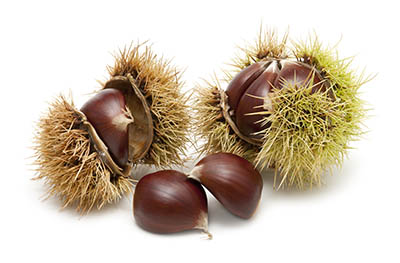
Will your future yuletide seasons include native chestnuts roasting on an open fire? It’s entirely possible if you’re prepared to plant some Castanea dentata and then tend them very carefully for at least the first three years.
Where to Get Them
Not many American chestnut trees can be found anymore, so it’s likely you wouldn’t recognize one if you saw it. Even the leaves can vary from one region to another. So rather than scrounge the woods looking for a sapling to transplant, you might want to consider ordering nuts, or young trees, direct from Edgar Huffman.
Edgar says he learned the best procedure for growing chestnut trees by observing how squirrels conceal the nuts. Apparently the furry creatures instinctively know the way to bury the seeds so that they’ll sprout. Here’s how it’s done:
Plant the nuts in pairs in a well-worked germination bed, one with its pointed end out, the other with its pointed end in. Naturally, if you live in an area where there are squirrels, you can expect to have a hard time sprouting any nuts without running interference. Huffman prevents squirrel raiding by planting the seeds inside an old bicycle rim (the squirrels think it’s a trap and leave it alone). He can get as many as 125 nuts planted in one rim, which will produce–if they’re handled properly–more than 100 young trees.
How to Plant Them
Mr. Huffman recommends transplanting each newly germinated seed into a cut-down paper milk carton for easy transportation. Once you’ve done so, prepare a hole–about a foot in diameter–just as you would for any nut tree. Dig it deep, making certain there’s no rock in the bottom. Then, plant with great care. If the chestnut’s long taproot is injured, the tree may always be inferior. Be sure, also, to avoid exposing the young root to drying air for any longer than necessary.
Here’s another tip that’ll help you achieve a successful transplant: Maintain the seedling’s original compass direction. For instance, if a branch was pointing east when the tree was at its germination and early growth site, that same branch should be pointing east after the tree is transplanted. (If you can’t remember which way the limbs began growing, it’s a good bet to turn the longest ones to the east. Then, when placing the tree in. the ground, lean its top to the south about one inch.)
Huffman also suggests planting at least two chestnut saplings near each other (but no closer than 25 feet). The proximity of the trees will help bees cross-pollinate the fragrant blossoms more easily in the spring.
Keep in mind too that trees in a chestnut grove will grow tall and straight, while loners out in the open will branch out much the same as oak trees do.
How to Order
As a result of the lessons learned in his years of studying chestnuts, Edgar Huffman can produce saplings each spring at a phenomenal rate. If you’re Interested in purchasing some, though, you should know that it’s first come, first served until they’re all gone. One-year-old transplants, which are shipped in May, sell for $5.00 each. A dozen ready-to-plant chestnut seeds are $15. The blight treatment (which is supposed to keep for years) costs $5.00 per pint or $40 per gallon. All products are sent with complete instructions.