
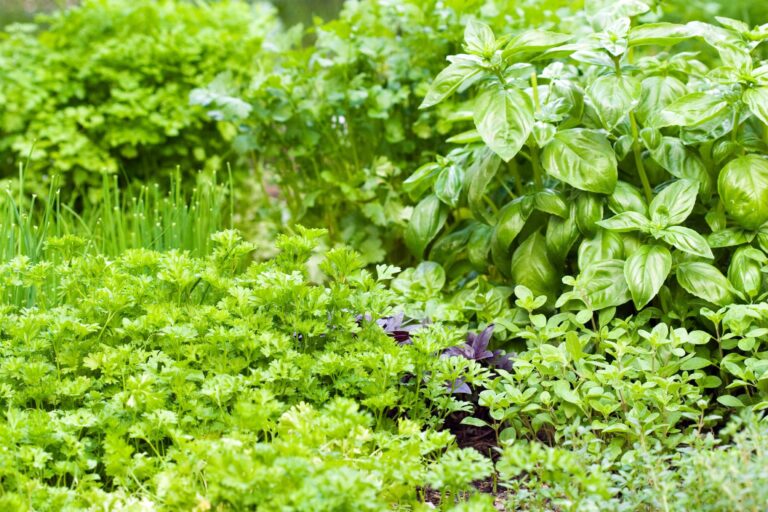
Follow these kitchen herb garden plans for a 12-square-foot area to grow kitchen herb garden plants in the space nearest your kitchen door.
The stunning flavors of culinary herbs make them star players in a healthy diet, and the best way to make the most of big-flavor herbs is to grow them yourself. This article includes plans for four herb garden designs, each of which can fit into a 12-square-foot area, to help you make the best use of space near your kitchen door. See Top 12 Kitchen Herbs for more on the featured herbs: basil, chives, cilantro, dill, marjoram, mint, oregano, parsley, rosemary, sage, tarragon and thyme.

Kitchen Herb Garden Plans

You could grow kitchen herbs in a geometrical design dating from the days of medieval monasteries if you like, but there are easier ways to include culinary herbs in your landscape design. By following a few basic guidelines and choosing to grow the herbs you’re most likely to use, you can grow a generous supply of kitchen herbs in a surprisingly small space. Add some container herbs that are marginally hardy or prone to crowding out other plants, and you’re well on your way to a gourmet herb garden.
The first and most important step is to grow your herbs as close as possible to your kitchen door. “Accessing your kitchen herbs should be as easy as going to your pantry for the dried version,” says V.J. Billings, who grows herb plants by the thousands at Mountain Valley Growers in Squaw Valley, Calif. To find great places to grow herbs, simply walk out your back door and survey every space within 20 paces that gets at least a half day of full sun. As you plan, consider the times you will dash out to grab a handful of chives, dill or basil when it’s raining or something on the stove needs your attention. Having your herbs within easy reach of a walkway or well-placed steppingstones can also make a big difference.
Herbs need average or better soil and good drainage, but they are generally not as demanding as vegetables and flowers. With kitchen herbs, it’s better to make use of a convenient location than to move away from the house in search of better soil.

Kitchen Herb Garden Plants
By now you probably have visions of your favorite cooking herbs dancing in your head. Gayle Sathre-Zimmerman, owner of Blossom Farm in Columbia Station, Ohio, suggests including a variegated plant, or one with dark leaves, to enhance the visual appeal of your herb garden. Thyme, sage and mint come in variegated versions, and basil varieties with deep purple leaves are as flavorful as those with green leaves.

Also be on the lookout for varieties with unusual textures and forms. For example, ‘Berggarten’ sage has broad, velvety gray-green leaves that give it a luminous presence in an herb garden.
Several of the top culinary herbs, such as dill, basil and cilantro, are fast-growing annuals whose seeds can be easily sown directly in the garden. Most other cooking herbs are hardy perennials that come back every year. Perennial herbs can be grown from seed, too, but the seedlings require several months to reach picking size. Some herbs require starting with plants that were propagated from rooted stem cuttings. For example, mints that carry the subtle flavor of chocolate or pear are best purchased as plants, and the only tarragon worth having is French tarragon, which is always grown from rooted cuttings. To be sure you’re getting true French tarragon, taste a leaf before you buy. It should have a zippy licorice flavor.

Speaking of rooted cuttings, if you buy fresh mint, oregano or marjoram at the store, and you decide you’d like to grow it, by all means choose a few healthy sprigs and try growing them as rooted cuttings. Just pinch off all but the top three or four leaves, trim the base of the cutting back to green healthy tissue, plant the cutting in a pot of moist soil, then cover with a plastic bag for a few days. I have rooted oregano right in the garden by covering the cutting with a flowerpot for a week (the pot protects the little plant from sun until it has time to grow roots). My mint got its start as a supermarket sprig, too, and after four years in a large pot it’s still going strong.

Rosemary is not consistently winter hardy beyond Zone 7, and cold winter winds can damage oregano, sage and tarragon, even in areas where they’re rated hardy. The safest way to make sure your favorite perennial herbs survive winter is to move them to pots, allow them to become dormant, then keep them in a cold garage or outbuilding where temperatures seldom drop below 20 degrees. Or dig and store only rosemary, and surround your other perennial herbs with a 12-inch-tall wire cage filled with loose straw or pine needles. A loose pile of evergreen boughs arranged over the plants’ crowns also does an excellent job of protecting them from biting winter winds. Remove either form of winter protection about a month before the last expected frost.
You may want to mail order special strains of some culinary herbs, or wait until spring and shop for plants at local garden centers or herb farms. As you examine prospective adoptees, take a moment to check the pot to see how many plants are growing there. Last spring when I bought what was offered as a single sage plant, I found four nicely rooted cuttings in the pot, which were easy to pull apart and put out in individual planting holes. Small pots of basil often contain more than a half dozen little seedlings, which can be divided and transplanted, provided you shade them from the sun for a few days as they become accustomed to their new home.

If all of this talk of seeds and cuttings has you feeling confused, take a deep breath and relax. Your first venture into a kitchen herb garden is sure to be successful if you start with a simple planting plan like the ones shown here. Fill your garden with tried-and-true favorites, which are offered as collections by Mountain Valley Growers, Blossom Farm and many other herb growers. Start small, keep it simple, and you’re sure to be delighted by the fantastic flavors of your kitchen herbs.
Originally published as “Use One of These 4 Simple Garden Designs to Grow the 12 Best Kitchen Herbs” in the October/November 2006 issue of MOTHER EARTH NEWS.
Contributing editor Barbara Pleasant has smothered the steps leading to her deck with kitchen herbs.
Frequently Asked Questions
What's the best place to put a kitchen herb garden?
The best place for a kitchen herb garden is within close walking distance to your door. Because herbs are grown for their leaves (and not their fruits), your herb garden only needs a minimum of a half a day of sunlight. This makes them easier to place closer to your kitchen, so you can dash out to pick your herbs while you're doing dinner prep.
Can you plant rosemary in zones 4, 5, or 6?
Perennial herbs like rosemary, oregano, and tarragon can struggle in colder climates, and do not always reliably come back. Plant these herbs in pots so they can overwinter in a sheltered location, such as a basement or garage. They can also be dug up and potted, if a fully in-ground garden is preferable to you.
What herbs can be directly seeded in a kitchen garden?
Direct seed fast-growing annuals in your kitchen herb garden. Herbs like dill, basil and cilantro are extremely easy to reliably grow from seed, and do not always benefit from being started indoors.
How can color and interest be added to an herb garden?
The herbs at the grocery store are often all green, but these are only the most common and easy to recognize variations of these plants. When growing your own kitchen herbs, consider varieties with variegated or even purple leaves. Thyme, sage and mint come in variegated versions, and basil varieties with deep purple leaves are as flavorful as those with green leaves.
Can tarragon be grown from seed?
French tarragon cannot be grown from seed and must be rooted from cuttings, unlike its Russian or Mexican counterparts. To be sure you’re getting true French tarragon, taste a leaf before you buy. It should have a zippy licorice flavor.






