Read Part 1 of this accounthere.
Carla Jordan and her family settled in their new house in Spotsylvania, Virginia, feeling safe that the biosolids experience was now behind them. In 2014, Carla accepted a business manager position at a berry farm in the neighboring Westmoreland County. The farm was a burgeoning agro-tourism destination; a place where children get to pet friendly goats, pick strawberries, and enjoy breathtaking views of the nearby Rappahannock River.
Early one winter morning in 2014, the farm was visited by a local resident. Mr. Tilley, whose house was just down the road from the farm. He explained that he’d overheard a conversation between two congregation members at his church. One of them was Rodney Rollins, local businessman, owner of multiple companies, including Rollins Soil Enhancement. Mr. Rollins was discussing a permit he had been granted by the Westmoreland County Land Use Administrator to construct a ten unit outdoor drying/processing/storing facility for Class A biosolids. The permit included manufacturing bagged mulch and topsoil products as well as the right to land apply biosolids on the property. The facility would be located inside a private, residential neighborhood – Porteus VI, directly across from Mr. Tilley’s house, on the same road as the entrance to the berry farm.
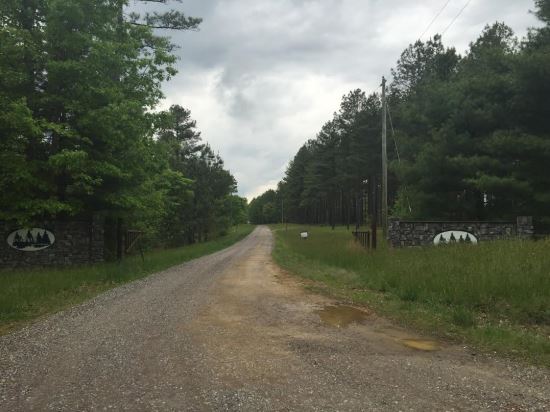
The entrance gate to the residential neighborhood Porteus VI in Westmoreland County, VA. VDOT classified the private neighborhood gravel road as “in poor condition.”
“This sounded an alarm in my mind,” Carla recalls, “I couldn’t believe biosolids were back in my life.”
This time Carla rushed to prepare a petition for the Department of Environmental Quality (DEQ) to revoke the permit. She created an informational flyer about the dangers of biosolids and outlined the realities of the damage a business like this could bring to the community. Then she went door to door, asking local residents to read the flyer and sign the petition. Nearly every person who spoke with her signed the petition. One of the local residents, Mr. Lawrence Perry of Leedstown, took it upon himself to review the county zoning ordinance. He concluded that the Land Use Administrator had made a mistake issuing the permit to Rollins Soil Enhancement as a by-right activity on a parcel zoned A1, (agricultural residential).
DEQ received the petition prepared by Carla and signed by scores of local residents, and felt compelled to grant a public hearing on the issue. The meeting took place that winter. Many families living near the permitted project were present and one local church brought a bus-load of parishioners. The board room was packed that night; with so many local residents in attendance, there was standing room only.
In his opening remarks one DEQ representative stated: “We are not here to listen to what the public has to say, we are here to provide the information.” The hearing didn’t go well for the proposed Rollins project. Residents were outraged at the county government for issuing the permit, for not adequately informing the public prior to the permit issuance and the overall gross abuse of governmental powers.
The Westmoreland County Board of Supervisors, and then the Zoning Board, held public meetings wherein the previous decision authorizing the permit to Rollins Soil Enhancement was deemed voided; on the grounds that the permit should not have been granted under the agricultural clause. It was determined that this was a precedent-setting case; the new decision would have to be appealed either by Rollins Soil Enhancement suing the county, or the business would have to reapply for a new permit including a land use special exceptions hearing.
“Rodney Rollins wants to build ten outdoor units for processing and storage of biosolids in a private, residential area. The only access to that neighborhood is a narrow, unpaved, gravel road maintained by the homeowner’s association. Commercial trucks filled with sludge will be going up and down that road for delivery, and the road is not even wide enough to accommodate both a dump truck and an oncoming school bus. The sludge will be stored and processed in proximity to an in-home daycare. And local and state agencies are telling us that this is not a public issue; are you kidding me?!” – Carla exclaimed.
She actually researched the width of dump trucks and school buses, and then measured the road; noting that there were no road markings, no signage, no lighting. According to Virginia Department of Transportation the road was listed as being in “poor condition”.

The proposed site of Rollins Soil Enhancement Inc biosolids processing facility in the residential neighborhood of Porteus VI in Westomoreland Co.
“The road is not wide enough, either a load of sludge or a load of school kids will end up overturned” – she concluded.
Within a nine mile radius of this proposed facility in Westmoreland County, there are seven tourist destinations: George Washington’s Birthplace, Stratford Hall, Ingleside Winery, Westmoreland Berry Farm, Virginia Nature Preserve and Westmoreland State Park. Those attractions draw thousands of visitors each season; families come on weekends and school children come in droves.
The preposterous idea of processing municipal and industrial sludge in this quiet, rural, residential neighborhood, situated on a picturesque historic area of Virginia countryside, continues to be considered by the local and state governmental agencies. The evaluation process, with its various appeals, legal twists and turns, is being funded by taxpayers. The obvious absurdity of this idea strangely escapes local officials and is given additional credibility by the position of the state DEQ office on this matter. It doesn’t come as a surprise – the DEQ obtains a permit application fee of $5,000, with an additional $1,000 fee for any amendment to the existing permit. Afterward, there is a fee of $7.50 per ton of biosolids delivered. Those contributions go into the budget that finances the DEQ. It’s no wonder that in the history of biosolids use in Virginia no permit has ever been denied.
Carla has since changed her job. She lives in Spotsylvania County and is no longer involved in the situation with Rollins Soil Enhancement in Westmoreland County. However, this precedent-setting case continues.
The latest news on the Rollins Soil Enhancement biosolids facility is disheartening. In January of 2016, Rodney Rollins appealed the decision of Westmoreland County Board of Zoning, which had ruled that his proposed facility did not qualify as a “by-right” project on property zoned A1. He also challenged the right of Mr. Lawrence Perry to have brought the appeal before the Board, because Mr. Perry did not live near enough to the proposed facility and so his quality of life would not have been directly affected. In reality, anyone living in the state of Virginia should have a vested interest in the outcome of this case; as it could establish a legal precedent with disastrous consequences.
This time the legal battle could move at a much swifter pace. The largest waste distributor – Synagro, LLC, is lending its legal power to Rollins enterprise. Synagro’s well retained lawyers will be assisting with the appeal. If the citizens lose this case – what will happen in other Virginia neighborhoods?
References
1. State Water Control Board meeting details
2. Westmoreland meeting minutes
Photos by Carla Jordan
Lidia Eppis active with a local group of residents concerned about the agricultural application of biosolids, a dangerous practice that devastates farmland. She corroborates with local activists, politicians and scientists to bring public awareness to this issue and advocates for changes in state and federal regulations of biosolids land use. Read all of Lidia’s MOTHER EARTH NEWS posts here.
All MOTHER EARTH NEWS community bloggers have agreed to follow our Blogging Guidelines, and they are responsible for the accuracy of their posts. To learn more about the author of this post, click on their byline link at the top of the page.