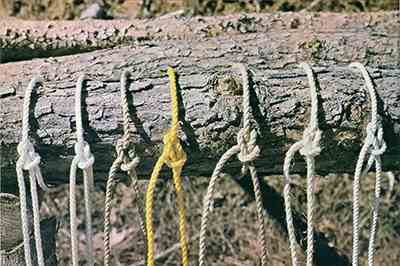
Over the last 20 years, the once simple act of picking out
and using a length of rope has become pretty complicated: A
profusion of new synthetic lines has joined the natural
varieties on hardware store shelves, forcing baffled
buyers to choose among well over a dozen combinations of
fiber and twisting style.
Of course, each of the numerous ropes available are
better suited for some tasks than others, and the
material that a cord is made of will likely require
specific care. So we decided that it might be helpful to
describe several of the more common types of rope and tell
you what they’re good for, as well as what steps should be
taken to get the maximum life from each.
Twisting the Right-A-Way
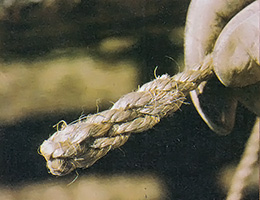
In its most simple form, rope consists of long fibers that
are first twisted (usually in a clockwise fashion) to form
yarns. Then a number of the wound strings are spun
together, in the opposite direction, to yield strands …
which are in turn twisted back in a right-hand direction
(in groups of three) to make “hawser-laid” rope.
The combination of these counterdirectional twists gives
the finished cord more strength than that of the individual
fibers composing it, since the friction between the fibers,
yarns, and strands increases the line’s resistance to
stretch. Furthermore, the winding process prevents the
material from unraveling. (In fact, if you take a good
piece of three-strand rope and attempt to untwist it in the
middle, you’ll notice that, after about one quarter-turn,
it vigorously resists unwinding.)
There are, however, a number of other ways to “lay-up” a
rope. Although they are somewhat rare, it’s possible to
locate left-hand-laid three-strand ropes, and even
four-strand ropes. But braiding is by far the most common
of the alternative twist techniques. It’s accomplished by
weaving eight (or more) strands together in a “diamond”
pattern and produces a rope that’s very flexible,
doesn’t tend to curl, and stretches even less than does a
twisted rope made of the same material and of equal
diameter. (Not surprisingly, braided–sometimes called
plaited–line’s superior qualities result in its
having the highest average price tag of all ropes.)
Synthetic vs. Natural
From a utilitarian point of view, synthetic rope
has a number of advantages over natural fiber rope. For a given
diameter, they are stronger, more resistant to most types
of decay, and only slightly more expensive than the
nonsynthetics.
Such “artificial” lines are, for the most part,
manufactured from by-products of the oil refining process
and therefore depend upon nonrenewable raw materials. (In
fact, polyethylene ropes are made from ethylene, a
petroleum substance that can also be used to produce ethyl
alcohol, or fuel ethanol.) Compounds obtained from the
hydrocarbons are extruded and drawn, and–depending
upon the fastidiousness of the production process can be
formed into threads that extend for the entire length of a
rope (a feature not possible with natural fibers). The
finest nylon lines are made by this “continuous filament”
method, and are easy to distinguish from the fuzzier “spun”
nylon ropes.
Despite the advantages of synthetic fibers, many folks
still prefer the relatively strong, easy-to-handle,
economical natural lines. Manila is the most popular of the
plant-derived ropes (it comes from abaca, a banana-like
plant). In fact, among seafarers (and landlubbers) who do
fancy work with rope, manila is considered the only choice.
A less preferred–and less expensive–option is sisal, which
takes its raw materials from a species of Mexican cactus.
And hemp, which was once a common top-quality rope made
from fibers in the stems of Cannabis (marijuana) plants,
has become quite difficult to find.
The relative strengths of the-common natural and synthetic
ropes (as well as their resistance to the elements and
their stretch, cost, etc.) are compared in the chart that
accompanies this article. (It is important to note that the
performance of two firms’ versions of the same kind of rope
is likely to vary more than will the performance of two
different kinds from the same manufacturer. Be sure to
check the factory specifications, which will be available
for many quality ropes.)
For general farmstead needs, the two most useful types of
line are manila and nylon. The former has very little
stretch, takes knots well without slipping, and can easily
be spliced and employed in permanent applications. Nylon,
on the other hand, has a significantly higher breaking
strength than any other common rope, and has a tremendous
ability to stretch and absorb shock loads. In addition,
it’s unaffected by water, sunlight, and alkaline chemicals
and is very easy to handle.
Rope Care
Whatever a particular rope’s durability and resistance to
the elements may be, the line won’t last long at all if
it’s abused. Proper care begins with putting it
away after each use.
Ropes–whether they are synthetic or natural–should always
be coiled up and hung in a dry place for storage. Of
course, when a line is brand-new, you’ll find that it won’t
stay in a neat coil. One way to convince an “unruly” rope
to cooperate is to coil it once or twice in a left-hand
direction (for hawser-laid ropes) and then coil it in a
clockwise fashion (If, however, you invest in a braided
rope, you’ll find it easiest to coil it in a figure-eight
pattern.)
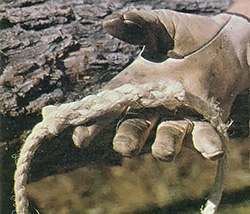
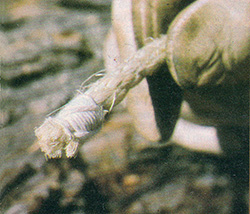
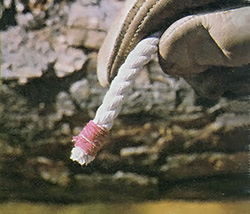
One should never leave frayed ends on a good piece of rope. Once the line has begun to unravel, that “unwound”
portion will have to be discarded! Natural fiber ropes
should be whipped (a method of (continued from preceding
page) binding the line’s tips) with either a good synthetic
whipping twine or a natural fiber such as waxed linen.
There are a number of different ways to whip a rope’s end, but “common” and “sailor’s”
whipping are two of the more popular
approaches.
Another way to prevent unwinding in a natural fiber rope is
to back-splice it.
Back splicing, however, can be used only when the rope will
not have to pass through a restriction–such as a pulley
block–since the splice increases the end’s diameter
significantly.
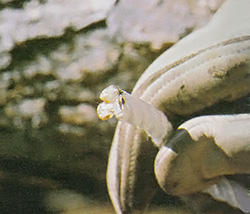
Synthetic lines are generally protected from unraveling by
either melting the fibers in their tips or by applying a
length of shrink tubing to their ends. (Alternatively, it’s
possible to apply whipping to the ends of synthetic rope,
just as you would when dealing with natural fibers.)
Whichever method you choose, it’s particularly important
that the binding be secure because synthetics seem to be
more inclined to unravel than are the natural ropes.
Finally, you should know that some lines are more resistant
to certain environmental conditions and uses than others. Manufacturers’ specifications should be looked
over carefully. For example, most polypropylene and
polyethylene ropes can’t be used where they’ll regularly be
subject to direct sunlight, but some factories do apply
ultraviolet inhibitors to such lines, eliminating or
alleviating that problem.
Rope Applications
When you’re trying to decide which rope to use for a
particular job, it’s important to consider both the working
load and the breaking strength of the cord in question.
While all natural fiber lines are rated for regular working
loads of about 20% of their breaking strength, nylon is
usually rated for a working load that is 11% of its
breaking strength because of its tendency to stretch.
Hence, nylon might be perfect for a towing application
where the rope needs to flex and the load will vary
considerably. But in a situation where an object needs to
be held in position–such as when a rope is used to
temporarily guy a tower–a low-stretch manila might be a
good choice.
Furthermore, there are a few basic rules for the use of any
rope. When you’re bending a rope around pulley blocks, for
example, the diameter of the pulley should be at least
eight times that of the rope. And in any application where
a line is permanently affixed to either another line or to
some object, use a splice rather than a knot … since it
places less stress on the fibers. Of course, there are
times when a knot is the only practical choice. In such
cases, find out what the right “tie” for the job is and use
it (see “How to Tie the Ten Most Useful Knots”, on page 80
of issue 57). You’ll insure your own safety, and your rope
will last longer as a result.
Even under the best of conditions, all fibers–either
natural or synthetic–will wear out. You should learn
to recognize the symptoms and put a deteriorating line out
of service before an accident happens. Most natural ropes
tend to become quite limp when they’re nearing the end of
their useful career. The surface will become soft and
fuzzy, the color will turn to a dull gray, and the inner
filaments will have crumbled to dust. Synthetic fibers,
however, don’t offer such clear warnings. Generally, they
will become limp and soft–and, in the case of the
ropes affected by ultraviolet light, the color may
change–but the interior fibers may, to the eye,
appear unaffected. To inspect such a rope, bend the
material and study the condition of the surface fibers. If they’re excessively frayed, it’s time to retire the
line.
But don’t throw away rope that’s a little too old to be
trusted. There are likely to be many short sections that
can be turned into all manner of useful objects. Sailors
have fashioned everything from handles to door mats out of
old lines, and there are numerous working applications for
tired rope, too: It can be used to make bumpers and
grommets, for instance.
As you pay more attention to the lines you use, you may
find yourself becoming more interested in the time-honored
art of ropecraft. There’s a real pleasure in working a
quality section of rope, and the results of an expert’s
handiwork can often teeter on the boundary between function
and art.
Specifications for Common 3/8″ Ropes
HEMP
- Working Load: 270 lb.
- Breaking Load: 1,350 lb.
- Enemies: moisture, chemicals
- Stretch: low
- Handling: good
- Price: 2
- Comments: becoming difficult to find

SISAL
- Working Load: 225 lb.
- Breaking Load: 1,125 lb.
- Enemies: moisture, chemicals
- Stretch: low
- Handling: fair
- Price: 1
- Comments: tends to fray, has barbs that poke hands

COTTON
- Working Load: 150 lb.
- Breaking Load: 750 lb.
- Enemies: moisture, chemicals
- Stretch: medium
- Handling: excellent
- Price: 1
- Comments: very easy to handle, swells with moisture and grips

MANILA
- Working Load: 270 lb.
- Breaking Load: 1,350 lb.
- Enemies: moisture, chemicals
- Stretch: low
- Handling: good
- Price: 3
- Comments: the standard natural fiber rope

NYLON
- Working Load: 410 lb.
- Breaking Load: 3,725 lb.
- Enemies: acids
- Stretch: high
- Handling: excellent
- Price: 5
- Comments: tends to slip, very flexible if braided, unwinds easily

POLYETHYLENE
- Working Load: 420 lb.
- Breaking Load: 2,700 lb.
- Enemies: ultraviolet light
- Stretch: low
- Handling: fair
- Price: 3
- Comments: floats, stiff, slippery, may have barbs, subject to chafe, unwinds easily

POLYPROPYLENE
- Working Load: 400 lb.
- Breaking Load: 2,350 lb.
- Enemies: ultraviolet light
- Stretch: medium
- Handling: fair
- Price: 2
- Comments: floats, stiff, may have barbs, subject to chafe, unwinds easily

Price numbers indicate relative cost from least to most expensive on a scale of 1 to 5.
EDITOR’S NOTE: If you’d like to learn more about the craft
of working with rope, two excellent books on the subject
are The Marlinspike Sailor by Hervey Garrett Smith,
published by John De Graff, Inc. ($7.95) … and Modern
Rope Seamanship by Colin Jarman and Bill Beavis, published
by International Marine Publishing Company ($12.50).