



Learn how Tillers International is preserving traditional farming techniques. (See the Tiller farming photos in the image gallery.)
Picture yourself in an open field under the radiant sun
walking behind a pair of one-ton oxen. The heavy animals
plod rhythmically through the soil and you watch dark
clumps of earth fall to either side of the plow, creating a
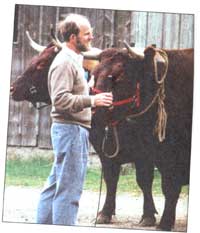
furrow for planting. The oxen are wearing a handmade yoke
from the woodworking and blacksmith shop and they respond
to your “gee” and “haw.” There is no hum of a tractor and
no smell of its exhaust. You are in southwestern Michigan
working the land the traditional way at Tillers
International, an organization committed to preserving
historical rural skills.
Located on 30 acres of country land at the edge of
Kalamazoo, Michigan, Tillers International has offered
training in rural skills for over 15 years, preserving traditional farming techniques. International
rural innovators, American farmers, historical
interpreters, craftspeople, and hobbyists alike travel from
around the United States and abroad to sample classes in
animal power, farm crops, construction skills,
metalworking, woodworking, and international rural
development. Class participants plow fields with draft
horses, build yokes for oxen, forge fireplace tools, and
even travel to Africa to develop and share rural skills
abroad.
Hands-On Farming and Homestead Experience
“Tillers is a skill-based organization,” says director
Richard Roosenberg, with the small classes structured
around hand-son practical experience. In the Sweet Sorghum
Molasses class, for example, people from ages 10 to 70
spend the day cutting and preparing sorghum cane, pressing
it with animal power, and evaporating the juice to
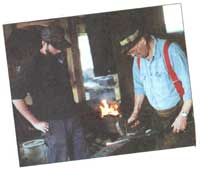
molasses. Participants in the Introduction to Blacksmithing
class go home with their own handmade coal chisel after
covering the basics of hammer skills, heat treating, and
forge welding. Blacksmithing classes are limited to eight
people so everyone uses his or her own anvil and no more
than two people share a forge.
The practical experience of Tillers classes draws students,
volunteers, and interns to the organization. “Right from
the start I knew Tillers was a hands-on experience where
you were learning and working to support agricultural
endeavors,” recalls former Tillers intern Alex Crockford.
Interested in farming from an ecological standpoint,
Crockford says he came to Tillers from the perspective of
wanting to live on the land appropriately and act as a
steward of the environment.
Janet Ott, another former intern, recalls being thrown into
the middle of everything during her first few days at
Tillers, from the workshops to the animal care and the day
to day living. Animals need to be fed, watered, and taken
out to graze and crops need to be tended. Now the spring
plowing, disking, and planting make way for the summer
cultivating. “There’s no typical day at Tillers;” Crockford
says. “It starts with chores and ends with chores.”
The Tillers Farmstead
The Village Shop, one of the four barns at Tillers, houses
the blacksmithing and woodworking facilities. Built several
years ago as part of a timber framing class, the barn is
unique because it operates off the electrical grid, thanks
to solar cells which power the lights. None of the tools
require electricity. The remaining barns store farm
implements, hay, oxen, and a power tool workshop.
A large farmhouse serves as the office and guest house,
providing on-site lodging for interns and visitors.
Finally, an intensive pasture rotation system of oats,
wheat, sorghum, beans, corn, clover, and rice completes the
Tillers farmstead.
Maintaining the soil through crop rotation is only one
example of the earth-friendly farming techniques both taught
and practiced at Tillers. The Water and Soil Conservation
class offers visitors hands-on practice using
animal-powered tools for contour ridging and terracing,
creating small catchment dams, and trenching for
irrigation. In the Solar Applications for Small Farms
class, participants practice connecting photovoltaic panels
and wiring for solar electric fencing, small water pumps,
farm lighting, and battery maintenance.
In addition to the solar cells in the Village Shop,
Roosenberg says he hopes to hook up a solar pumping device
to water cattle with stream water, as opposed to well
water. The cattle currently are prohibited from walking to
the stream in an effort to protect the soil from erosion.
Roosenberg saw a great reaction to the use of animal power
when he worked with the Peace Corp in Benin, West Africa,
in the early 1970s, and wanted to learn more. In 1981, he
started Tillers as a program at the Kalamazoo Nature
Center’s historic farmhouse. In 1989, Tillers moved to its
current location at Abbey Farms, gained non-profit status,
and became a program of Rural Futures International.
Operating on a tight annual budget of $130,000, Tillers
depends greatly on volunteers and interns. Roosenberg and
Dave Kramer are the only full-time paid employees. Roughly
one-third of the budget comes from donations, while class
fees round out close to another third. The remaining money
is raised by selling oxen no longer needed for field work
or instruction, and handmade oxen yokes and carts not
readily available elsewhere. Publications for sale range
from oxen training handbooks to short papers available for
a few dollars.
More than 300 people from 35 states contribute to Tillers
and around 70 people volunteer their time at the
organization. As a result, 400 people took advantage of
Tillers classes last year. Each year approximately 20
people vie for two to four internship slots.
Animal-Powered Agriculture
Crockford took advantage of the Tillers internship program
last year. Although he grew up in suburban Detroit, his
father’s tales of life on the farm sparked an interest in
rural skills. When studying biology at Michigan
Technological University, Crockford learned about Tillers
through a demonstration of an oxen-powered water pump. Made
with plywood, old truck inner tubes, and threaded rods, the
tool “pumped water like crazy” and Crockford knew he wanted
to learn more about animal-powered agriculture.
Like Crockford, Ott was also drawn to Tillers because of
the unique opportunity to learn about animal-powered
agriculture. After traveling to Morocco with the Peace Corp
in the early 1980s and then earning a degree in animal
science at California State University, Ott, 37, was eager
to use her skills in development. Tillers accommodated Ott
and her husband and two children during her three month
internship in 1992.
Working with the oxen was one of Crockford’s favorite tasks
at Tillers. “It’s amazing to be able to go to a 2,000-pound
steer and tell him to come with you, and he will,
willingly.” Crockford found the oxen steady, hard-working,
cheap to maintain, and trainable by anybody, including
children. While at Tillers, he trained oxen, introducing
them to new implements, including carts and sleds, and new
work such as harrowing, disking, mowing and raking hay.
Ott also enjoyed working with the oxen at Tillers and keeps
up with her ox-driving skills today at Garfield Farm Museum
in La Fox, Illinois. “Oxen are big and a
little bit clumsy sometimes, but it’s such a nice rhythm
walking with them,” Ott says. “It gives you time to think
and pay attention to what’s going on around you.”
Working with the oxen taught Crockford the value of
low-capital rural development first-hand. “If you spread
your labor out over the year and do different activities
that keep your animals in shape, you can get by fairly well
without having the need for a tractor,” Crockford found.
“Just because you have a tractor or baler doesn’t mean the
work is easier or better.”
International Rural Development
And not everybody has a tractor or baler. When Ott applied
rural development skills in Uganda on a three-week Tillers
trip last summer, she discovered the importance of
appropriate technology. “Sure, you can send a tractor over
and they would get the plowing done a whole lot faster, but
is it really appropriate?” she questions. If animals can be
used for a task and people are willing to try it, it’s a
lot better than a tractor, Ott says. A tractor may not be
appropriate if fuel or spare parts are not also available.
Tillers uses appropriate technology to find what works best
in a situation. “They will take traditional designs and
adapt them, which is different from the history farm where
they’re trying to take a traditional thing and maintain
it,” Ott notes. With this approach, old and new ideas can
both be used in new ways. If there are no local power
supplies or material sources, for example, you might build
with used tires and scrap-metal. “You can take a piece of
scrap off a car and turn it into a fine woodworking tool,”
Crockford says.
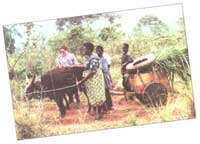
The women Ott worked with for three weeks in Uganda were
very receptive to working with the oxen as they quickly
realized how it would reduce their daily burdens, such as
moving produce, water, and firewood. Men traditionally care
for the oxen, so it was something very new to see women
interacting closely with the animals, Ott says. At the
beginning of a training week, the group introduced oxen to
yokes and commands, and by the end of the week they watched
the oxen pull a cart from the swamp with a few cans of
water. Ott was impressed with how quickly the women learned
and developed a rapport with the animals.
When Herb Nehring, 78, traveled to Uganda with Tillers
almost two years ago, he helped people put another kind of
traditional skill to use by sharing his blacksmithing
expertise. Along with four others from Tillers, Nehring
joined 40 people representing agricultural departments of
Ugandan districts. Six weeks of training in ox-driving and
pasture-management yielded a new yoke style and the use of
more than one team of oxen per plow for greater efficiency.
Participants took sets of iron back to their districts to
make yokes and put their training to use.
Preserving Historical Skills
In addition to participating in the Uganda trip, Nehring
has been a volunteer blacksmith instructor at Tillers since
1983. Over the years, he has watched Tillers grow from a
program of the Kalamazoo Nature Center with its first set
of oxen, to a larger organization that has worked with
people from at least half a dozen countries. Roosenberg
says he sees more growth in the future of Tillers,
including expanded overseas programs and membership groups
which might lead to developing chapters for easier access
to the organization.
Nehring learned blacksmithing skills in 1949, after the
trade started to die out. Today, he strives to keep the
skill alive, calling blacksmithing the most depended-upon
trade in the development of civilization. “At one time
everything made from iron or steel had to be made at the
fire on an anvil with a simple hammer,” Nehring says. He
worked as a farrier on and off for 10 years before a
30-year career in the machine shop.
“Blacksmithing is a skill where your hand and eye and brain
all have to work together because you’re working fast and
can only work while the material’s hot.” It takes
dedication and a desire to learn, Nehring adds.
Nehring boasts a 98% success rate in teaching the
techniques of forge welding and notes that all class
participants go home with their own usable handmade coal
chisel after two days of Introduction to Blacksmithing.
Most class participants start with little or no experience
or training. As the most popular metal-working course, one
Introduction to Blacksmithing class last year spilled over
into three sessions.
In Tillers’ future, Nehring says he would like to see
additional funding and exposure so more people can work on
pending projects in Uganda and Tanzania. Tillers helps
people learn, produce, and advance, Nehring says. “It’s an
organization that has started out and continues to grow in
the helping of others.”
To learn more about Tillers, register for a class, or order
a publication, contact them in Kalamazoo,
MI, or TillersInt @ aol.com.






