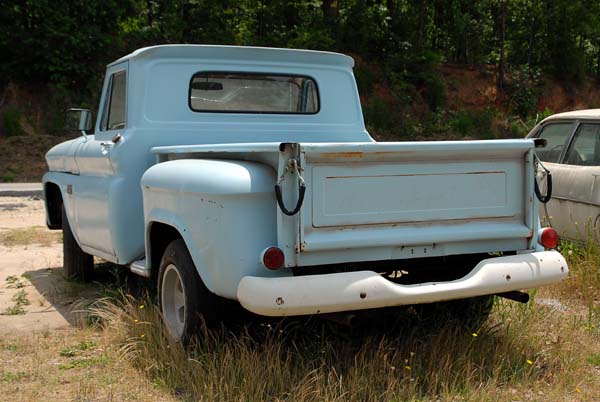
The points of greatest wear on a truck are usually in its running gear: axles, drive shaft, tie rods and brakes. Look at a pickup on a grease rack to check the past pickup truck maintenance before you buy it.
With the Truck on the Rack:
Grasp a front wheel top and bottom and try to work it back and forth sideways. More than an eighth of an inch play means a king-pin replacement bill. Spin all four wheels with the truck out of gear . . . a metal-to-metal sound on any wheel indicates worn or badly-adjusted brakes. There should be absolutely no or-at most-barely noticeable play in the universal joint. Muffler and tailpipe should be sound. Tie rods and tie rod connections should be tight with soft–not hard–grease extruding from grease fittings. Soft grease indicates regular lubrication. Check frame for bent, warped or welded spots and the inside of all tires for streaks of hydraulic fluid (indicating a leaky wheel cylinder in the brake system). Oil in the transmission should be level, or nearly so, with the filling plug. Differential grease should be within reach of a finger thrust in through the opening. If either is low, you have reason to believe the owner may have shortcut other maintenance.
With the Truck on the Ground:
An engine caked with oil, grease and mud may run like the proverbial sewing machine . . . but the odds are against it. Grease and oil on the ignition harness can cause voltage loss between the distributor and spark plugs and–in extreme cases–short out the plugs entirely. Excessive oil on the outside of an engine may be there for a number of reasons . . . none of them good. Sometimes, though, the problem is nothing worse than loose bolts or a broken gasket around the valve cover. If the trouble is only a clogged breather cap, turn the cap upside down on the ground, fill it with gas and light it. After it has burned out, it’ll be good as new. Withdraw the engine oil dipstick and check for grit (a sign of excessive engine wear). Watch, too, for oil with a foamy, greyish appearance. It means that water is present and that’s a sure sign of a cracked block or head . . . trouble you want no part of. Remove the radiator filler cap and dip in a finger. Oil in the water is just as bad as water in the oil. Even a leaky radiator can be an expensive proposition, though, so carefully look over the cooling system for signs of leaks. If you look at a truck with an automatic transmission, remember that the engine must be idling before you can check the level of the transmission fluid. If the pickup has been driven just before your inspection, stall as long as possible before starting it again. Let it cool. You can’t tell much about an engine that’s already been warmed up.
With the Truck Running:
As you start the vehicle, listen for any unusual noises from the starter. Let the engine idle. It should run quietly and smoothly with a minimum of vibration. Put your ear on the radiator cap and listen . . . or, if you don’t know what you’re doing, get a good mechanic to listen to the engine. A good man can tell the difference between piston slap, wrist-pin rattle, the dull hammering of a flat shaft on a worn main bearing and the sharper sound of a rod bearing . . . but even a rank amateur should be able to notice if something is drastically wrong. Anything other than the steady hum of a well cared for engine is apt to spell trouble. Don’t take, “That’s just a little valve rattle. All trucks sound like that,” for an answer. Valve jobs cost at least $40.00. With the engine still idling, walk around to the exhaust and have someone race the engine. A puff or two of black smoke–caused by carbon–is not important. White smoke–which probably means the old jalopy needs rings–is something else (a major repair bill). Climb in the cab and let out the clutch. Hear a faint (or not so faint) jingle? If it disappears when you let the clutch in, it’s a worn ring gear . . . not a catastrophe, although it may indicate that the life expectancy of the clutch is not all it should be. The brake pedal should depress less than a third of its total arc before becoming effective. You should not have to pump it. Test the lights, turn signals, hand brake, horn and windshield wipers.
The Test Drive:
Ease into gear and pull away gently. The truck should “lug” along on the level without bucking and jumping with your foot off the throttle. Speed up and try the brakes again. Try the truck on both right and left turns. If you can find a steep hill, put ‘er up it. On the downhill side, in high gear, take your foot off the throttle. Does the truck slow down or pick up speed? If the latter, it’s probably low on compression and needs new rings. Watch the temperature gauge. A good engine runs neither hot nor cold . . . just warm.
Truck Dealing:
Your best bet is buying a one-owner truck from a private party. A pickup on a dealer’s lot could’ve been anywhere. If you do find an exceptional machine offered by a dealer, though, bargain with the salesman. They always ask more than they expect to get. Be tough. Drive the price down. A truck with an excellent body and running gear-but with a blown engine–can be a good buy . . . depending on how disgusted the owner happens to be at the time. Sometimes you can get a good pickup that way for $100 or less. Before you make the deal, though, shop around for necessary parts and get a good mechanic to give you an exact estimate of the repair costs. Add it all up. If the total is reasonable, within your budget and less than you’d have to pay for a secondhand truck in supposedly-good condition . . . buy it. It’ll be the closest you’ll ever come to getting a practically new truck for a second-hand price.