

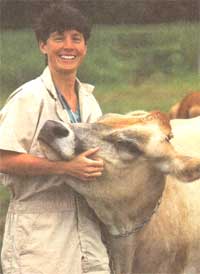
Andrea Looney, DVM, offers her farm animal health experience in caring for cows, calves, horses and sheep. This issue includes questions on pet and livestock predators.
The greatness of a nation and its moral progress may be judged by the way its animals are treated.
–Mahatma Ghandi
Control of Pet and Livestock Predators and Pests
As medicine moves into more and more technologized eras, we
are developing a health-care system that often views the
patient as a collection of moving parts, all fixable.
Advances in medicine for the most part have projected our
nation farther into exceptional health care than most
peoples will ever know. Yet, are these advances converged
on the fixable part to the extent that they are
discompassionate and lifeless to the individual (person and
animal)? Imbalances of general health and lack of common
compassion and common sense have the same negative and
disquieting effects on our companion animals as they do us.
It is more imperative than ever that we find methods of
wellness, prevention, and care that have broader
perspectives for us and our animals. MOTHER strives to
communicate this urgency with an understanding that healing
for the least among us (through oftentimes simple methods)
will lead to the health of the entire individual and a
betterment of the community. I hope you continue to join us
in this concern with your questions and letters.
Our Jersey cows have a disease known as laminitis.
What can we do to prevent it? These cows are housed
outdoors mostly. Their lameness was noticed first a few
months ago when the ground got softer.
–Will Davis
New Ulm, MN
Much of the modern dairy cow’s difficulty with hoof
disorders is directly related to abnormal hoof growth
caused by laminitis. Inflammation and disruption of the
lamina (the part of the foot that suspends the bones in the
hoof) results in unusually unrestricted hoof growth most
often detected as elongated toes, rings in the hoof wall,
and overgrown outside hoof walls. Since the hind legs
support more weight than the front legs, the outside rear
claws and the inside (medial) front claws bear a majority
of the problem in lame cows.
Laminitis is an inflammation of the suspending laminae, the
tissue that holds the hoof on the foot. There are two
forms, acute and chronic. The acute form is very painful
and all four feet may be affected to the point that the
animal doesn’t stand or move. First-calf heifers are most
severely affected. Common factors that contribute to the
development of laminitis include acute or chronic rumen
acidosis or endotoxemia (rapid or high concentrate change
in feed), foot trauma such as concrete confinement,
improper claw trimming or overgrowth, poor conformation,
and continued exposure to moisture and acids in manure and
urine. Some nutritional deficiencies and some viral
infections (BVD) may cause laminitis as well.
The chronic form of laminitis is more prevalent. Cows with
this form of disease have pancake-shaped feet, very dished
and overgrown. The abnormal shape forces cows to bear
weight abnormally leading to joint and ligament disorders.
The wall-sole junction at the white line often separates
and hemorrhages (black spots) appear. These often progress
into ascending infections and resultant sole ulcers. The
long toes cause cattle to rock back on their heels and heel
erosions develop.
Dietary management (decreasing concentrate), environmental
modification (providing some dryness), and diligent claw
trimming (biannually) may help reduce the incidence of
laminitis, although the former is probably most important.
What are the best worm-control methods? Our team of
Belgians is housed in a shed with tie stalls and turned out
daily when they aren’t used for work.
–Zelma Roberts
Waverly, IA
The optimum parasite-control program ensures the horses’
health, while conserving the efficacy or power of the
anthelmintic or dewormer and protecting the environment
where the animals reside. There are several points that
need to be covered to ensure a good parasite-control
program.
First, make sure you’re using an effective dewormer. Horse
farms can be tested annually for resistance that develops
in commonly used dewormers by doing parasite egg counts
before and after treatment. Turn a sample into your
veterinarian. Second, while it’s usually impossible to
weigh horses on a farm, use a girth tape to more accurately
estimate the weight of the animals. Weight is important
because dosages, based on weight, must be as exact as
possible; with the safety of most modern anthelmintics, it
is probably better to slightly overdose than to underdose.
Underdosage selects for resistant strains of worms. You
want to use the minimal EFFECTIVE dose a minimal amount of
times per year.
Third, consider different treatment strategies based upon
climate and temperature if the animals are common grazers.
For instance, in the northern United States, where a spring
and summer rise in equine fecal egg counts has been
observed, a spring and summer treatment regimen was just as
effective as year-round treatment recommended by the
manufacturer of certain dewormers. Consider also the
pasture, especially if youngsters graze it. Pasture
sweeping and vacuuming, alternate grazing with cattle or
sheep, or prolonged pasture rotation and harrowing may
really help with environmental control. Rotate anthelmintic
classes annually; this helps reduce the drug resistance
that develops. It’s also a good policy to treat new
arrivals to the farm with a nonbenzimidazole drug, the
easiest class of drugs to which worms become resistant.
My thirty-something horse grazes the grass and
clover lawn. Creeping Charlie has invaded the yard. The
horse doesn’t graze this, but I’d like to get rid of it
using boron. Should I?
–Georgiana Srachia
Homewood, IL
Creeping Charlie, also known as Ground Ivy, Gill over the
Ground, or Glechoma, is a short-branching plant that
invades many lawns. It has a very short, square stem and
may have a light-lavender tubular flower when in bloom. Due
to a toxic substance in the leaves, it causes a syndrome of
sweating, salivation, and difficult breathing in horses
when consumed. Horses usually find it offensive to munch on
and once tasting it, will likely turn away from the
“weed.”
Borax is used both as a herbicide and as a soil sterilant
and is toxic to animals if consumed in large doses. Many
herbicides, like borax, may cause a contact dermatitis
around the lips and nose of large animals, as well as
non-specific gastroenteritis and muscle weakness. Toxicity
is supposedly low when the chemicals are applied using
manufacturer’s directions, but I suspect it may be a better
idea to provide the animal with some quality hay in another
area of the yard while the weedy area is being treated with
the Borax. Always think of drainage of the Borax-laden
soil.
It may also not be a bad idea to supplement with some hay
regardless, as many of the common yard and lawn plants,
even if eaten in small doses may cause some signs of colic
and toxicity.
I recently picked up a barn cat and low and behold,
it came with lice. How do I get rid of these things? Are
they contagious to humans?
–Jean G. Haaland
El Dorado, KS
Pediculosis is infestation with lice. These pests are small
wingless insects that are relatively host specific
(meaning, will generally not infest humans!) and survive
only a few days off their victim animals. Lice are
well-adapted parasites and usually more of a nuisance than
a threat to their hosts. They accumulate under mats of hair
and around the ears and body openings. There are two types
of lice: sucking lice and biting lice.
Sucking lice produce a blood loss or anemia and debilitate
the animal. Biting lice generally cause severe itching.
Lice infestation is often more prevalent in the winter and
early spring due to the growth of longer, heavier hair
coats and closer contact among animals with the cold and
dampness. Diagnosis is easy–one can usually see these
pests crawling on long hairs. Treatment should involve all
animals associated with the lice-ridden cat. Thick mats and
long hairs should first be clipped away. After a regular
soap and water shampoo, the animals should be soaked or
sprayed thoroughly with a pyrethrin flea spray. Stronger
medications or insecticides are not necessary as these
insects are usually susceptible to common flea shampoos,
sprays, and powders. It is advisable to clean the bedding
and premises even though the lice usually do not live when
they are off the host.
Our Border collie has a history of back problems
frequently treated with a cortisone injection. We are
worried about the effect of the steroids on her health and
wonder whether acupuncture would help?
–Ken Minz
Asheville, NC
The classic disc disease seen in our companion animal dogs
is only one syndrome that may manifest itself as “back
pain.” Sadly enough, several other diseases such as
meningitis, hip dysplasia, or chronic kidney disease may
also make the animal appear as if it has back pain. Thus, I
would first suggest making sure that none of the above or
other related problems are occurring. If indeed the problem
is truly orthopedic in nature, possibly secondary to
chronic vertebral instability or to strained back
musculature, then acupuncture may indeed help.
In mild, lower-back disc disease, back pain is frequently
present and the animals are reluctant to walk upstairs, or
may cry when moving or being picked up. These animals would
benefit from REST, as well as relaxation of their back
muscles through any means-acupuncture, heat, or gentle
massage. In more severe lower-back disc disease, the dog
may show some signs of nerve deficit such as knuckling of
the toes or instability of the hind limbs. Acupuncture may
assist these animals as well, although the effect may not
be as profound.
The exact mechanism of action through which acupuncture
works is not yet fully understood. Some researchers believe
that acupuncture may destroy muscle pain and hence,
shortening and stiffness. Acupuncture may activate regrowth
of destroyed nerves if the framework of the nerves itself
is not destroyed. It also decreases local spinal
inflammation and prevents release of toxic substances from
damaged tissues.
Acupuncture involves the insertion and stimulation of
needles at specific points in the body. Some practitioners
use electros-timulation or laser treatment at the points
instead of or in addition to needles. Heat can also be
applied to the needles to further increase stimulation.
Treatment intervals vary from once daily to once every two
weeks. Supportive treatment includes rest (even confinement
to allow the muscles to heal), proper diets (+/-laxatives),
and supportive care of urinary and bowel habits if the back
is very injured. Acupuncture results for certain forms of
disc disease are comparable to those of surgery and drug
therapy, without the side effects of chronic steroid usage.






