The permaculture design process starts with the guidelines in Part I, adds a particular piece of land and specific farmers, and then uses the following step-by step procedure to arrive at a completed small farm or homestead plan.
Defining Goals
First, the person or persons operating a small farm or homestead must define realistic objectives and state them as precisely as possible. It’s not enough to want “to be self-sufficient.” Such vague statements immediately suggest other questions: Do you want to be self-reliant in everything, including energy needs? … Or only food? … Or only summer vegetables?
A workable goals statement could be as follows: On this land, within five years, we want to net $20,000 a year for 40 person hours of work per week and for a total capital outlay of less than $50,000.
No design will succeed if it’s developed without such clear objectives. You must know what you want to do before you can figure out how to do it. So although you’ll be tempted to avoid this issue and move on to the excitement of choosing a chicken breed or planning a crop rotation scheme, don’t! A good design must precede the implementation. Premature zeal often results in mistakes that may be costly later.
Ideally, for the first year you should do nothing beyond defining goals and identifying the resources at hand. Rather than rushing out to dig a pond or build a barn, spend those first seasons getting to know the land and its resources. The only exceptions to this “do little” strategy are activities that are obviously necessary or involve a minimal commitment of time and money. These could include establishing herb and salad gardens near the farmhouse, upgrading insulation and weather stripping, and harvesting firewood from dead trees.
Identifying Resources
Goals can be well-defined and still be unrealistic, of course. The next step, completing a resource inventory, will give you a check with reality. Through careful observation, collect data about the on site and local resources, and closely examine your personal resources, as well.
On-site resources. These include soils, climate, water supplies, pond sites, topography and slope, solar access, existing vegetation, microclimates, and geological features. By compiling information about these resources, you’ll get to know and understand your land and its possibilities.
Collect data for this from the previous owners, soil analyses, extension agents, weather stations, local farmers, and maps obtained from the regional branch of the Soil Conservation Service and the United States Geological Survey. Also, spend time on the land. Walk it in every season, identify the plants growing in different areas, note variations in the susceptibility to frost, determine what animal populations are present, note the location of wet and dry soils, calm and windy areas, and so forth. As you carry out your resource inventory, look in particular for the following:
[1] Problems. Good design takes advantage of all site resources, and especially those generally regarded as problems. Consider these, instead, as potential opportunities. While listing and analyzing your on-site resources, do the same for apparent problems … the eroding hillside, the wet bog in the ten-acre pasture, that huge patch of kudzu, or the rocky outcrop where you’d hoped to put a garden.
Weeds, for example, are familiar “problems.” Too often, eradication immediately follows identification. A better strategy is to find a productive use for such plants. Get to know each species, look up its economic botany to see if it contains useful medicinals or essential oils, and investigate its potential as a livestock feed or a green manure crop. Learn to recognize the functions of the plant, too. The very thorniness of some weeds suggests uses: protection for young trees from livestock and wildlife, hedgerows or living fences to contain animals, or simply a deterrent to trespassers. Now some weeds are just weeds and have no merit. But if a large patch of vegetation can be profitably exploited, you’re better off using it: The very fact that this species is growing abundantly means that it’s well adapted to the site, climate, and soil. Therefore, any managing of this “crop” would be minimal.
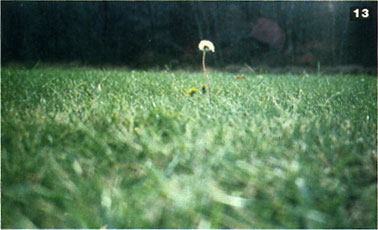
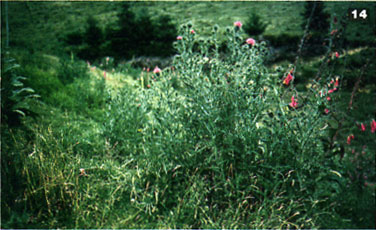
[2] Landscape indicators. Learn to read your landscape. Plant communities provide clues to microclimate and the texture, fertility, and moisture of the soil. Wild blueberries, strawberries, and dandelions (Photo 13), for example, indicate acid soils … while thistle populations (Photo 14) may increase as a result of overgrazing. Eroding soil suggests the need for alternative land-use practices, and snow deposition patterns will tell you where the sheltered and calm areas are. Large numbers of acorns in the forest may suggest a lack of wildlife … while the presence of wolf trees (those old spreading oaks) indicates that the land was once cleared for pasture or crops, thereby permitting later trees to adopt a spreading form rather than the columnar shape seen in native forests.
In gathering this type of information, record all of your observations, even those that seem irrelevant at the time. These records, singly or in combination, will provide much of the knowledge for correct placement that’s crucial to effective design.
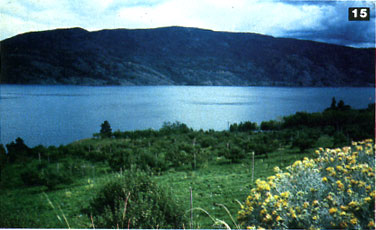
[3] Microclimates. Identify microclimates, particularly those specific to small areas where the influence of topography, vegetation, soils, bodies of water, and structures combine to produce a significant variation from the regional climate. Low-lying land, for instance, may be susceptible to late spring frosts … an indication that early flowering fruit trees should not be planted there. In contrast, land near a large lake may remain relatively warm in winter because of the influence of the water’s thermal mass, and thus might offer an ideal orchard spot (Photo 15). South-facing forest edges tend to be wind sheltered and warm … while north-facing slopes will be cool in the spring, thus delaying the budding of species susceptible to late spring frosts. After spotting specific microclimates, you can choose plants for their adaptiveness to these areas, thereby extending the range of possible crops. Once again, observation is the key to productive use.
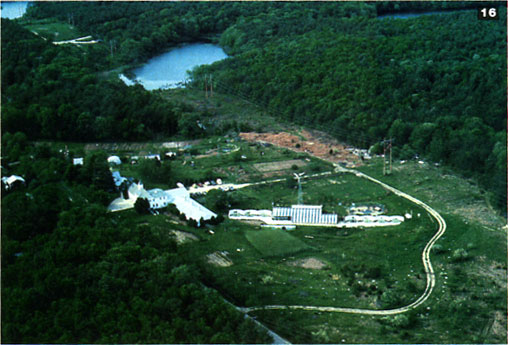
As you conduct your inventory of on-site resources, record the information on a series of maps. These don’t have to be accurate to the half inch, but they should come fairly close to scale. Aerial photographs (Photo 16) are a good starting point, and sometimes the local town hall has maps available. You may also be able to get assistance from the local branch of the Soil Conservation Service. Nature’s Design by Carol A. Smyser (see the Reader’s Guide) is an excellent source for sample maps. The book clearly illustrates how mapping aids the design process.
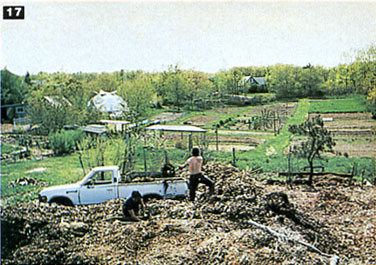
Local resources. Off-farm resources are almost always plentiful, and they’re often free or exchangeable. These may include animal wastes, lumber scraps, contents of the local dump, seaweeds, restaurant throwaways, food-processing refuse, the expertise of skilled farmers and trades people, and local markets. At the New Alchemy Institute, for example, we have an enormous pile of leaves that we use for compost and mulch (Photo 17). Each spring and fall the pile is replenished as local people on their way to the landfill see our sign and choose to recycle their leaves rather than dump them. At Prag-tree Farm in Arlington, Washington, certain weeds and edible flowers provide an unusual income simply because there’s a market for these “products” at local gourmet restaurants specializing in exotic salads. If you have beekeepers in your community, they may be willing to place hives on your land, ensuring the pollination of your crops and a secure source of nectar for the bees. Bartering skills with neighbors and sharing equipment are other obvious ways of using local resources efficiently.
Personal resources. Don’t overestimate your own skills and assets. Carefully consider the time, know-how, and finances you have available to run a small farm or homestead, and avoid a stressful future by designing the land with those limitations in mind. Determine the amount of time you can reasonably allot to your new venture, and list the skills you already have. Then stop at this point and reexamine your objectives. Can they be attained with the resources available? If so, proceed further … if not, go back and redefine your objectives and search for resources you might have overlooked.
Functional Analysis
At this stage of the design process, it’s critically important that you think function and not species. Consider the location and size of the landscape components, rather than their detailed composition. In other words, think in terms of “windbreak” and “orchard” and “pond” . . . not “three rows of white pine and two of autumn olive,” “Liberty apples or Reliance peaches,” or “hybrid tilapia or native trout.”
Inputs and outputs. Efficient design is contingent upon recognizing inputs and outputs. Each component should be located so that its inputs are provided and its outputs are used. (This is the concept of relative location that we discussed in Part I.) Compost heaps, for instance, require a mixture of organic materials, water, and air as inputs … and they produce heat, water vapor, carbon dioxide, and humus. Ideally, then, composting operations should be located with easy access to a plentiful supply of organic matter and close to the point of use (the market garden, the orchard, the pasture, or whatever). In addition, outdoor compost heaps produce only compost … but when the piles are placed inside a greenhouse, heat, carbon dioxide, and water vapor may be recovered as well. This could be especially important in the winter, when we could expect compost making to help keep a greenhouse warm and provide carbon dioxide enrichment at a time when CO2 is often a limiting factor in vegetable growth. Such a setup has recently been implemented at the New Alchemy Institute in cooperation with the BioThermal Energy Center (see Fig. 2). This winter, we’ll learn how well it works.
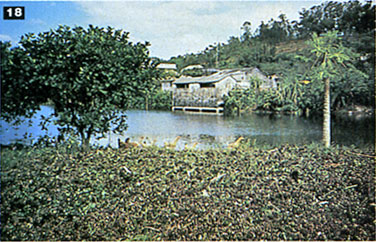
Integration. Recognizing inputs and outputs leads easily to the concept of integration–that is, placing systems so that outputs from one become the inputs to another with little or no labor used in the transfer. Effective integration is a function of good design. The preceding example of the composting greenhouse meets this criterion. So does the fact that in eastern Europe and Asia, pig, chicken, duck, and even human manure is often used to fertilize aquaculture ponds. Photo 18 depicts an integrated system in China that clearly illustrates this concept: The outhouse is situated over the water so as to provide ease in nutrient transfer. (Because of health regulations, this specific example isn’t applicable in this country.)
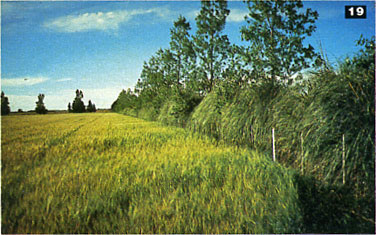
Recognizing function. Using each landscape component to its full advantage also requires a thorough understanding of its associated characteristics. Arguments against windbreaks, for example, are based on cropland lost, shading to the north of east-west plantings, and lower yields in the area where the windbreak and crop roots compete for moisture and nutrients. But windbreaks can also be designed to produce firewood and livestock feeds, to provide a protected site for beehives or a farm pond, and to increase crop yields in the area they shelter. In Photo 19, the dense ground growth and interspersed poplar trees of this windbreak protect the field from hot, dry summer winds. Thus, recognizing all characteristics of each landscape component creates options for siting other elements.
Locating components. Having identified each component and all its uses, next consider locations. Take the market garden, for example: If possible, it should be located on good soil … have easy access to a road for bringing in organic materials and moving the produce to market … and be below a pond supplying irrigation water. The garden should also be relatively close to the farmhouse and to cold frames or to a greenhouse that’ll supply it with transplants. It should be near your compost and mulch storage sites (these will preferably be placed above the garden so that heavy organic matter can be moved downhill). A naturally sheltered site is desirable, too, although the use of windbreaks can transform a windy spot into a calm one. And if you intend to run a roadside stand, the garden should boast road frontage that has ample parking for customers.
As you can see, siting any one farm component is contingent on its relationship to the others. As an aid to juggling the pieces, you might want to make cardboard cutouts and move them around your map, considering the advantages and drawbacks of various locations. Each farm will require different pieces, but you’ll probably want to include many of the following: farmhouse, barn, windbreak, hedgerow, chicken house, aquaculture pond, greenhouse, water storage tank, orchard, market garden, kitchen garden, compost pile, mulch storage area, potting shed, tool shed, equipment storage, beehives, and worm beds.
Working the design. Next, for each potential plan you devise, take yourself through the day-to-day farm activities to determine the relative ease (or difficulty!) with which they can be performed. See yourself feeding the chickens, applying the compost, harvesting the produce, and storing and distributing hay. This exercise quickly points up poor placement and identifies conflicting uses of a particular location. Change the design as needed and repeat the exercise until your design “works.” At this point, go back again and reexamine your objectives and available resources. This last step often leads to further modifications. Rework the design as much as necessary until you have it right.
Species and Specifics
Once the basic design is completed, you can move on to considering specific crops, species, cultivars, and breeds. (Although I’ll limit discussion here to plant choices, you’ll likely be selecting both plant and animal species.) If, for example, you have a functional requirement for a fast-growing deciduous windbreak shorter than 20 feet high, look for plants that meet this particular need, such as the willows.
Species selection. Choosing from a large number of candidate species can be a lengthy task. For each plant, you’ll need information about its tolerances–to different types of soil, to drought, to browsing animals, and to temperature extremes–and its functions (as a nitrogen fixer, windbreak, livestock forage, and so on). The required functions are then matched with the site characteristics and species tolerances.
One design toot that can aid you with species selection is a plant species matrix. The Future Is Abundant, a text put out by the editors of Tilth (see a Reader’s Guide), contains an excellent matrix that lists 300 plants and their characteristics. With such a chart, you can easily select plants by attributes. You can, for example, locate all the nitrogen fixing plants that tolerate cold winters, thrive on acid soils, and make good hedgerows. As the interest in permaculture systems grows, more and improved plant species matrices are being developed.
While you’re choosing the proper cultivars for your property, you might want to consider the following suggestions:
[1] Orchards. The soil of your chosen site will dictate species and rootstock options to some degree. The climate of your area will further narrow the range of suitable cultivars. (If your region experiences early spring frosts, you’ll naturally want to select late-flowering species.) Choosing only disease- and insect-resistant varieties will limit your possibilities as well: For example, Liberty, Priscilla, and Nova Easygro apples have a reputation for disease resistance, whereas many of the common apple cultivars are more susceptible.
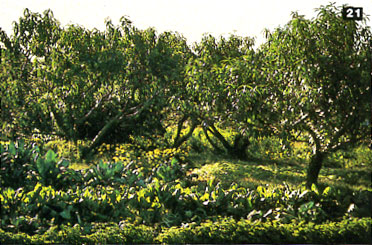
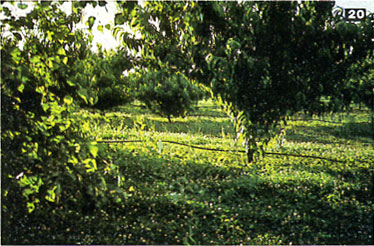
You’ll also need to decide what the understory of your orchard will be. It could provide forage for geese and ducks; contain nitrogen fixing clovers; grow green manure crops; provide a habitat for predatory and parasitic insects; or even produce strawberries, raspberries, vegetables, and herbs. Photo 20 illustrates a peach orchard with an understory of nitrogen fixing white clover … while in Photo 21, vegetables have been intercropped with the fruit trees. If you plan on using large equipment in your orchard, your understory options will obviously be reduced.
Give some thought to protecting your crop, too: Solar-powered electric fences or browse-resistant hedgerows may be needed to deter deer or other wildlife.
[2] Market gardens. When selecting species for the market garden, you’ll want to consider various crop rotations, successional planting schemes for continuous yield, local market demand for specific crops, and fertility maintenance. You may reject some crops as too labor intensive and others on the basis of your soil and climate. (Remember, though, that by using cloches, plastic mulches, and slit row covers, you can extend the growing season for those slow-growing species.)
[3] New crops. You may want to try some uncommon crops as a long term investment. Working with unfamiliar species does involve risks: In many cases, the cultural requirements have not been clearly defined, susceptibility to insects and disease is unknown, yield data may be sketchy, and the markets are uncertain. However, new crops are successfully introduced all the time, and folks who harvest a crop of the potential money makers first tend to realize the most profit. For example, farmers who planted kiwi fruit in New Zealand in the mid 70’s have made higher earnings than their more cautious neighbors.
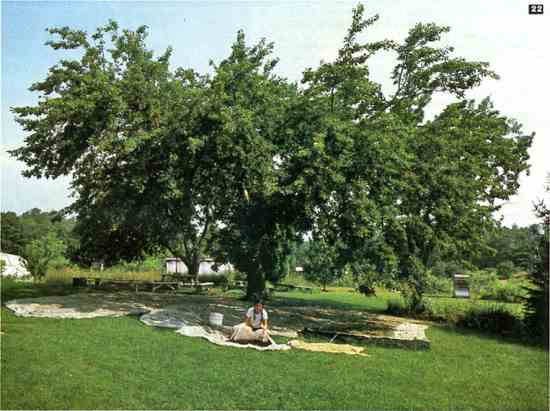
Some current candidates for such “stock market plantings” could include mulberries (Photo 22), juneberries, hardy kiwi, persimmons, nut trees, papaw, bamboo, paulownia, nut pines, truffles, ginseng, wild rice, and water chestnuts.
Management constraints. You may include many different species and cultivars in your design, add several ponds and a mix of livestock, and end up with a farm plan that includes a bit of everything. But a good design minimizes management requirements … and such a diversified small farm may fail simply because the plan’s too complicated to coordinate. So as you’re selecting species, ask yourself: Can you realistically manage all the species of fruit trees, the diverse market garden, chickens, ducks, geese, sheep, honeybees, pastures, and hedges you may have included? If the answer’s no, then simplify the design.
In general, a homestead can be more diverse than a commercial farm operation. However, there is one possible exception. If applying ecological principles and common sense in a farm-scale design leads you inexorably to a diverse and complex design, then you may want to incorporate management by a community of farmers. Because the components on any farm are linked by flows of energy, nutrients, and materials, managing such a system will demand close cooperation from the individuals involved. The orchardist and beekeeper, for instance, must cooperate so that non-crop nectar and pollen plants don’t compete with fruit trees for the honeybees’ services … the shepherd and orchardist must coordinate grazing schemes so that sheep aren’t introduced into the orchard until the trees are large enough to escape browse damage … and so on. In essence, the large, diverse situation creates an ecological argument for community farming, with cooperation among farmers demanded by the inherent characteristics of the landscape.
Permaculture Design Staging
Finally, the overall design is complete. Functions and species have been mapped and you know what goes where and why. But you’re not quite finished with the paperwork. You need an implementation plan–a timetable defining the sequence in which farm components will be established.
Some components, of course, must be operational before others can function. Fences or hedgerows must be functional before animals are let loose … and the orchard should be blooming before beehives are introduced.
Also keep in mind that components closest to the hub of activity should be established first. Implementation always begins at the back door and moves outward.
In addition, the sequence of events should mirror your skill development. Start small and simple, then add more complex components as your skills and confidence increase.
Budgeting
Although you’ve been planning within a budget all along (right?), at this point you must sit down and allocate where each dollar and cent is going. True, prospective economic returns often differ from actual dollars in the pocket … still, with the staged design as a reference, you must prepare a “best guess” budget that includes capital and operating costs for each year. Enterprise Farming (see A Reader’s Guide) contains useful sample budgets for small farm operations, and your neighboring farmers and local extension agents may also be of help. Because most of the available data apply to conventional farms, you’ll probably need to estimate costs for many of the components of a permaculture operation.
It’s possible that preparing this detailed budget may force you to modify crop choices and management strategies … perhaps by eliminating some costly practices and adding more profitable crops.
Home, Sweet Home
You’re done! Remember, though, that the design process is just that–a process. The final design is not cast in concrete, but is rather a preliminary tool to evolve from. However, because you’ve considered your site in its entirety and have followed a process that repeatedly checks your objectives and resources, you should have avoided serious mistakes. As the land matures over the years, you’ll want to add some elements and perhaps modify others. So during the implementation process, remain mindful of your work, let the landscape teach you at its own speed … and take satisfaction in the fact that in your own backyard, you’ve taken a step toward making a self nurturing agricultural system become a reality.
To review the design guidelines, see Permaculture Design: Part I. For an introduction to permaculture, see Permaculture Design for Small Farms and Homesteads.
A Reader’s Guide to Sustainable Agriculture
The following list was carefully selected from a large bibliography and contains titles that are most relevant to the issues raised in this article. A full bibliography that contains 250 titles–as well as magazine and journal listings and suppliers of equipment, beneficial insects, and plants–is available from the New Alchemy Institute.
Permaculture One by Bill Mollison and David Holmgren (Corgi Books, 1978) and Permaculture Two by Bill Mollison (Tagari Books, 1979). These volumes are the best introduction to commonsense design inspired by ecology.
Agroecology: The Scientific Basis of Alternative Agriculture by Miguel A. Altieri (self-published, 1983). This is the best text to date that describes the science behind ecological agriculture.
The Future Is Abundant edited by Lany Korn, Barbara Snyder, and Mark Musick (Tilth, 1982). Although this resource guide to the tools and information needed for farm design is geared toward the Pacific Northwest, it’s worth buying just for its plant species matrix.
Nature’s Design by Carol Smyser (Rodale Press, 1982). This is a good text for teaching the design process for home landscaping.
The One-Straw Revolution by Masanobu Fukuoka (Rodale Press, 1978). This well-known text is valuable for its philosophical approach to agriculture.
Principles of Environmental Science by K E. F. Watt (McGraw-Hill, 1972). This text is aimed at the college-level student.
The Unsettling of America by Wendell Berry (Sierra Club Books, 1977). If you haven’t read this book, you should. Wendell Berry is an eloquent voice for small farming and right livelihood.
Enterprise Farming edited by Peter Hemingson (The Ford Motor Company, 1983). This book, which is geared to the small farm, is especially valuable for planning budgets.
The New Farm published seven times a year by the Regenerative Agriculture Association. This magazine is an excellent source for information about organic farming.
EDITOR’S NOTE: The New Alchemy Institute is a 15-year-old non profit organization that conducts research, educational, and outreach programs promoting food, energy, and shelter systems that are environmentally sound and economically efficient. Tax-deductible membership in the institute is $35 per year and includes a subscription to the New Alchemy Quarterly (which reports on the work at the institute and contains articles by other researchers in biological agriculture and appropriate technology), a 20% discount on all institute publications and courses, and free admission to the Farm Saturday programs. To become a member or to receive more information, contact the New Alchemy Institute.