

After almost thinking this thing to death in the last article, Before Breaking Ground, we are ready to get to work. What next?
There are two nice building sites to choose from, one on each side of the road. Problem is, all these trees are in the way. Most landowners view this as an expense. I have seen lots of people just bulldoze the area, pile up and burn the debris, then prepare a home site. It seemed like such a waste of resources! I had to find a better way. Certain areas needed cleared, but contrary to conventional thinking, I saw this as an asset instead of a liability.
After much research, I contacted timber buyers in the area. With several bids in hand, we struck a deal with the company willing to do just what we wanted. I had previously decided to log less than half the acreage, marking to cut trees fifteen inches diameter or larger. This action would leave plenty of younger shade trees for the future, also helping to control erosion. In the end, we agreed to cut some of the largest trees. For compensation, the logger agreed to completely clear three home sites, plus two circle driveways totaling over a mile in length, and dig a basement at one home site. Additionally, we would receive one third of what the land had cost originally. Outstanding!
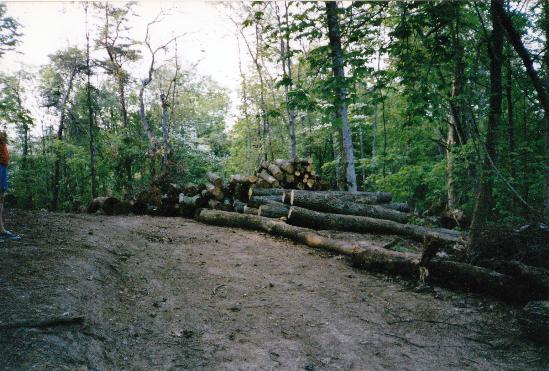
When the logging operation was finished, I was astonished at how good the property looked. Utter devastation had been expected, but did not result. Invariably, the solution to one problem creates another problem. What to do with the brush that was left behind? A lot of these limbs were of good size, but less than fifteen inches. In-depth thought revealed the only logical course of action.
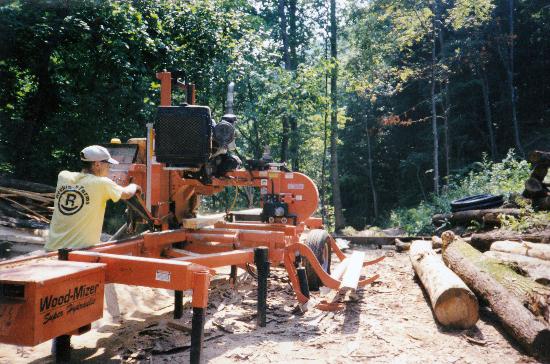
I spent the next year logging what the timber company had left on the ground, using my four wheel drive 1978 Ford Bronco. After exhaustive research, I came to terms with a sawyer that owned a portable band-saw mill. When inspecting my log piles, he estimated the job would take four or five days. This seemed quite ambitious, considering the fact that I was working full time, and planned to haul off and stack the days’ sawed lumber, and roll down the next batch of logs to be sawed the next morning, after the sawyer had finished for the day. Quite a lot to say, much less do! In spite of my serious doubts, we began to saw lumber.
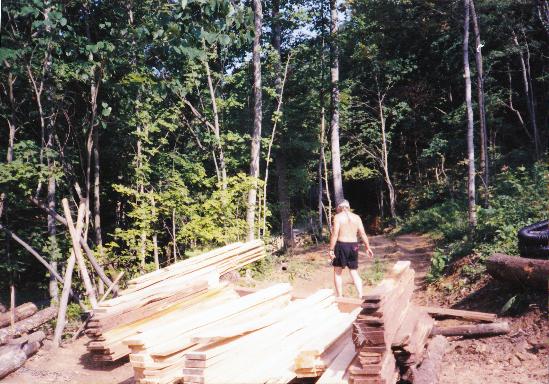
I had begun an impossible schedule. Go to work at 6:30 AM, leave at 3 PM, haul two to three loads of lumber, stack it, then return to the property to roll down the logs to saw the next day. Exhausting! I stacked and spaced the boards in the basement of my house in town to allow them to air dry, and to keep them out of the sun. Direct sunshine will cause the lumber to warp, split, and check. It is imperative to protect the boards from sunshine! One could use kiln-drying, but that would add expense. What started out as a five-day job turned into a three-week ordeal. I could not keep up the pace, and informed the sawyer the job was ending, if not finished. I decided to cut the remaining logs into firewood that could have been sold, but were stacked and covered for later use.
At the beginning, I instructed the sawyer to cut the southern yellow pine into framing lumber. Standard sawmill lumber, in this area, is cut true. A 2-by-4 is sawed 2 inches by 4 inches. A “storebought” 2-by-4 is 1.5-by-3.5 inches. I had the pine cut to “store bought” dimension. The sawyer had never done this, and was amazed at the yield per log using this technique. The hardwood was cut to 1x, meaning one inch thick and variable width and length. We also cut three fireplace mantels out of walnut measuring 6 inches x 8 inches x 16 feet. We ended up with ash; red, white, and chestnut oak; hickory; cherry; walnut; sassafras and poplar hardwood, along with pine framing lumber. All this wood totaled over 10,000 board-feet worth over $20,000, at a cost of just under $2,000. Sweet!
So, we bring in the year 2000 owning 12 acres of country forest a half-mile from a lake, five minutes from Main Street, with no neighbors in sight, and 10,000 board-feet of lumber drying in the basement, at a cost of under $12,000 plus massive amounts of sweat equity. Life is good! We say we are landowners, but actually we are just caretakers. This property will be here long after we are gone. That concept must remain in thought at all times, and bear on any future actions. The best advice: Do nothing without very careful consideration, in advance! Second best: Please remember to recycle any and everything, if possible.
Visit us at: Off The Grid Energy Solutions, Natural Power & Light, Yahoo, & Facebook






)