


Unless you live in desert country, water is a pretty big
factor in building decisions and techniques. I’m not talking about the water
you drink, but rather the water that is sure to rain or snow on your house and property.
Roofs – One of the most important features of your home is
the quality of roof. Shake, shingle, and metal are the most common types of
roofs. There are a few BUR (built up roofs) using some kind of rubber type
material or even asphalt mop down roofing, most commonly used on flat roofs.
As a commercial builder we put flat roofs on half of the buildings we built so
I know it can be done successfully. That being said, I still don’t recommend
them for houses, especially if you get a fair amount of snow in your area.
So you’ve researched the type roof you want to put on and it
sheds water really well. Now what? Most
of the houses around here don’t have gutters. WRONG. It doesn’t matter how much
snow you get, gutters can be put on to last in the snow country. This is our
second year with gutters in snow country. I’ve had as much as 3′ of snow on my
roof at any given time. Most of the time it slides off the metal roof. There is
zero damage to my gutters so far. It can be done. We placed the gutters a little
lower than usual so the ice goes over the top of them. We also used more
fasteners than normal. My fasteners are 12″ on center. As a side benefit, if
you have flower beds next to your house, you won’t have tons of water running
off your roof and flooding your planters and destroying flowers.
What’s the big deal you ask? Water, that’s what. One of the
most important features of any home is to make sure you get any and all water
away from the house. Water kills houses. Water is responsible for mold, mildew,
rot, and flooding. Get the water away
from the house.
Sooner or later that snow is going to melt and having all of
it just pile up next to your foundation and walls isn’t the best situation. It
also isn’t good for the rain to fall off your roof and splash water and dirt on
your siding all year long. Gutters do double duty at our house. They help catch
rain and snow melt and channel that water into a cistern. Every drop we catch
is one less drop we have to pump from our well. We use the cistern water for the
gardens and to water the horses.
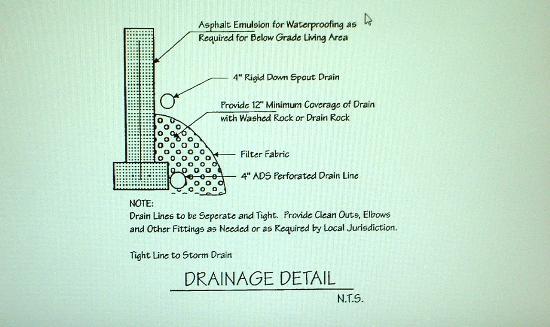
Another common mistake some people make is to eliminate
footing drains. Especially if the subsoil is clay. Most clays don’t absorb
water so the ground water will go to the path of least resistance and that may
be under your concrete floor or crawlspace. The other mistake made with footing
drains is that some people put the drains on top of the footings. They need to
go BESIDE the footings in order to work properly. Footing drains are made of
perforated pipe. Water goes in the holes in the top of the pipe and back out
the bottom holes. If the pipe is laid alongside the concrete footings it will
eventually go into the ground away from your house and not into it. Also DO NOT
use the footing drains as drain lines for your downspout drains. You need to
have two sets of pipes running around your house. One set of perforated for the
footing drains and the other is non perforated for your downspouts.

The last thing you can do to prevent water damage is to make
sure the ground (surface) slopes away from your house. This past year we
experienced some settlement along the back concrete garage wall. When the snow
melted really fast it ponded in the new low settled area next to the wall and
came into the garage through a crack in the concrete wall. The ground was
frozen and all that snow melt had nowhere to go. It will always seek out the
lowest point so you need to make sure that point is not toward your house but
away from it. I just placed more soil in the low areas and even after a major
rain storm I had no more leakage because all of the surface water now runs away
from the house once again. And yes, my concrete wall is sealed on the outside
from all ground water but in this case it ponded higher than all of our sealed
wall surface and it got behind the vapor barrier and ran down the wall into a
crack. Not anymore. Problem solved.
Water can be dealt with properly as long as you pay
attention to these basic principles. Your home will look nicer, last longer,
and be healthier if you do.
As I sit here writing, we’ve had another late snow storm. It’s melting fast,
and my cisterns will be full again before I am finished writing this article.
Ed and Laurie Essex live off grid in
the Okanogan Highlands of Washington State where they operate their website goodideasforlife.com and offgridworks.com.






