

With the present mania for recycling, “getting rid” of may soon be an idiom gone from the language. Certainly getting rid of anything down on the farm these days is next to impossible.
For years now Paul has been wanting to burn the kettle house — a little vine-covered shack in the backyard containing a great kettle built into a brick fire pot once used for rendering lard and making apple butter.
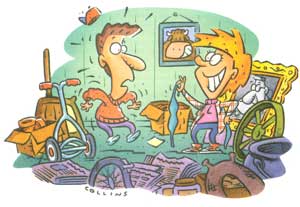
“Don’t you dare touch that!” I say. “It’s a period piece — irreplaceable!” And besides, I need it. It’s crammed with old newspapers and pop bottles and flower pots and push lawn mowers and dozens of other things awaiting recycling.
Forty feet south of the kettle house is the ice house, crowded with antique tools and household implements and great-great-grandfather Leimbach’s gilt-framed portrait. The seed house, 40 feet to the north, stores a wealth of old doors and windows and lumber and porch swings and butter churns and discarded appliances “somebody might need sometime.”
The horse barn, in addition to motorcycles and bicycles, shelters old harnesses and horse collars and wagon wheels.
That’s just the beginning. There’s also the granary, the chicken coop, the hay barn, and the “big barn.” Then there’s Newberry’s barn (when you buy a neighbor’s farm his fields and buildings traditionally carry his name ad infinitum), Newberry’s milk house and Newberry’s toolshed. And every weathered building has its cache of farm treasures.
For 100 years the Leimbachs have prevailed on this site — enlarging, expanding, acquiring, with neither a sale nor a fire. The accumulation is overwhelming.
Every time I get ready to do a good cleaning job, some yahoo comes around blabbing, “Don’t throw THAT away! They’re paying fabulous prices for that stuff.” Where, I ask, are all these people paying “fabulous prices” for barn siding, mason jars, old bottles, rusty nails, wavy windowpanes, hand-hewn beams, and — are you ready for this one! — worn and faded blue denim?
Yup! I was just fixin’ to go down to the cellar and make a clean sweep of those dusty old overall jackets I inherited when we bought the Newberry place, and then I read it right there in Time magazine: Saks Fifth Avenue was selling old denim jackets for $26! And bikinis made of old denim go for $20. Wow! If Nelson Newberry thought his overall jackets might be resurrected as bikinis, he’d have himself reincarnated!
Odd as it seems, there’s justice in placing such value on genuinely faded blue denim. (It seems they try to simulate the faded effect, but imitations don’t command the price of the real McCoy.) In order to achieve the desired quality, blue denim needs to do a lot of bending in the sun and whipping in the wind. It needs to be dunked in farm ponds and ground into the slag of playgrounds. It needs to fall from horses or motorcycles or bicycles a few dozen times, and be forgotten on a fence post for a while. It should kick around in a dusty pickup truck a couple of weeks. Most of all it needs to be soaked repeatedly in sweat. It has to lie in dirty laundry piles on damp cellar floors and hang for long spells on clotheslines. It needs to be shortened and lengthened again and mildewed in the mending, nursed back to health with patches.
Then and only then does a garment of blue denim have integrity. And believe me, it’s worth more than any city slicker’s money can pay.
I wonder idly, while I’m pondering the new values, if there’s any market for a retread farmer’s wife in her late-forties who can bake bread in an old black stove, make apple butter in one of those old kettles, can tomatoes (she raised herself) in those old mason jars, make butter in a stomp churn, and manufacture faded blue denim as a matter of course.






