

Here we are, about to dig in for another winter after our second busy
food-growing season. No two summers are alike, and this year we’ve run
into new problems that taught us more about gardening in our difficult
climate. Maybe some of you trying to cope with similar conditions can
profit from our experience.
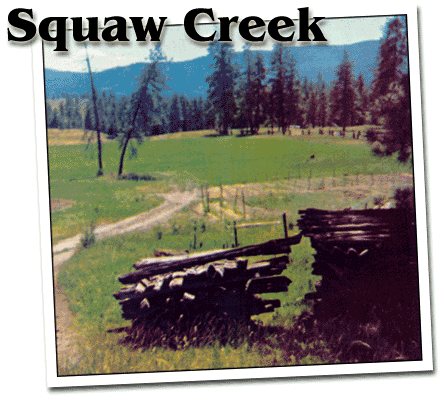
Squaw Creek: Summer Homesteading in Washington State
First, a couple of successes: You’ll
recall that we decided to consider our grainfields sown after our
improvised harvesting technique strewed the area with shattered kernels.
The broken heads just lay there all winter, while a good two feet of
snow fell and the temperature hit 20 below zero. Then the last of the
white blanket melted in three days of heavy winds (April 15 through 17).
The wheat began to sprout within a few weeks, and looked much
thicker — with no work at all — than the crop we had hand-sown the year
before. We disced the wheat under, in the middle of June, as a green
manure crop. Our present plans are to sow winter rye in the fall, along
with a mixture of grass and clovers, for future hay.
Another bit
of good news is that the alfalfa and clover we planted last spring — as
cover crops with the barley and oats — came on very strong this year . . .
perhaps thanks to cool, wet weather (in fact, I’m writing this on
August 12 and summer still hasn’t really come). We harvested
approximately 6 tons of hay off a bit less than 3 acres.
Otherwise,
this was a difficult year for gardens. Four nights of hard frost the
last week in June got most of the squash and beans. The pole beans and
soybeans, though shriveled right to the ground, did come back all by
themselves, but by that time it was too late for them to develop. No
other crops were affected . . . partly, I think, because I was a
confirmed dryland farmer right up until the dust started getting thick
in mid-July. At that point I set up my gravity-feed sprinkler and
watered on a regular cycle . . . but it’s possible that the lack of
water earlier in the season made my plants hardy enough to withstand
those 26-degree nights.
This year we planted a fifth of an acre in
main garden. I started out by covering the area with a heavy mulch.
Unfortunately, however, a portion of the mulching materials was leftover
wheat and barley which we hadn’t hand-threshed during the winter. Big
mistake. Believe me, those little seeds were just as viable as the ones
that had lain on the ground all winter and produced our green manure
crop . . . and they soon grew up to be a real pain in the fingers. We
wasted a lot of time pulling weeds and grassy grain, and the more we
yanked out by the roots, the more that grew to take their place. Then,
at the end of July, 5 inches of rain fell in one night. The
weeds — especially the pigweed, which had sprung from seeds in the cow
manure I’d dumped on the land — actually doubled their size in a few days
and kept on growing until the garden was almost lost. No mulch could be
seen under the jungle of wild plants.
In desperation I
took off every bit of covering, cultivated heavily, and pulled weeds
until you couldn’t see a thing except vegetables anywhere in the garden.
That cleanup, plus a little daily working of the soil, finally licked
the intruders. You won’t be surprised, though, to hear that I never
replaced the mulch and have little inclination to do so next year.
In
contrast, here’s the story on an alternate vegetable plot . . . a 50 foot by
25 foot area which was planted just as soon as the snow left the ground in
April. Since this garden was beyond the reach of the sprinklers, I
watered it by hand only once (in order to apply fish emulsion). Such
conditions provided a stiff test of the dust mulch method I’ve described
in the accompanying report, and I can only say that it worked
beautifully.
Something I tried on another, smaller area worked
even better: a dust mulch covered with a light sprinkling of straw. Our
land loses most of its moisture to a constant breeze, and the thin
covering formed a surface a few inches above the ground . . . just
enough to keep the wind from blowing directly across the soil and drying
it out. The plot did get parched, believe me, but I’d worked the earth
thoroughly and the roots of the crops went deep.
What about
results? Well, I swear that there are cabbage plants in that last plot
which haven’t been watered for six weeks, and they’re forming nice
heads. The dust is so thick right now that you can’t see your feet as
you walk along, yet the carrots are 8 to 10 inches long and the turnips
had the thickest, biggest, lushest, and darkest green, unserrated leaves
I’ve ever seen. They kept us in greens right up to the day when we
stored the roots for winter.
Part of the secret of the third
gardens success was certainly the very early planting, six weeks before
our area’s frost-free date. For a month I covered the little plants with
straw almost every night and uncovered them again in the morning of
every decently warm day . . . and it really paid off. All the same, I’m
sure that in a truly dry year a dust mulch in this area woe have dismal
results.
Another bit of progress: With the help of some wood ashes
applied about four weeks after planting, we avoided all major problems
with bugs and worms (even in the turnips). Now I just have to figure out
what to do about grasshoppers, moles, and deer.
Here’s one last
idea I tried this season, with fantastic re suits: I wanted to raise
garlic on our place, but couldn’t get any sets until February. That
meant spring planting for a crop that usually goes into the ground in
the fall . . . and given our short summers, I knew I had to get it out
there early.
OK. At the beginning of March I went into the meadow
(when no one was looking) and shoveled a sidewalk through 16 inches of
virgin snow until the black of the frozen earth showed. Then I snuck the
spade back into the tool shed and waited three days, which was how long
it took the sun to melt the thin layer of ice on my path and turn the
ground to mud.
I returned to the scene at that point and slung the
soft dirt very thinly over a 50 feet by 50 feet area, until the white snow was a
grimy black. After that 10-minute job I left again, this time for four
days, while the sun drove the black dirt straight down through the snow
and removed the icy substratum. I watched closely, and the day my patch
of earth turned to mud I mulched it with hay so that it wouldn’t
refreeze after dark. (Nighttime temperatures were still hitting 10 degrees Fahrenheit.)
Every
day after that I turned a little soil and then remulched it, and the
third week in March — with a foot of snow on the ground everywhere except
my little hole in the meadow — I planted 25 pounds of garlic . . . some
mulched, some not. Four weeks later, the uncovered bulbs were growing
faster because the sun warmed the soil every day. (I cheated, of course,
by piling hay on the area every night and removing it in the morning.)
The mulch on the other bed — which was left covered day and night — didn’t
let the earth freeze, but it didn’t let it heat up either.
Well,
it’s mid-August now and the garlic — a good lot of it — is 2 inches in
diameter. We’ve been eating it every day, and I figure to have somewhere
between 60 and 75 pounds to replant this fall.
If you’re
wondering why we need such a large crop, it’s because my wife and I are
involved in the use of herbs . . . both to cure and prevent disease and
as sources of vitamins and minerals (to be taken in combination with a
healthful diet). Of course, the best healers are sun, fresh air, and
clean water . . . but several plants have proved themselves sure-fire
remedies for us, and may be useful to others in emergencies.
Pliny
lists garlic as a cure for 61 disorders, and we’ve found it useful
against all forms of infection (both internal and external). The same
remedy works well when our horses begin to show signs of worms. We cut
up one garlic clove per pint of pre-boiled water, steep the tea for 20
minutes, strain it, and mix the liquid with steamed rolled oats. This is
then fed to the animals, which have been corralled overnight and which
are kept penned until they decide to eat the medicine.
We also
find that raw garlic eaten before or during a meal prevents the
formation of gas in stomach and bowels (the result of certain
combinations of food). Other favorites of ours are alfalfa and
comfrey — both of which we regard as wonder plants — and the peppermint that
we use as a general pickup and cure for headaches.
Most
herbs — which correct causes of illness, rather than symptoms — tend to work
much more slowly than the pills and drugs of modern science. An
exception is fleabane, a small, purple, daisy-like flower with a yellow
center. The plant — a member of the aster family — reaches an average height
of 1 to 2 feet, sometimes has multiple flower heads, and is generally
the last to bloom in these parts (along with goldenrod). The leaves are
lanceolate and connected directly to the main stalk. One cup of tea made
from this herb will slow a super-heavy menstrual period in just an hour
or two. For other, more severe forms of internal hemorrhage you might
drink a cup hourly on the way to the hospital. (A number of plants
are called “fleabane” and Ronald doesn’t know the botanical name of the
species that thrives in his area. Both Meyer’s The Herbalist and The Rodale Book of Herbs mention one of the fleabanes — Erigeron canadensis — as a powerful astringent. — MOTHER.
A
final note: My wife and I have been slowly adding to our horse herd,
and this year we were able to realize a longtime dream with the
acquisition of two pure-blooded Arabians, one of them in foal (Salsify,
born in July). These animals should have been very expensive — registered
stock of good bloodlines costs money — but we were given a special price. A
lot of people love us, it seems, and we’re certainly not going to
forget their kindnesses.
The next few years are going to teach us a
lot about breeding and training. Stud fees are costly now, but there’s
a stallion in our future. Eventually, we hope, we’ll be able to pass on
lots of information about these most beautiful of all horses . . . and
we’ve vowed that someday we’ll pass on a few horses here and there, too.
What goes around comes around. We know.
P.S. The following are the sources of information that have helped us most.
ON FARMING THE SOIL WITHOUT MURDERING IT:
Malabar Farm by Louis Bromfield, paperback edition, Ballantine, 1970, $1.25.
Farmers of Forty Centuries: Permanent Agriculture in China, Korea and Japan by F.H. King, reprint of 1911 edition, Rodale Press, Inc., 1973, $7.95.
ON WOODWORKING, OLD BUT STILL USEFUL TOOLS, AND BUILDING IDEAS:
Eric Sloane.
ON HERBS:
Take your pick of guides . . . almost all have some worthwhile material.
FOR GENERAL REFERENCE:
Public Works, a collection of government and military publications compiled and edited by Walter Szykitka, Links Books, 1974, $10.00.
The Encyclopedia of Organic Gardening by J.I. Rodale and Staff, Rodale Press, Inc., $12.95.
SPIRITUAL:
The Secret Life of Plants by Peter Tompkins and Christopher Bird, Harper & Row, 1973, $8.95.
Seven Arrows by Hyemeyohsts Storm, paperback, Ballantine, 1973, $4.95.






