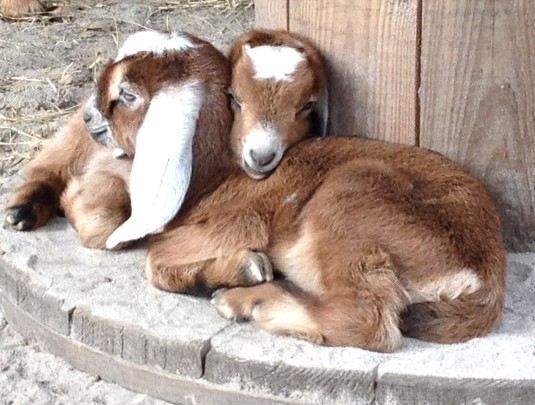
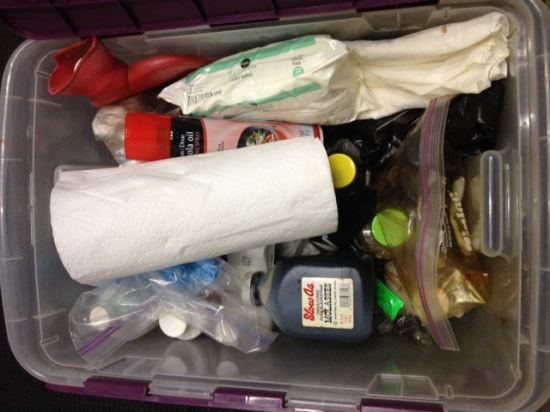
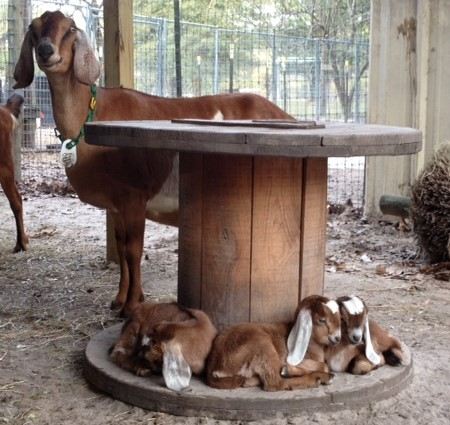
This is an exciting time, every year. We are waiting for our newest members of our goat family, the itty bitty goat babies. Our first dairy doe’s official due date was on December 31st, closely followed by five more. Every due date generally varies by five days plus or minus, so we ARE NOW in ready mode for the impending births. We have the kidding box stocked up and ready, ten kidding towels freshly washed and stacked on top of the kidding box, the scale and the bucket for hot water with molasses nearby, the mommy-pen cameras turned on, and the text group for: “BABIES!!!!!!” is set up in the phone to sound the “alarm” to the interns when the time comes. We have prepped and prepared for the last 150 days according to our “Mom’s-To-Be-Health Schedule” and now all we can do is wait. Each dairy doe typically weighs about 190 – 220 pounds around birth and on average gives birth to two five pound goat babies (kids).
The Signs
We check on the “Almost Moms” every time we walk by the birthing pen and look for the signs of an impending birth, which may, or may not, all or some, be present: the softening of the ligaments around the tail and relaxing of the muscles in the hind legs (the mushy feeling), the filling of the udder, the nesting behavior, and last but most important, the “goop”. Goop is our scientific term for the white mucus plug with string which, when present, usually signals a birth within two hours. But of course, a goat being a goat, all of these symptoms can be present and it will take another 48 hours, or none of these symptoms are present and in the time it takes to bring a tool from the barn to the house (15 minutes), two goat babies are on the ground.
The Birth
The average birth goes like this: it is cold and rainy out and night. We are fast asleep or we are having company for dinner. The mommy cam comes to life with a no-to-be-mistaken sound of a goat in labor. We check the camera and for sure: the goat is laying down, head outstretched and labor has started. We drop our forks or put on our clothes and race to the birthing pen while attempting to text the interns. One person runs to the goat, the second one grabs the birthing box, several towels and the bucket. We hover near the goat ready to assist if needed, but not disturbing, and as each new goat baby arrives, we help with cleaning, drying and presenting it to Mom. We make sure the kids are standing and nursing on their own within an hour to drink the so important colostrum, we dip the navels in iodine and we give the exhausted doe fresh hay and a bucket of hot water with molasses to restore much needed energy. Once we are certain that the doe (or dam) and the goat babies (or kids) are healthy, dry and clean with full tummies, we turn on the heat lamp, clean the pen, provide fresh, deep bedding, record the dam’s name, number of kids, sex, weight, date and time of birth and future tattoo number in at least three locations, and then go back to what we did when the birthing started, about 2 hours later.
The Preparation
The secret to happy and healthy birthing is no secret at all, just good organization, a well-stocked kidding box and of course, a bit of luck. We control breed, meaning we supervise every breeding with the buck. We record the date and fill in a spread sheet with the name of the doe, the name of the buck, date of breeding and most likely due date with the gestation calendar from www.goatbiology.com. We fill in the dates for 90 day & 60 day prior to birth selenium/Vitamin E supplementation (we are in a selenium deficient area) and start feeding organic kelp free choice with the mineral supplement. We set the date for the “30 day prior to birth” worming, multi-min shot, and CDT vaccination. We note the dates when to dry the doe off, if milking, no later than 60 days prior to birthing, and the date to move the doe to the birthing paddock and pen (about a week prior to the due date). We note the dates when to adjust and increase grain and hay. We check off each task on each date for each doe. The spreadsheet then also includes a space for the actual birthing date and time, number of kids etc., dates for disbudding, first and subsequent vaccinations, wormings, and coccidia prevention treatments. As for the contents of the kidding box: towels, molasses, Vitamin E tablets with a little poker, iodine and a little cup, syringes, a short sling for pulling babies out (never used), denatured alcohol (for disinfecting), latex gloves, Vaseline, hemorrhoid cream (in case of a tear), garbage bags (for the afterbirth), birthing gel (if we have to go in), a fresh roll of paper towels, wet wipes, baby wipes, a hot water bottle and a heating pad that can be microwaved. In addition, we have sterile saline solution in the fridge along with 50 cc disposable syringes and an antibiotic from our vet in case of an emergency if we have to go in and pull out or rearrange one or more babies and need to flush out the dam’s uterus afterwards. We also have an antibiotic from our vet handy for subcutaneous injection for five days to prevent an infection from setting in.
Sharing
If you would like a template of the spreadsheet, just go to our Facebook page Serenity Acres Farm and Goat Dairy, and post a message or request with your e-mail. If possible, I’ll also post a downloadable PDF on our website www.SerenityFarmFl.com.
We are happy to report that Jilly gave birth on New Year’s Eve to three – three kids, two doelings named Juno and Juliette at 5 pounds each and one buckling, Jamie, at 6 pounds. And again, we are waiting…
Happy Kidding and Happy New Year.