

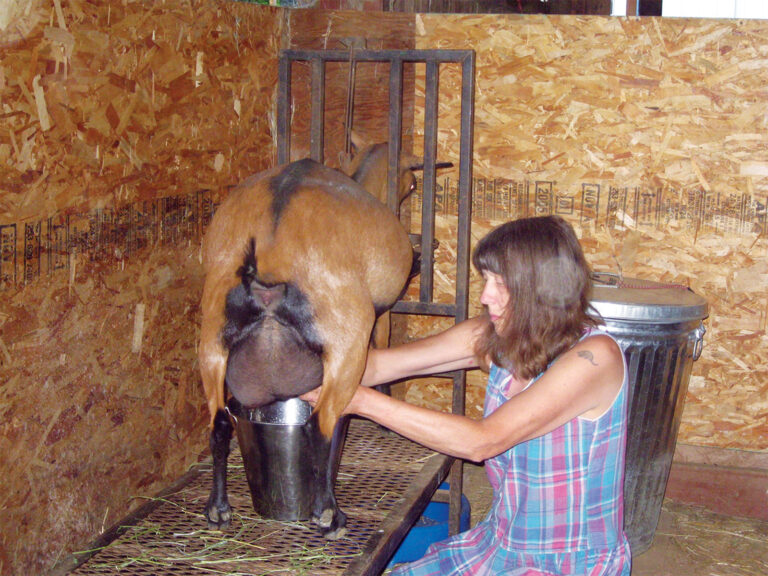
How do you milk a goat? Follow an established milking routine with a consistent hand-milking method, and use essential equipment to ensure a clean, safe milk product.
Safe milking practices require not only a willing goat, but also the right equipment.
- Milk stand and stool. A milk stand serves several purposes: getting the goat off the ground, restraining her by the neck, and holding a feeding bowl to keep her occupied. Some milk stands have attached stools.
Bucket. A stainless-steel bucket is ideal because it resists bacterial growth, is easy to sanitize, and can tolerate temperature extremes. - Strainer and filters. Milk must be strained to remove any hair, dirt, or other impurities. A stainless-steel strainer is best for the same reasons as a bucket. Filters can be purchased at a farm store or online.
- Storage containers. I used half-gallon canning jars to store milk in the refrigerator. Alternatively, you can purchase a milk tote with a lid. Strain your milk directly into your storage container of choice after milking each goat.
- Rags and paper towels. These are needed for cleaning and drying udders and hands. I use rags for washing and installed a paper-towel holder in the milk room for drying.
- Teat dip. Dip the teats after milking to prevent mastitis. The teat orifice can stay open for up to an hour after milking, allowing bacteria to enter. You can purchase a commercial teat dip or make your own. Never use the same dip twice; use fresh dip for each doe.
Steps for Milking
- Secure the goat on the milk stand with a bowl of grain or some alfalfa.
- Cleanliness is essential when milking a goat. Always wash your hands before starting and, ideally, between each goat.
- Wash the udder well with warm water and a cleaning solution, such as mild dish soap, chlorhexidine, or 1 percent iodine, using a fresh cloth for each goat. Don’t put the used cloth back into the water.
- Thoroughly dry the udder with a new paper towel or a clean, dry rag after washing.
- Milk the first couple of squeezes into a teat cup to check for abnormalities.
- Place your clean bucket under the goat and begin milking by wrapping your thumb and one or more fingers around the teat to trap the milk, and squeeze it out. Never pull on the teat. When it seems empty, massage the udder back and bottom and bump it gently with your fist in front near the teats to let down any milk that remains.
- Immediately strain milk from the bucket into your storage container.
- Dip teats in solution and let the goat off the stand.
- Put the strained milk into the freezer or on ice for an hour to chill. If you put the milk in the freezer, don’t forget to take it out before it freezes. I had a refrigerator in my milk room, so I immediately put the jars of milk in that. Each day after milking, I added the jars from that day and then transferred the jars from the previous day into my home refrigerator.
- Clean your milk stand after the last goat is milked. Wash and sanitize equipment.
Additional Goat Milking Tips
- Clip the udder to help eliminate any hair that might get into the milk.
- Be consistent in method; for instance, milking from the back or a specific side. Goats are more cooperative with routine.
- After milking, give hay or alfalfa and water to keep her from lying down immediately after rejoining the herd. This makes it less likely that bacteria can get in the udder.
- If you want to track your goats’ milk production, weigh it before straining and record the amount in a notebook each time you milk.
- Besides daily monitoring for mastitis, test annually for caprine arthritis encephalitis virus (CAEV), Johne’s disease, and caseous lymphadenitis (CL).
Originally published in the June/July 2026 issue of MOTHER EARTH NEWS and regularly vetted for accuracy.





