(Editor’s note: We reprint this article with permission from Grist.org. Increasing evidence shows that genetically modified crops, manipulated to resist herbicides or to kill insect pests, create their own problems. Roundup Ready corn and soy, created to resist application of the herbicide Roundup, are evidencing stands of invulnerable weeds that the broad-spectrum herbicide no longer kills. And as reporter Tom Laskawy reports here, the bacillus Thurengiensis in GM corn apparently may no longer controls corn rootworm. If this genetically modified corn no longer controls the pest, the problem could have huge ramifications — not only are crops at risk, but farmers may not be able to buy enough non-GM corn to plant instead, since Monsanto et al. have locked up genetically modified seed lines. — MOTHER)
Last winter, I wrote, in Grist, about evidence that one of Monsanto’s flagship GMO product lines — seeds engineered to produce the pesticide Bt — was succumbing to corn rootworms, the exact insects it was designed to kill. The evidence was somewhat thin — the Environmental Protection Agency (EPA) received reports from several states that indicated a problem — and certainly not decisive enough to prevent Monsanto from issuing an outright denial.
But now comes a report from Minnesota Public Radio (MPR) on the damage rootworms are doing to the current corn crop and the real concern farmers have that Monsanto’s seeds are no longer helping them control pests. The EPA is treating these latest reports seriously; according to the article, EPA officials visited some “problem fields” to observe possible evidence of resistance while awaiting results from Monsanto’s own scientists.
One pest expert MPR interviewed, Bruce Potter of the University of Minnesota, spoke more directly about the threat posed by rootworms, which appeared to have been held at bay by GMO corn until now. “We’re not going to make this go away … We’re stuck with managing this problem,” he told MPR. The report continues:
Potter has seen what he calls a “ridiculous” increase in rootworms apparently unfazed by the usually deadly protein [in GMO Bt seeds] in southern and western Minnesota this summer.
Potter also spoke at a workshop held on a farm experiencing rootworm resistance, where he said that Monsanto Bt seeds are “basically backfiring.”
“Instead of making things easier, we’ve just made corn rootworm management harder and a heck of a lot more expensive,” Potter said.
Of course, this is the summer of 2012, so a story about farmers in the Midwest wouldn’t be complete without a reference to the drought. And guess what? Droughts enhance and amplify the damage corn rootworms exact on crops:
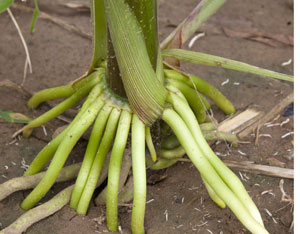
In fields with a rootworm problem, the bug damages the cornstalk’s ability to absorb water just when it’s needed most. With the roots weakened, the plant can also be more vulnerable to wind.
Charlie Sandager, who hosted the workshop on his farm near the town of Hills in southwest Minnesota, said he learned last summer just how seriously rootworms can damage corn’s ability to stand.
“Strong wind came up and it just tipped the corn plants over like a big old tree,” Sandager said.
The sad irony is that farmers don’t need to transform themselves into organic farmers to keep their crops from being worm food — though that may be the best approach for developing more drought-tolerant fields. Historically, farmers managed corn rootworms through traditional crop rotations. These rootworms eat corn exclusively, so by alternating a corn crop with soy or another alternative, farmers would deprive the insects of food and the rootworm larvae would die off. This, by the way, is an age-old technique (originally part of the Native American Three Sisters agricultural tradition) that generates profits only for the farmer — not for seed companies.
Indeed, this abandonment of crop rotation was the other “innovation” of Monsanto’s Bt corn — aside from releasing its own pesticide, that is. Farmers could now grow corn season after season in the same field. At the time, it seemed like an amazing development to farmers across the country — and remains so to starry-eyed, tech-loving politicians and industry representatives.
For years sustainable agriculture advocates from Wes Jackson to Michael Pollan have decried farmers’ move to this corn monoculture, but not just for philosophical reasons. The danger of biotechnology and chemical-based agriculture as practiced today is the false sense of security it offers farmers. When you adopt Monsanto’s seeds and chemicals and “simplify” your farming, it seems like you’ve solved all your problems.
But what you’ve actually done is increased what finance-types call “tail risk,” which means in essence that all your assumptions about the chances something bad will happen to you turn out to be wrong. And probability being what it is, you can go a long time without disaster striking and then, when it does, you find yourself totally screwed.
Even so, it’s only taken about 15 years for GMO seeds to come onto the market, take it over, and then contribute to a crop failure such as this one. Of course, the rise of superbugs and superweeds came as no surprise to many scientists — molecular biologist Margaret Mellon of the Union of Concerned Scientists was warning about the possibility of Bt-resistant bugs as early as 2001; so don’t be fooled when Monsanto executives pull a Macaulay Culkin.
It’s tragic that it has taken a devastating drought to give farmers the full understanding of the risk of an over-reliance on a single crop and a single product line from a single company. The question is: What will they do in the face of this new reality? Will it be what one farmer in the MPR report felt forced to do this year — blow significant amounts of money on other, more toxic pesticides? Or will farmers consider returning to classic rotations or even organic methods? Growing less corn, perhaps, but providing profits to no one but themselves.
Tom Laskawy is a founder and executive director of the Food & Environment Reporting Network and a contributing writer at Grist covering food and agricultural policy. His writing has also appeared in The American Prospect, Slate, The New York Times, and The New Republic. Follow him on Twitter.