

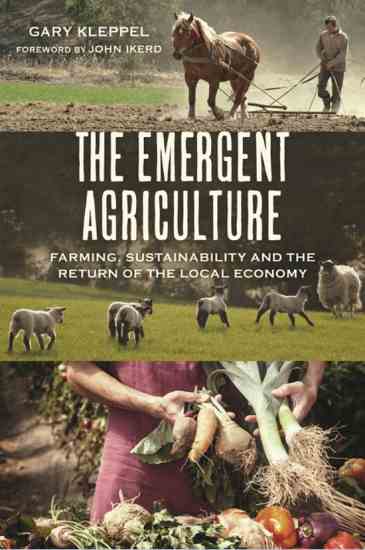
Farmer-ecologist Gary Kleppel argues that industrial food production is incompatible with the realities of nature, science and ethics in The Emergent Agriculture (New Society Publishers, 2014). Through a collection of lyrical essays Kleppel makes the case for a locally based food system. The following excerpt discusses how CSA programs can help enliven local economies and reduce some of the risks to farmers’ profit margins.
You can purchase this book from the MOTHER EARTH NEWS store: The Emergent Agriculture.
On September 20, 2011, just after noon, I was sitting in a third floor conference room in the Russell Senate Office Building in Washington, DC, as a member of New York State’s Agriculture Working Group. Richard Ball was explaining how row crop farmers make a living. “Every spring,” he began, “You take a loan and you buy your seeds and your fertilizer. You plant and tend and harvest your crop. You sell your harvest, pay off your loan, pay your help and your mortgage, and maybe put a little in the bank. That’s how agriculture works.” He continued, “When a natural disaster takes out your crop three days before the harvest, you have nothing left. You can’t pay your loan. You can’t pay your help, or your mortgage, or anything. You’re finished.” This was about three weeks after Hurricane Irene ravaged the agricultural landscapes of the Hudson, Mohawk, and Schoharie Valleys of New York State.
The members of the Agriculture Working Group had been listening to USDA representatives describe the various loan programs available to farmers to help them pick up the pieces. To my left sat a large, ruddy-faced fellow — an onion farmer from the “black dirt” region of the lower Hudson River Valley — with a stoic expression that concealed deep pain. “How the hell am I supposed to take another loan?” He whispered. “I already owe two hundred thousand. What…I’m supposed to ask my wife to go to the bank and borrow another hundred grand? Can’t do it.” I realized that he probably would not be back for next year’s working group meeting.
Enter Thomas Christenfeld. With his wife Liz, Thomas owns The Alleged Farm in Valley Falls, New York, in rural Washington County. Thomas grows excellent vegetables that he sells through a CSA — Community Supported Agriculture — program. Every April, each of the 350 or so members or member-families of The Alleged Farm’s CSA writes a check to Thomas for about 500 dollars. Thomas uses that money to buy his seeds, pay his help and the mortgage, and put a little in the bank (if the tractor doesn’t break down). Every week, from June through late October or early November, each “shareholder” gets a box of vegetables. Usually, the boxes start out pretty light — some greens and lettuces. By late June, however, the boxes are burgeoning with all manner of colorful, textural produce. And along with the produce comes Thomas’ weekly newsletter. Thomas was trained as a writer (with degrees from Harvard and Stanford) so the newsletters are well crafted and usually full of humor (Thomas’ writing style reminds me of Mark Twain). Embedded within the prose are subtle messages about the importance of family and farming, about how the unpredictability of the weather drives farmers crazy, and about the inevitability of weeds. There is always a description of the vegetables in the week’s share and some recipes (usually involving olive oil, garlic, and a skillet). All-in-all, shareholders come away with well over 500 dollars’ worth of vegetables, and some pretty inspiring reading.
A few years ago Thomas hurt his back. He had real trouble working and ultimately he needed surgery. The boxes of vegetables were light that season but, in the end, Thomas paid his bills. The following season the boxes were once again full. The Alleged Farm had come through the crisis — not without pain, but with farm and family intact. Thomas’ shareholders had shared more than vegetables that year. They had come to appreciate what the “community supported” part of CSA means. That is part of the reason why the Alleged Farm made it through. Thomas’ injury might have been devastating had The Alleged Farm functioned on the conventional model. As a CSA, however, the impact of the disaster was spread among the shareholders and, in the end, the Christenfelds and all of the families for whom they grow food still had a farm from which that food would continue to come. The CSA is a hallmark of the new approach to farming that recognizes, first and foremost, the importance of managing, and where possible, eliminating debt. Secondarily, the paradigm shift in agriculture is characterized by a focus on direct, retail markets. Wholesale and commodities are certainly components of many operations, particularly mid-sized and large operations, but direct marketing is a cornerstone of the emergent system. The CSA model addresses both elements — debt reduction and direct marketing.
Thomas Christenfeld’s outcome is far from typical. Often the farm does not recover from a medical crisis or an environmental disaster. If income depends on an unpredictable commodity system or a vertically stratified payment system controlled by large, distant corporations, the potential for bankruptcy increases dramatically. As the spatial or economic distance between producer and consumer increases, the viability of the operation becomes less certain and the control of outcomes by the farmer decreases.
The survival of small to medium-sized family farms depends on the ability of farm-families to escape, or at least to conduct an organized retreat, from markets that are fundamentally unstable. This was apparent to the earliest practitioners of the now burgeoning community of farmers who practice some form of direct marketing. It is grounded in the premise that factors which increase the risk of failure must be abated. As obvious and logical as this premise seems, it has been difficult to achieve and has sometimes been ignored, with predictable consequences. Risk management is a strategic pillar of the emergent market.
Profitability is key to sustainability. Without profitability, farming is either a hobby or a path to bankruptcy. When the price paid for a product is less than the cost of its production, the producer is on the road to bankruptcy. As ludicrous as this sounds, under-payment is part of the fabric of commodity-based agriculture. For instance, in 2005, the cost of producing a bushel of corn in Iowa was approximately $2.50. The price paid to the farmer at the grain elevator was $1.45. Federal subsidies based on the commodity price of corn are “theoretically” used to make up the difference. However, corn subsidies, and with them the farmer’s profit margin, have declined in recent years. The problem is that if the farmer doesn’t like the price being offered at the grain elevator, he can’t go to another elevator. Prices are pretty much fixed by the few multinational corporations that own the elevators. This is called a bottleneck. A similar bottleneck exists in the beef industry. Four corporations process 81 percent of the beef in the United States. They own the feedlots and the five or so large packing plants that process most of our beef. They buy the rancher’s stock prior to delivery of the cattle to the feedlot. Between 1982 and 2002, the price of beef paid to ranchers fell from $0.63 a pound to $0.46 a pound. That price often did not cover the cost of production. Not coincidentally, the suicide rate among cattle ranchers is three time the national average.
I have a friend who produces milk. I met him a few years ago, after delivering a lecture on the paradox of agriculture. He told me that he was 30 years old, has a wife and three kids, and an Ivy League education. He milks 500 Holsteins twice a day and is $7 million in debt. “The bank won’t even let me sell my land. They just keep giving me money.” “How much are you getting for your milk?” I asked. “Fourteen dollars per hundred-weight,” he responded. That was the commodity price. “How much does it cost you to produce?” “Sixteen dollars per hundred-weight.” It didn’t require an Ivy League education to see that my friend is going broke. At about this same time, a gallon of milk in the supermarket was going for about $3. The industry has determined that a standard gallon of whole milk weighs 8.6 pounds. Using this weight, at the supermarket a hundred-weight of whole milk would go for $34.90, two and a half times what my friend was getting, and about 218 percent of what it costs him to produce. Stating it another way, my friend was getting about $1.20 per gallon, 40 percent of the supermarket price. Why is there such a sharp difference between the price at the barn and that at the retail market? Well, there are a lot of hands on that milk. There is the company that trucks the milk to the pasteurization facility, and the wholesaler who buys the milk and sells it to the retailer — who then sells it to the public. In the end, just three companies — Dean Foods, Kraft, and Leprino Foods — control about 70 percent of that process. They don’t own the farms. Instead, working together with large cooperatives, they determine what the farmer gets for their milk and what the public pays on the other end. The National Family Farmers Coalition has reported on the manipulation of milk pricing by collaboration between large dairy cooperatives and distributers such as Dean Foods.
Why doesn’t my friend simply sell his milk directly to the public? He can’t. The law says that to sell milk off the farm it must be pasteurized. To do that would require a large investment in equipment, facilities, and labor — far more than a man $7 million in debt can afford. My friend is caught in the pasteurization bottleneck that helps a few companies to maintain their control over milk in America. Congress has tried to help farmers caught in this bottleneck by increasing the subsidies for dairy farmers being paid less for their milk than the cost of production. But is that really a help? Or is it just life-support — a way to temporarily sustain an unsustainable system?
The commodity food chain is too long. There is the farmer, the wholesaler, the retailer, and ultimately — calling the shots — is a board of directors. My friend is a superb craftsman. I could not get 500 Holsteins milked twice a day if my life depended on it. But in the end, nobody knows what he does. Nobody appreciates the craftsmanship involved in being a dairy-man. He is part of a black box, comprised at one end by our iconic images of farming — of black and white cows grazing happily on a hillside — and at the other end by a clean crisp carton or plastic jug of milk in our grocer’s cooler. Nobody knows his name or the name of his farm or even how much of the milk in that carton is his. Really, nobody cares. His milk meets certain government standards for bacterial count, butterfat content, and so forth, just like the milk from a hundred other dairies that is picked up and transported to the pasteurization plant and then distributed to supermarkets, anywhere.
The Rise of Farmers Markets and CSAs
I bake bread for a farmers’ market. I can produce about 130 loaves of bread in about 24 hours. I sell those loaves for about $6 each. I generally sell all of my bread in less than three hours. It costs me about two dollars for the ingredients in most of the breads that I bake. Other than the costs of running my ovens and transportation, I’m clearing $4 (200 percent) per loaf. What are my customers paying for? Well…they’re paying for me. It’s not just my time. They are paying for my skill as a baker — as an artisan. The ability to make a sourdough starter, mix the pre-ferments, manage the three ovens simultaneously, and oversee the development of as many as twenty doughs at a time is a craft. My customers understand this. They appreciate not only the time I spend baking for them, but also the time I spend explaining the process of making bread to them at the market. Many know my name. After my farmers’ marketing season ends, several come to the farm on weekends, some driving more than 30 miles, to buy a couple of six dollar breads. Some of my customers have become our friends. One, a professional editor, actually edited this book for me…gratis! People get it! They want farmers to succeed, for farms to be profitable.
To state the obvious, profitability is achieved only if the farmer produces a product for less than the market is willing to pay for it. Profitability improves by reducing the number of steps between farmer and consumer, and the cost of each step. That means direct marketing, particularly for small-scale and many mid-sized operations. Direct marketing through farmers’ markets and CSAs is the fastest growing sector in agriculture according to the USDA. Creating a market at the farm is even more efficient, if the location is right. Farm stands and retail stores on site obviate transportation costs. And for the mid-sized farm, too small to compete in commodities and too large to sell only at farmers’ markets, diversification — from wholesale, to retail, to catering — is critical to profitability. Jim Abbruzzese loves producing apples at his beautiful Altamont Orchards. But he would have gone broke long ago if he and his brother Joe hadn’t put a golf course right through the orchard, and built a restaurant, and set up a small farm store and a nursery and, recently, a catering business. The Abbruzzeses are a commentary on both the business savvy of the American farmer and their love for the land.
The downside of direct marketing is that the producer has to take the time to sell his or her products. Some farmers have no problem with this. But others prefer being farmers to sales reps. Many just don’t have the time. Farming is a “team sport” and family members, interns, and field hands — just about everyone but the dog — have to participate in marketing the farm’s products. My experience at farmers’ markets is that the salesperson matters. Whoever is doing the selling must know the product and the process used to produce it, because market patrons care about these things. And, of course, the seller must enjoy selling. The energy the seller brings to the market correlates directly with sales. The tent at the farmers’ market is a retail environment; its appearance counts and direct marketing requires commitment to… well, marketing.
The market can be challenging and the proliferation of farmers’ markets around the nation requires that farmers make some fairly sophisticated decisions about what, where, and how to sell. On what day of the week and at what time is the market? How many other vendors are selling the same product? Do the vendors get along? What is the cost of space? Are there unusual insurance requirements? Is it a seasonal or year round market? Can I do more than one market per week? Who monitors quality? Are crafts people and fast food vendors involved? And, of course, how much traffic is there at the market location and how much parking is available? For years I participated in a market in a beautiful small village a few miles from my farm. The market was readily visible from the road and had excellent access for foot traffic, but signage announcing the market was scarce, as was parking. Vendors did not do particularly well.
Every week, Jody and Luisa Somers, owners of Dancing Ewe Farm in Granville on the New York-Vermont border, transport their sheep and cow’s milk cheeses (created from ancient Tuscan recipes) to New York City’s iconic Green Market at Union Square in lower Manhattan. Along the way, they drop off cheese at some of the city’s best restaurants. On Saturday, Dancing Ewe is at the markets in Saratoga Springs and Troy, and on Sunday they are in Rhinebeck in the Hudson Valley — a lot of driving, but the return justifies the cost. As you pass the Dancing Ewe tent in Saratoga Springs, Luisa gives you a glance and whispers in her wonderful accent, “Would you like to try some cheese?” A sliver of caciotta passes into your fingers, then to your mouth. And you’re hooked. You will not walk away from the Dancing Ewe tent without at least a quarter pound of that incredible cheese. Everything about Dancing Ewe speaks to the marriage of superb craftsmanship with skillful marketing. Jody and Luisa understand that you need both. A great product without a way to reach the market will get the family a lot of good food and the farm a path to bankruptcy. A great marketing strategy without the quality to back it up will get you exactly one day of good sales. Jody and Luisa understand that sustainable farming practices must sustain both the land and the farm family.
Coincident with the growth of farmers’ markets has been an explosive increase in the popularity of community supported agriculture. In the past 30 years the number of CSAs in the United States has increased from two to more than 8,600. More than any other marketing approach, CSA reduces the financial risk of farming. From its roots in Rudolf Steiner’s anthroposophy school of philosophy in early 20th century Europe, the community concept emerged in the 1960s as the marketing strategy for the organic and biodynamic farming movements — as an alternative to the already suspect industrial food system. The first CSAs opened in North America in the 1980s; they have spread prolifically since. CSAs, such as the one operated by Jean-Paul Courtens and Jodi Bolluyt at Roxbury Farm in Kinderhook, NY for the past 30 years, have built large and loyal followings. Roxbury Farm has more than 1,000 shareholders. And farmers like Jean-Paul have trained dozens of young farmers in organic technique and in the use of the CSA model to increase financial stability. Today, 60 percent of Wisconsin’s family farms that sell through the CSA system obtain their entire family income from the farm. That is a striking indication of success. A new breed of farmers is experimenting with and pushing the limits of the CSA model, testing new approaches to distribution, increasing the variety and quantities of food available to shareholders, and stretching the season to as much as 12 months. I discuss the exciting and constantly evolving CSA model later in the book.
Farming & Marketing
While marketing is ultimately the farmer’s job, the yoke is not solely the farmer’s to shoulder. State and federal agencies have been impressed by the successes of direct marketing in agriculture and are now committing resources to programs that foster small-farm viability. And the market as well must be willing and accessible — the consumer must be interested in the product and the farmer must be able to reach out to the consumer at a cost that permits profitability. Consumers must recognize their responsibility to reward craftsmanship and hard work with patronage, and be willing to pay a fair price for their food. The examples above suggest that they are. That’s what makes this time so interesting. All of the pieces are in place. Consumers are actively seeking out farmers’ markets, CSAs, and other opportunities — to buy directly from the producer, to know the life cycle of their food, and to be assured that the food they are buying is safe. Supermarkets have taken to listing the names, and even displaying pictures, of the farmers that produce their vegetables. High-end catalog companies, such as Williams Sonoma, will sell you lamb, cheese, and even bread from farmers and artisan producers whose names and pictures appear in their catalogues. An emergence is underway in agriculture, not just in the way farmers produce food, but in the way people think about their food.
The books, films, media reports, and undercover videos documenting the inhumane treatment of livestock, the filth, the dysfunction, and the general insecurity of the American food supply are all beginning to have an effect. The assumptions that all food is the same, that the only thing that matters is price, that we can avert our eyes as animals are treated in ways they should never be treated, that we can trust the industry and government to ensure food safety, no longer hold water. The public is waking up. People are disgusted with what they’re seeing and they’re looking for alternatives.
Of course, the industry isn’t oblivious to what’s going on and there’s a noticeable increase in the corporate cultivation of “fuzzy feelings” about farming, with heartwarming pictures of fathers and sons and family dogs on the backs of orange juice containers, and pictures in the coupon section of the Sunday paper of farm families gathered ’round the table…all very touching. But as they say in Kentucky — “that dog don’t hunt!” You can’t patent the genomes of the American food supply and call yourself sustainable. You can’t put a hundred and twenty-five thousand chickens in a house and call yourself humane. You can’t pay a farmer less for his milk or his grain or his cattle than it costs him to produce it and call yourself ethical.
Americans are fed up with the food system. They are fed up with being part of artificial commodities markets — with a system where eating a hamburger may be suicidal. People are seeking new markets and they are finding them right in their communities. These are markets where, for a reasonable price, consumers can buy food that tastes the way it is supposed to taste. These are markets where the person who hands you a loaf of bread actually baked it, where the person who hands you a bag of carrots has dirty knees because he picked those carrots at five o’clock that morning. These are markets where the person who hands you a package of ground beef is going to feed that same beef to her family that very night. While I don’t believe in fate, I do believe in inevitability. I also believe that all living things instinctively follow paths that they perceive will lead to greater viability. When one discovers that the path one is on, a path thought to be sustainable, is in fact separating them from their life support system, it is inevitable that they will seek a new path. That is what is happening in the American food system. The emerging market is a new path. It offers hope for the future of farming. It is inevitable that, shown the path, we will take it.
Reprinted with permission from The Emergent Agriculture: Farming, Sustainability and the Return of the Local Economyby Gary Kleppel and published by New Society Publishers, 2014.






