

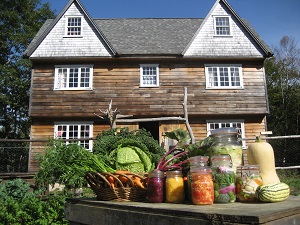
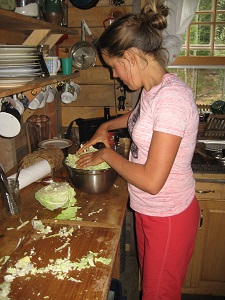
It’s like a slow-coming tsunami that’s now crashing in over my kitchen, as if the Earth trembled under the garden and lifted beans, cucumbers, cabbages and squash to flood the counters. Between now and say, late October, hundreds of empty jars will be brought out from storage and filled with pickles, sauerkraut, apple sauce and salsa, and tucked away for winter. From then on we’ll bring those jars from our root cellar back up onto the counters and feast on the stored garden bounty long into next summer.
It’s a task, to bring the harvest from our gardens in and put it up in ways that will preserve it. Pretty much every day for the next couple of months I’ll spend part of the day filling our cellar back up, one way or another, whether it’s chopping cabbage for kraut, picking apples, sorting storing pears, drying herbs, packing carrots or canning tomatoes. I know what it takes, but I also know what I get. Last year Dennis and I went through several months in the depth of winter and spent less than $50 on food. Still, we had unlimited access to better, fresher and more food than ever before in our lives.
Questions About a Self-Sufficient Lifestyle
One of the most frequent questions we get on this self-sufficient lifestyle is if it’s not a lot of work. Often it comes as a comment “This must be so much work.” Many have admitted to me that they once canned and stored put food away for the winter but found it to be too much work, so they stopped and now rely on stores for their grocery needs.
When I first came to Maine, Dennis and I also depended on the store for our food and the lumber yard for most of our building materials. Throughout the summer and fall we ate from our garden but the rest of the year we stopped at the grocery store about once a week and usually bought one head of cabbage, one bag of carrots, a rutabega, potatoes and a weekly splurge, like celery or a squash. The rest of our diet was rice, beans and oats that we bought in bulk through a buying club. On Sundays we usually went to visit Dennis’ family and treated ourselves with a to-go coffee from the gas station.
This was our way, a strategy, to get to where we are now. By turning every dime we could afford not to have a paying job and instead stay at home and work to achieve the Hostel and our viable homestead. By also staying away from debt and instead having the patience and prevalence to go through years of scraping by, we eventually we came ahead, and now we still can work at home and have all the rewards that money could, or couldn’t buy.
Big Rewards
And me, I no longer talk about how much work it is – I’d like to talk about the rewards, that far outweighs the labor. Faced with the task of harvesting food, milling lumber, cutting firewood or any other chore we do, we do it with our gaze set on the outcome. For each passing year we’re working out systems that allow tasks to be executed with as little work as possible, for example how to process food in a time efficient manner, prevent weeds before they start to grow, how to plant the garden in the spring and put it to bed in the fall. That too is a thresh hold we’ve climbed, Dennis and I. With patience and prevalence we’ve overcome some of the homesteading hurdles and can now take on the year to year tasks knowing that we can get it done in a quick and satisfying way.
As homesteaders, all the rewards are directly ours to keep and compared with the time and labor invested the return is very high, and for every year, increasing. Our work provides most of our necessities but the multiple returns we get from our homestead also give us what money couldn’t buy, such as the self reliance, sense of security, dignity, the beautiful place where we spend our days and the choice to set our own schedule. Since we have no debt, we can navigate outside a system where, due to how general finances, mortgages, credits and corporations function, most people will never break even or come ahead.
To talk about the rewards when others talk about the workload is also a way for me to say that living of the land, doing physical work, growing food and pursuing a path of simplicity is possible and positive. It’s a way to look beyond the hurdles and the issues and to see the beauty of the garden, the gratitude from our Hostel guests, the year round abundance of food and the viable and righteous lifestyle it offers.






