

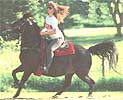
Andrea Looney, DVM, offers her farm animal health experience in caring for cows, calves, horses and sheep. This issue includes questions on exercise for horses, padding shod horses and proper feed for cows.
What warm-up procedure do you recommend for a 6-year old Morgan mare? We ride or drive her almost daily and with so much concern
over exercise intolerance, we are willing to do what it takes to help her exercise property. Is there any set protocol for a horse this age, working about a half hour daily?
–Owen Grant
Knoxville, TN
Horses are naturally designed for quick bursts of energy to
flee predators or escape fear. This fight-or-flight
response in the wild need usually be sustained for only a
few moments. However, today’s horses are asked to perform
for many hours at maximal energy requirements. Just like
their human Olympic counterparts, an equine athlete needs
to limber up and cool down properly. Here’s some hints for
an exercise for horses routine that really needs to be tailored to your horse’s
daily workload, feed intake, life stage, conformation, and
other health problems. Warm-ups should be no more than
10-15 minutes long and will improve the efficiency of the
muscles working at the same time it reduces risk of injury
to ligaments, tendons, and joints. The cardiorespiratory
system also profits by increasing its oxygen uptake and
efficient use.
To maximize heavy upper muscle elasticity,
try manual stretching. During the forelimb stretch, stand
to the front and side of the animal and pick up the front
leg by grasping it above the knee, and gently pull it
forward. Pull the leg gently to the outside and across in
front of the other forelimb. Pull the leg to the outside
and then finally backward towards the hindlimbs. During the
stretch of the hindlegs, grasp the leg just below the hock
while standing next to the front shoulder of the animal,
and pull forward slowly. The hindlimb may also be gently
tugged out to the side and then directly backwards. These
stretches should be held for 10-15 seconds in each
direction. If the animal becomes uncomfortable, they should
be stopped and attempted at a later date. These maneuvers
are extremely helpful in adding flexibility and suppleness
to the muscles of the shoulder, elbow, hip, and epaxial
(back) muscles.
Making the animal reach down to the ground,
high up in the air, or around to the side of its body for a
favorite treat are what’s known as “carrot stretches.”
These stretches are extremely useful for dressage animals
and those doing tight circling maneuvers and will improve
flexibility and tone in the neck and shoulder muscles.
In
addition to all of the above stretches, walking can be done
under saddle, in hand, or on a long line. Start slowly and
increase gradually to a brisk pace. Easy trotting further
improves oxygen uptake and cardiac output. These two
exercises should be performed in the beginning of each
workout before any further strenuous work. Trotting’s
symmetrical pace also makes it easy to pinpoint lameness
before more difficult exercise worsens them beyond repair.
Both these gaits are used in warm up to facilitate
stretching of the distal limb muscles, tendons, and
ligaments. Sidestepping and tight serpentine workouts at
the walk are advocated by many horse folk as a method of
not only “collecting” the animal but making sure back and
neck muscles are ready for a further workout.
Our 4-year old Appaloosa mare had pads placed on her front feet last year for a sole bruise on one foot. What do you think about padding shod horses? Should we continue to have her shoes padded?
–Maura Thompson
Odessa, TX
Massaging major muscle groups,
specifically back and hip muscles, will improve range of
motion and increase circulation to major body organs, such
as the spleen and kidney, as well as increase circulation
in the muscle bellies themselves. With firm pressure, use
the heel of the hand to create a circular massaging motion
over each muscle group. The horse will relax and lean into
the pressure after a few go-rounds. Likewise, using a thick
curry comb, followed by a brisk brushing, will also
stimulate skin and superficial epidermal/dermal blood flow
while removing sweat and dirt.
Whatever the warm-up, be
sure to go slowly when conditioning the horse to any new
exercise. Also, be sure to switch patterns of exercise
frequently after a proper warm-up to avoid performance
“burnout.” Pads are often added to shoes if more than just
applying a standard shoe to cover the bearing surface of
the hoof wall is necessary, or for healing short-term
problems such as sole abscesses, puncture wounds, bruises,
corns, or severe inflammation of the third phalanx or
navicular bone. These problems can cause a great deal of
lay-up time and consequently, it may be advantageous to pad
the shoe, encasing the entire bottom of the foot in a
“protective” coating.
I use the term “protective” loosely
however, because padding may have some adverse long-range
effects that may outweigh its benefits. A full pad may
reduce the chance of bruising the sensitive tissues and
will reduce some concussions to the foot. However, the feet
then never have access to the ground. The sole consequently
can become very soft and vulnerable to injury and deep
bruising. The hoof wall tends to lose its grip in the nails
since the shoe now is farther from the wall proper. Without
support from the ground surface, the sole begins to flatten
and may even develop bacterial (thrush) or fungal growth on
its surface or, worse yet, in hidden injuries due to
moisture and dirt trapped under the pad.
While most horses
do not require pads year round, a horse with laminitis,
navicular disease, or one that is prone to bruising on
heels or sole from genetically flattened feet or lax
tendons may benefit from padded shoes. Unless your horse
has one of these problems, I would suggest keeping the pads
off. Turn out and regular exercise on appropriate
supporting surfaces help strengthen and toughen feet and
may provide an alternative to chronic padding. Try not to
be overzealous with the hoof knife or rasp, so as to remove
too much hoof yet leave behind a flat (vs. concave) sole.
Your farrier will use appropriate caution to make sure sole
and frog are well above ground level. Finally, formulas
with phenol, formalin, or even straight Clorox precipitate
and injure valuable sole, and may weaken the hoof wall if
used on a regular basis in solutions or baths.
What concentration of iodine is needed in teat dips–should you require a certain percentage?
–Judith Greene
Rutland, VT
The cleaner an udder is when it’s time to
put on the teat cups, the lower the concentration of
germicide needed to kill the bacteria that causes mastitis.
A famous dairy veterinarian, now professor emeritus and a
friend of mine, once told me in school that you should aim
for three things in the udder-care department: clean, dry,
and comfortable. If the udder hygiene program is up to
speed, then the concentration of sanitizer can be low.
Research has indicated that 0.1 to 0.5 percent iodine dips
are useful for pre-milking bacterial reduction. These same
concentrations and up to 1.0 percent iodine were effective
after milking. Just as important as the concentration of
the dip, however, were things like its viscosity (which may
change in weather extremes and will affect the amount of
dip that adheres to each teat), addition of any skin
conditioners (which ultimately will affect how often the
dip is used) and its residue potential (probably a bigger
problem with pre-milking dips).
Try to keep the teats clean
with warm water and dried properly (individual paper
toweling), especially after milking, to avoid using dips as
much as possible and to strive for the lowest concentration
germicide in the dip. Phone several companies before
purchasing to see if their dips have been tested both in
controlled research environments and in the field, and have
been shown to be not only efficacious but safe to the udder
as well.
We have several cows lame with what looks to be symptoms of founder. We don’t have much mastitis. Could this be feed related?
–Richard Newcomb
Lebanon, PA
A balanced dairy ration is made up of
proper amounts of fiber, protein, energy, minerals, and
vitamins, with the most important ingredients being the
first three listed. The fiber comes from forage or roughage
(hay, haylage, or silage). The protein usually comes from
high protein by-products or forages, such as oil-seed meals
or high calcium hays. The energy is starch or grain
related, mostly corn in the eastern United States. However,
barley and other grains may also be fed.
Problems in dairy
cows often occur when different proportions of fiber,
protein, and energy become out of balance in their feed
rations. A common occurrence is feeding too much energy in
the form of grain, which can lead to ruminal acidosis,
laminitis, and displaced abomassums. Compensation for this
increased grain usually comes in the form of the farmer
increasing haylage or silage. The unfortunate problem with
this solution is that the silage is usually corn related,
which again (depending on the growing season and whether
it’s ground or shelled), may also contain more relative
grain than the original energy source.
First try increasing
dry matter with grass haylage vs. silage. Try replacing
some or all of the ground corn with another grain such as
soybean, or a different type of corn (less concentrated).
The carbohydrate (starch) is often the ingredient that if
slightly out of balance may create the most trouble.
Nutritional analysis of the silage currently being fed by
your veterinarian or extension office may help you
formulate a new ration balanced for energy, protein, and
fiber–and custom made for your wallet and your herd’s
health.






