


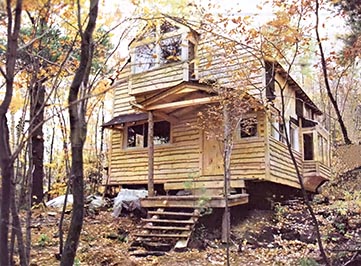
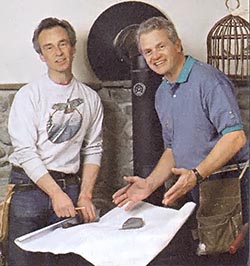
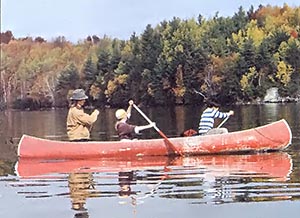
Round Island is a 20-acre range of miniature mountains, giant boulders, old aspens, birch, maturing pines, and one ancient oak in the western portion of Lake Bonaparte, New York. That elder statesman of an oak was the only one of its kind to endure the fire that a hundred years ago burned even the topsoil right off the ridge-backs at that end of the lake. The island is so irregular and divided by so many ridges and draws that on foot it takes a half day to circle the shore, especially if you are a nester and stop to dream at the many possible harbors. This story is how I, with generous help from my family and friends, managed to build a country cabin there for summer residency. I have every reason to hope it will be filled with generations of adventurers who love the lake as I do.
Another Exiled Bonaparte
Having escaped the failure of his family fortunes in Europe, Joseph Bonaparte bought the lake now called Lake Bonaparte to be the center of his own nation-state. With Round Island as its capital, he built big, he built with wood, and it all burned down. Not much was recorded much about it, except that it served briefly as an imported civilization with a railroad driveway 20 miles long, bringing courtly clothing, gondolas, and musicians for lavish parties.
Since gondolas are meant to be poled, I imagine that more than one must have been blown past pole depth into deep water and is preserved at the bottom of the lake, or else was paddled home with a lute. Joseph’s dream was not designed for a land of deep water, snow, and flies.
The Island Has a New Family
In the sixties, a few years out of school, my brother Herb did a title search on the property and discovered that it had been separated from the mainland by a dam that had raised the Bonaparte water level back in Joseph’s day. The original land survey had described no island, so it had been unowned through much of its history. Somehow, it had come to belong to people in California who had never seen it. So, along with a few partners, Herb bought Round Island in 1969.
The lot lines and numbers for each partner were painted on the shoreline rocks, but thankfully, that was all that was done to it through the sixties and seventies. During those years my brother and I exchanged many letters about building something on Round Island. But in the seventies the power company wanted $20,000 to bring electricity to the island. Our designs on the property suddenly took a nosedive down the grandeur scale.
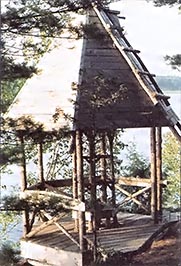
In 1987 Herb’s wife died. In memory of their old dreams he had me build a gazebo on the point of Round Island that faces across to Loon Island. A few seasons after I built the gazebo, we decided to design a summer cabin 30 yards or so inshore from the gazebo. We would keep it simple and primitive, with no power lines from the utility company and made of local rough-sawed lumber.
First Steps
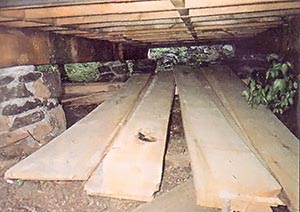
In spring I went up with a mason friend from Lodi and we chose the building site up on a flat area between the gazebo and the ridge-back and marked the locations for each of nine stone piers. I returned alone on another weekend and excavated each of the pier locations. It was mostly a matter of sweeping away pine needles, though there was one dirt-filled crevice, a sort of drain in the rock, that I shoveled out and filled with rubble.
On another visit, the mason and I brought stone from the rich talus slope of the cliff behind to add to the loose stone already on the site, including a few big ones already naturally in place. The piers we then laid up with mortar were typically about as wide as a bushel at the base and at least 12 inches at the top.
The main idea with the foundation was to put the weight on bedrock. Had the bedrock not been mostly exposed, we would have had to dig until we got to it or at least four feet down to be below where the ground freezes in winter. Otherwise ice would get under the stones and heave them up, which is why New England farmers heave a new crop of rocks every spring. A foundation of rubble bears ultimately on the ground below the frost line and allows water to drain through it.
At one time I had planned to saw our lumber out of Round Island pines, using a chain-saw mill attachment. That would have taken a few summers by itself and made the island a lot less attractive to us in the process. But we wanted rough-sawed, unplaned lumber anyway, for the natural look and feel of it. It will usually be cheaper than the standard kiln-dried and planed lumberyard product and it will be stronger too, because an unplaned two by four is actually around 2″ x 4″ instead of 1 1/2″ x 3 1/2″. Because it is unplaned, rough-sawed lumber is not uniform, however, which makes it slow to work with. It is also much slower to sheathe a building with boards instead of with plywood. For that reason, but also to provide a perfectly flat surface under the shingles, we chose 1/2″ plywood for the roof deck.
Our neighbor Ken Weeks had a portable sawmill (though not as portable as lumber is), so the winter before we started construction, we had him saw pine for most of our framing and sheathing, and hemlock for our rafters. Hemlock is a little stronger than pine and the rafters would have to carry a heavy load of snow. If we had been building on a site accessible to a truck and with enough standing timber to spare, we would have saved by having him bring in his equipment and saw it on the spot. As it was, Ken delivered the lumber and stacked it in ventilating lapped triangles to dry in the lake breeze for several months.
Green lumber is a thrill to work with, like building with fresh vegetables. But if the wood isn’t relatively dry when you nail it up, the cracks between the boards can get as wide as the boards are thick. And the uneven drying induced by covering the backside of the walls and firing up your stove inside, can make green lumber twist, cup, pop nails, and creak.
Even fairly well air-dried lumber will shrink a little and split in the thicker dimensions. The thicker the stick, the longer it should dry. Were I to build a timber-frame house or a log cabin, I would want the trees to have been sacrificed six or more years beforehand.
Rough-sawed lumber, on the other hand, has the advantage of being dryable within a shorter period of time, manageable in size, conservative in its use of wood, and compatible with the most economical insulation, which requires a cavity to stuff. Ken Week’s father, Skip, brought our own pretty-dry lumber across the lake by pontoon boat on weekends when I could muster enough family to load and unload the boat. We handed the lumber, bucket-brigade style, up the rocky face of Round Island.
Working by myself for another weekend, I made three carry beams of tripled, 2 x 12’s to rest on the three rows of three piers: one in the middle and one 1 1/2′ from each end of each beam. The three parallel beams would carry the whole weight of the house and transfer it through the piers to the bedrock. Fabricating the triple beams was difficult without any flat place on which to assemble them, as is evidenced by a slight dip in one of them. The piers are short and wide enough at the top so that once the floor frame was completed and rigid, I wouldn’t have to worry about it sliding off its support if Round Island should tilt and rock a little sometime. If a freak hurricane should move us a little, we will clean up the spilt milk, jack the camp level, and put some new piers under it.
On my next weekend, I began laying the 10″ deep floor joists every 16″ perpendicular to and across all three beams so that they would be supported in the middle and 1 1/2,’ from the ends. We toenailed them to the beams with sixteen-penny nails, which are larger than I would use for ordinary two-by lumber. Cantilevering the beams and joists over the support that way protects the masonry from the weather and makes for shorter unsupported spans in the final floor. Depending on the weight it will finally get, a joist can be cantilevered as much as a third of its length beyond its support. But I wouldn’t build a wall on top of such an extreme cantilever and I would get my plans engineered before doing any cantilevering at all.
That rough-sawed, resinous, and fragrant wood was still a little moist and a pleasure to handle, though it gave good splinters when I rubbed it the wrong way. Because of that residual moisture I expected spaces eventually to open up between our sheathing and decking boards, but we planned to use a wind barrier between layers to keep the draft out and our lapped siding would be tolerant of shrinking. Between the sheathing and the siding we would be using ordinary tar paper. This asphalt-saturated felt is a barrier to moisture as well as to wind. Most modern construction, which includes insulation (as our plans did not), puts a more expensive, windproof but moisture-permeable barrier such as Tyvec on the outside of the wall and a polyethylene moisture barrier on the inside, to keep moisture showering and migrating into the walls where it can become trapped and destroy the effectiveness of the insulation and even rot the framing.
I came back the next time with more wood, more help and family, and a big qenerator for a full week of work. Herb came north from Louisville to help me lay the subfloor of 1″ x 10″s diagonally across the joists, then trimmed off along the outside of the box frame. Laying the boards diagonally is of course another laborious choice, but I am a laborer by choice and putting the boards on diagonally keeps the walls and floor braced square. One board on the diagonal can brace a wall, but a whole wall sheathed straight across with boards will not be well braced at all. Plywood serves the purpose of bracing by having its own substantial diagonal dimension, and of course it doesn’t have to be put on diagonally to do so.
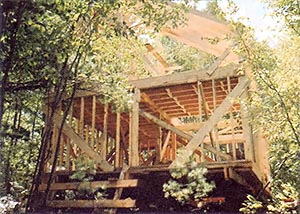
The stud walls and second floor went up quickly with my family carpenters. We braced the stud walls from rocking back and forth with diagonal braces on the inside and left the slower wall sheathing job until we had a roof over everything.
Tackling the Roof
We had decided on a saltbox-style roof of two unequal slopes with one short up-stair wall and one taller to provide enough room for a sleeping loft. On a sunny day in August, Jon and Liz of Natural Bone Builders, David Morgan of Natural Bridge Caverns, and I pushed up the second story walls, put up three masts of 2″ x 4″s holding a 1″ x 12″ roof ridge board that had been marked for each pair of rafters. With two of us cutting rafters downstairs, and two of us putting them in place, we began to raise the dense hemlock 2″ x 10″ rafters, going by pairs along the marked ridge board. The purpose of the ridge board is not to support the rafters, but just to help in placing and stabilizing them as they are put up.
I was the person on top of the operation, spiking and toenailing at the ridge. I was also the one responsible for bracing the walls, which by the time half of the rafters were up, were taking a strong outward thrust. In most house designs, the walls are held plumb by the linking joists of the floor above them or by horizontal collar ties from rafter to rafter, which hold them together so that their thrust is downward rather than outward. In our case, the two short knee-walls that we had built on top of the first floor would eventually be held plumb by collar ties on every other set of rafters about eight feet overhead and by their connection through the gable end walls.
But our scaffolding was in the way of getting the ties in as we worked and we had to depend on sufficient temporary bracing at the gable ends and a few braces along the length of the side walls.
We decked the roof with 1/2″ plywood and installed a skylight of 1/4″ Plexiglas: one 4′ x 8′ sheet laid on the rafters, and screwed down through holes drilled large enough to allow for expansion under strips of 10″ wide aluminum flashing and aluminum 2″ wide and an 1/8″ thick over that, to be lapped by the shingles beside and above it, flashed over the shingles below, and caulked all around with silicone.
Generally speaking, homemade skylights and cheap skylights with poor flashings leak, but this design has worked for me. I would not recommend it for a low slope roof or for a space where insulation is very important, since one layer of Plexiglas, or even two, can’t compare to the insulation value of any commercial double-insulated skylight. And where labor is calculated in the cost, a smaller, factory-made skylight will save money. We didn’t need a lot of insulation and were interested in allowing the most light we could into the cabin. Some say Plexiglas will yellow after much exposure to the sun, but too much sun is not one of our problems.
I finished shingling the roof, added a square bay window downstairs and another upstairs at the gable end, which looks out over the lake. Each one has a sliding drawer bed that pulls out of the bay seat.
Back to Basics
With the main framing done, we began coming again on weekends and going back to Ithaca during the regular work weeks. Leaving after working by myself one weekend, I put the generator in a corner of the bathroom and covered it with a pile of firewood. Coming back, I found the wood pile scattered and the generator gone.
Taking that as a sign, we returned to hand tools for much of the rest of our work. My partner Ed had brought some Japanese saws to the cabin site, which have blades thin enough to pull through wood faster than you could get out the extension cord, crank up the generator, and plug in a chop saw. And they are good for using your whole body instead of just your right arm. But they were harder for us to control than the stiff, new-style toolbox saws, which imitate the Japanese in their tooth design, cut on both strokes, and stay true when you are cockeyed. For most of our long rip-cutting, we measured on the site and then did the cutting on the mainland where we had a little table saw set up.
Windows, Doors, & Floor
We installed the door and the Plexiglas windows that Tim Merick had made and prime-painted in our shop the winter before. Once again, we chose the Plexi, not because having to make our own windows was cheaper, tighter, or better insulating (which they were not), but because we wanted an awning-style window that we could hook up overhead, without hanging glass over our heads. The Plexiglas window panes are held in with painted and caulked wood beadstrips, because Plexi expands and contracts more than glass and is likely to break glazing putty.
Then we trimmed the outside of the windows and the building corners with 2″ x 4″s and gave the camp slab-sawed siding, which is simply boards sliced from whole, unsquared saw logs with bark left on the edges. This provides the look I like, of a house made out of trees, though not of whole logs. And it is definitely cheaper than the same wood sawed to beveled clapboards, primed, and painted. The wood siding will eventually become stained and bleached from exposure, and if we don’t like the effect we may try to even it out with a dark stain.
Besides the roof deck, the windows, and the doors, the final flooring was the only regular milled, kiln-dried lumber we built into the camp. We wanted it to be without shrinkage cracks, uniform, and smooth, and we did not want to bring in a floor sander to get it that way. We used #2 tongue and groove pine 1″ x 6″s, commonly called “roofers,” though it isn’t much used for roofs anymore. We protected the soft floor with three coats of polyurethane, which, after the prime paint on the windows, was about the only paint or finish we have used. It is now possible to buy a waterborne urethane finish that is durable, freer of toxins, cleans up with water, and can be recoated more quickly than the spirit-based urethane. But our camp floor will soon be aged by dog claws, chair legs and sand anyway.
The mason and I came up for a few days to fish just a little; then we footed and attached a front porch. Relying more on eye squinting than measuring, I built an entry stair with cedar log stringers and copper flashings over the tread-stringer joints so that water wouldn’t run into the joints and start rotting them.
We installed the front and back doors Tim had made in our shop. He used one thickness of tongue-and-groove 1″ x 6″s held by a Z-shaped brace of the same material. Then he put a 1″ x 1 1/2″ strip all around the edges of the doors, filled in the voids between the bracing and the edge strips with sheet-foam insulation, and backed the doors with another layer of tongue- and-groove 1″ x 6″s. Installing the doors, we used strap-style gate hinges, simple iron lift latches, and added hasps for padlocks.
Servicing the Cabin
We mounted a gasoline-powered pump down at the lake to push water to three recycled plastic cider barrels in the loft. The barrels feed by gravity to the kitchen and bathroom sinks. The pump can fill our three barrels in five minutes and then we don’t need to run it again unless we’re planning an extended stay. We could have gotten by with less, and the gas motor has a tendency to be cranky. I would really like a bicycle-powered pumper like my friends over on Cranberry Lake have, but I’m glad to have the big one for fire prevention.
After considering a fire-breathing, propane-fueled incinerating toilet that I saw in a yard sale for $50, I was happy to discover a used composting toilet, which seems to me a better solution for the cabin–certainly better than flushing into tanks or lugging a tank of propane to the house every year.
Our composter (a Sun-Mar) uses a wind-driven roof turbine to draw off excess moisture and odors. The man who sold me the composting unit showed me his own installation: two toilets that shoot down cellar into a single digester bin the size of a chest freezer. In eight years the digester had not quite filled. He pulled it out part way and showed me. The soil was black and fluffy with less odor than inside a new car. He pulled aside the pearly grained soil to show me the red worms he had added to his system to do the final stages of composting.
I installed the toilet and a site-built gray water collector/evaporator, which is just a pit lined with polyethylene plastic, then filled with wood scrap. I needed it because you can’t put your dishwater, shower, sink, or laundry water, with their bacteria-killing detergents, into a composting system. They are too much for a septic system to digest. In eight or ten years we will strip the pineduff lid off our grey water pit, dig out some of the rotted wood, add some more and a few red worms, then cover it up again. Lake Bonaparte has, in recent years, passed several health department tests for potable water, making it about the largest drink of water in the state. It should stay that way. But even so, we get our water from springs that don’t have beavers and other bathers playing around in them.
Moving In
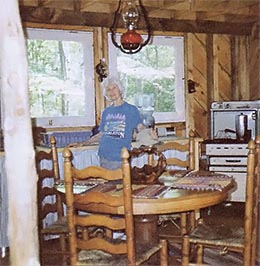
By 1992 the camp was ready for its people, who had been assembling archaic furniture and fixtures, junk store deer heads, and antique fish mounts. In July, Herb and family moved in. Propane stove, primitive icebox, kerosene lanterns, and all. That year my sister Valerie got married on Loon Island and she and Ray went to Round Island for their honeymoon.
The place isn’t quite finished. Of course it will never be really finished. Though the hearth has been built up to just about floor level, the chimney is still a long pile of stone on the ground, looking much like the tumbled remains of an old one. For next year the camp could also use some surrounding deck and more slabs of siding on the back, or maybe we will want to add a shower room in back, or sheathe the inside walls. My brother may want to continue life after his retirement as a one-project builder and keep it going for as long as possible.
But already the Round Island camp looks like it has been there for years. Already there is the quaint carcass of our old wood and canvas canoe as a memorial to itself on a high bank near the water and there is the platform of a small boy’s tree house in one of the pines.






