

My wife, Meghan, and I have found that a comfortable house,
sturdy outhouse and woodshed can still be built for
practically nothing here in the continental United States
(as we’ll soon relate) . . . but one thing definitely costs
money today and that one thing is land. So we worked two
years at jobs we didn’t especially like–Meghan as a
school teacher and myself in construction and other odd
jobs–and bought our own little chunk of earth with
the money we earned. After that, the rest came easy.
We chose to settle in northwestern Montana for four
reasons: (1) to get away from hyperactive politics, (2) to
drink sparkling, clear water from a mountain stream, (3) to
breathe clean air and (4) to be part of the beautiful,
snowy, peaceful winters. True, snowmobiles have destroyed
some of that peacefulness . . . but the people who own such
machines must hold a 9-to-5 job to support them and,
therefore, can come up to the mountains on weekends only.
Our paradise is still quiet five days a week . . . and it’s
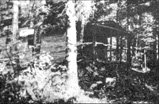
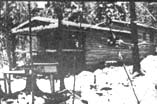
here that we’ve built a two-room cabin, a woodshed and an
outhouse–all three–for under $215.00 (1972 prices).
Start with Inexpensive Lumber
The cabin–except for log beams and log
foundation–is constructed entirely of cull 2 x 4’s.
It seems that one of the many sawmills in our region cuts
only this one standard size of lumber and many of the
timbers produced by the still are short, split or have
minor flaws. The culls, which average about seven feet
long, are sold in large bundles for approximately 7
1/2¢ each. By laminating these “seconds”, one on top
of another, we found we could build a solid wall four
inches thick that was not weakened by the imperfections in
the individual pieces of lumber.
We began our new home last summer by constructing a
foundation of fir log. We could have chosen spruce, balsam,
birch or tamarack just as easily but–of the
four–spruce and balsam rot rapidly once subjected to
dampness . . . and birch is just too beautiful to cut.
Tamarack and fir are both strong and long-lasting and we
picked the latter only because two large fir trees were
near our building site.
In addition to being tough and tenacious, fir–we soon
learned–is also extremely heavy. We felled the trees,
cut. them into 20-foot lengths, peeled them and let ’em dry
and lighten in the hot summer sun. Even after seasoning, it
was a three man job to wrestle each log into place.
Foundations should be both level and square . . . no small
feat on our mountainous building site. We placed the
largest logs we had on the downhill side of the slope,
positioned the smaller ones uphill and filled in around
them all until we had the beams anchored firm and true.
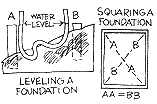
The best way to level a foundation without expensive tools
is by picking up a new or used length of clear plastic
hose long enough to react, diagonally across the structure
you’re building. Fill the hose with water and level from
point A (a reference point) to point B by holding one end
of the tubing up at A, allowing the hose to slump in the
middle and moving the B end of the tubing up and down until
the water’s height at end A is on the reference mark. Check
and you’ll find the water at B at the same level.
Constructing the Cabin
To square a foundation, measure it diagonally both ways.
When the diagonals are exactly the same length, you can be
sure the structure is absolutely square.
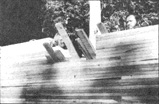
Once our 20-foot-long foundation logs were firmly bedded,
we placed 14-foot joists across them at right angles. We
then nailed a floor of 2′ x 4’s across the joists and
started stacking and nailing the cabin’s walls, one on top
of another. It was amazing to see how fast those walls went
up.
We placed only one average-size window in the front and one
in each of the cabin’s two sides . . . and we’ve found that
our lighting is inadequate. If we had it to do over, we’d
now figure at least one large window per wall.
Wood (and our house is nothing but) absorbs light and makes
the building much darker inside than one would think.
The lower a structure is, the easier it is to heat. We
therefore placed three equally spaced 14-foot log ceiling
beams only 6 1/2 feet off the floor. Again, to save heat,
the roof we built (of 2 x 4’s) over laminated 2 x 4 rafters
is very low pitched. So low pitched that we worried the
typical worry that heavy snows might cave in the top of
lodge . . . until we found that excess snow is melted off
the building by escaping heat.
We installed durable asphalt roll roofing on our homemade
home, taking care–as a local professional had
instructed us led us–to put a double layer over
building’s eaves (where ice may form and tear the covering)
and crown.
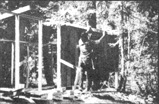
Our front door, made of 2 x 4 laminated vertically with a
birch limb a handle, is so heavy that we to swing it from
four 9-inch hinges. And folks be sure to move that
monstrous wood stove in before you hang the door .
. . we didn’t, and we had to screw all those hinges on
twice.
The six by fourteen-foot across the front of our cabin was
built exactly like the cabin itself. We just extended the
building’s roof to cover it. In the summer (we faced our
house south to take full advantage of the sun), that porch
becomes a wonderful place to spend the long evenings.
During cold weather, we stack wood on the porch
and our dog lives underneath in a snug home insulated with
straw.
Finishing Touches
As soon as we had our house and porch up and roofed, we
caulked–or chinked–the walls of the main
structure. We chinked only on the inside (maybe we’ll catch
the outside next year) and it took three to four
cases–we lost exact count–of caulking compound
to fill the cracks between the layers of lumber. With that
detail finished, we moved into our new home! It had taken
us 15 days–working from sunrise to sunset–to
build the 20′ x 14′ cabin and six-foot-wide porch,
The first time outside temperatures dipped to 30 below last
winter, we found the cold coming up through the floor of
our brand new house. Straw stuffed under the building and
snow banked completely around its foundation cured the
situation for the rest of the season although a double
floor with insulation between would certainly be a better
permanent solution.
While on the subject of frigid weather I should mention
that the lower the mercury dropped last winter, the more we
noticed the draft coming in around our windows. We had
gotten the windows free because they were slightly warped .
. . and I’m afraid we didn’t custom-fit our casings to the
bowed sashes quite as tightly as we might have. I recommend
more care with such details.
We deviated from our laminated 2 x 4 construction technique
when we built the outbuildings on our homestead. In this
age of concrete floors and aluminum walls, you know, many
farmers are tearing down the old to make way for the new.
We found such a farmer who wanted a chicken barn removed
and we dismantled the structure for the lumber in it. The
jolt gave us enough material to build an outhouse, a
woodshed and the furniture and shelves in our cabin.
Building an Outhouse
While putting in the outhouse we began to realize that
anyone digging a hole six feet deep and two-and-a-half feet
square through rock and gravel . . . only wants to do it
once. So we built a casing to fit that hole and prevent it
from collapsing.
Our approach to designing the actual privy may be a little
unorthodox . . . but what we did was we measured the toilet
seats and just kind of worked out from there. Backhouses
(being relatively small) don’t need foundations in the
sense that larger buildings do . . . so we just built a 2 x
4 frame for ours and embellished the structure with a
generous porch across its front.
In addition to supplying us with siding, the barn we tore
down gifted our homestead with a couple of doors, hinges, a
milk can, chicken manure for the garden, two repairable
work harnesses and twelve log rafters. We decided to use a
few of those timbers to make a high peaked roof over our
privy and its porch.
With the high roof on the outhouse, we had room for a
ventilating window in front and another on the back of the
building (both are screened to prevent bugs from entering).
The privy door is the original front door from the chicken
barn. And yes, you’re right . . . no matter how it’s built,
an outhouse is cold in a Montana winter.
Building a Woodshed
The third structure we erected on our land was the
woodshed. It was easy . . . no floor or foundation was
needed. We built the frame from the last of the 2 x 4’s and
used recycled barn boards for the siding and the roof. The
former back door on the chicken became the door to the wood
and the few dollars we spent for the roll roofing with
which we topped the building was almost our entire expense
for the structure.
We designed the woodshed to six cords of firewood plus our
carpentry and gardening tools . . . and since found the
structure hand for drying weeds and flowers, hanging meat,
storing dry goods or whatever.
With three snug buildings erected on our land, we thought
our carpentry duties were completed . . . until we noticed
that we owned more possessions than we could fit into a 14′
x 20′ cabin. So we made the house ten feet longer by adding
another room directly to the back of the original
structure.
The addition was easier said than done in some respects
because there was a slight rise behind the cabin and we had
agreed to build only with the contours of the land. So we
elevated the back room.
Once the addition was completed we connected it to the main
house by borrowing a chain saw and cutting a door-size hole
in the back wall of original cabin. The severed stud were
cased in with 2 x 4’s (to make neat entry way) and two
steps up the new room were added to the passage.
And does our new “split level” work? Probably better than
you’d expect . . . because it contains the element of
separation that is often needed when two people live
together and alone for long, isolated periods.
We’re kind of pleased with our outhouse and woodshed, too.
For $215 … we think we’ve done all right.






