

Over the past decade or so, dairy goats have become enormously popular among back-to-the-landers, and even some small town folks, who’ve decided to become milk self-sufficient. And no wonder: Goats cost only about a third as much as dairy cows, yet — pound for pound (of body weight) — nannies produce more milk than their bovine peers, eat only a sixth to an eighth the feed, require less space, and are a whole lot easier for a woman or child to manage. (Besides which, of course, goats are charming and intelligent “people!”)
Finding and buying a good dairy goat can be a confusing task, however, unless you’re fortunate enough to have the assistance of someone like JoAnn Salmonowicz of Lapeer, Michigan. JoAnn is a longtime nanny-raiser, a licensed American Dairy Goat Association judge and the author of the following article.
Unless you know what to look for, buying a dairy goat can be downright risky, especially the first time around. Prices vary tremendously, and it’s easy for the inexperienced buyer to be conned into paying hundreds of dollars for an inferior cull.
You needn’t make a bad purchase, though — even if you’ve never shopped for a goat before — as long as you know how to properly evaluate exaggerated milk production claims and determine for yourself whether a given animal is (or will be) a healthy milker. With the advice I’m about to give you here, you should be able to do both.
Three Ways to Go
Before you begin to look for a goat, you should decide whether you want to buy a female kid, a dry doe (that is, a non-lactating adult female) or an actively producing milker. Each kind of nanny has its advantages and disadvantages. For instance …
Kid Goats: Cute but Risky
As cute as kids are, they’re a risky buy, particularly if the dam (that’s the mother) isn’t around for your inspection. Because unless you know something about the mother’s characteristics, there’s no telling how the youngster will turn out. You may very well find — after feeding the animal for a year, paying to have her bred and (perhaps) becoming attached to her — that your goat only gives a pint of milk per day. (Such performance is, unfortunately, quite common.)
Think long and hard before you purchase a kid, then, especially if you’re asked to buy it “blind.”
The Dry or Bred Doe
A dry doe is a mature, non-lactating female that has never been bred, kidded before but isn’t milking now, or been bred recently but is not yet producing. The same cautions that apply to kids also apply here, only more so.
Be suspicious of a virgin dry doe, especially if she’s more than two years old. Chances are, there’s some reason, such as a fertility problem, why she was never bred. If the doe is husky and masculine-looking, for instance, it’s quite possible that she’s a hermaphrodite (a pseudo-female with incomplete internal male sex organs). These animals are always sterile, and, because their meat has a strong “bucky” flavor, they’re not even very good for eating purposes. (Hermaphrodites are difficult to recognize, so if you have any doubts be sure to get a veterinarian to look the animal over.)
Of course, if you purchase a perfectly healthy virgin doe, you may still have trouble breeding her, particularly if she’s more than a couple of years old. (It’s often difficult to settle a mature doe if she hasn’t been bred once already, before the age of two.)
A dry doe that has kidded before can be a good prospect, but only if the owners can give you a satisfactory explanation for why they let the animal dry up. It may be that the doe is pregnant. (Most nannies, however, will continue to produce milk after they kid and right up until six weeks before the end of their next pregnancy). Then again, there’s the very real possibility that the goat was such a poor milker that her owners dried her up on purpose just to sell her.
A recently bred doe, on the other hand (especially if she’s still producing a good flow of milk from her last lactation) can be a real buy, although she will cost a little more than an unbred female. If the nanny’s still early in her pregnancy, count on paying something for the animal plus whatever the stud fee was. And, if the doe is well into her pregnancy, you may have to pay extra for the yet-to-be-born kid or kids, too.
Be sure — when buying a bred doe, dry or milking — to get a written guarantee of pregnancy, and if the buck was registered, insist on a service memo as well. With one of these memos (signed by the owners of the buck) you can record your doe’s kids with the American Dairy Goat Association and proceed to work your stock up, via successive breedings, to full American registered status (which makes your herd much more valuable). Remember, though, that nothing can substitute for a properly endorsed service memo when you go to register your kids with the A.D.G.A. (It’s the only proof you have that the doe really was mated to a particular buck.) Don’t let anyone promise to send you the memo “later,” or try to tell you that you can obtain the memo yourself from the owner of the buck. Pay no money until you have a guarantee of pregnancy and a valid service memo in your hands.
Milking Goats and Milk Production
The safest way to buy a dairy goat, as I’ve already mentioned, is to buy one that’s milking. And here, your main concern will be how much milk the animal is giving on a daily basis, something you can’t always trust the seller to be 100 percent truthful about. (If you think fishermen spin tall tales, just wait till you hear the whoppers some goat owners will expect you to swallow!)
I’ll tell you right now, there’s only one way to know for sure whether the doe you intend to buy is a good producer: And that’s to milk her yourself in the morning, and come back to milk again that same night.
And it is important to milk the goat twice, not just once. Sometimes, when you make an appointment to milk a doe her owner will skip the milking immediately before, so that when you arrive, the animal gives almost twice her normal amount. Then — after you take her home, note an obvious drop in production and call back to complain — the previous owner will tell you that the stress of moving caused the drop. Happens all the time, so beware.
How much milk should a doe give? It depends on how long she’s been fresh (i.e., lactating). The average nanny will give milk ten months per year, dry up for two months before kidding, and bear a kid or kids (usually two) once every 12 months. She’ll produce close to her maximum amount, around a gallon (8 pounds) of milk daily, when she’s two weeks fresh, and continue to do so for about three months. Afterward, mama will begin a slow decline in production until approximately 305 days after parturition, when she’ll be giving about a quart (2 pounds) of milk per day, at which point you should dry her up.
Although a three-to-six-year-old will (at her peak) produce about a gallon of milk per day, the first-time mother usually gives a smaller amount, but not less than three quarts a day. Likewise, older nannies aren’t as productive as younger animals, although — again — they should never produce less than three quarts daily at their peak of production.
These are approximate figures. Some goats give more than a gallon daily, and many, many others give barely half that much. My advice: Expect to pay more for a heavy producer, and don’t even bother with the others.
How Old Is Too Old?
A doe is considered to be in her prime when she’s between the ages of three and six years. She can still be a good buy up to an age of about ten years, but after that, you’re asking for trouble.
There’s nothing at all wrong, though, with buying a healthy seven-, eight- or nine-year-old. Any animal that’s managed to hold up for that long under the stress of milking and kidding and still remain in good health has more than proven her worth. And in all likelihood, she’ll pass the same hardiness on to her young.
What to Look for in an Udder
By definition, the most important part of any dairy animal’s anatomy has to be the udder. That’s where the milk comes from.
The ideal goat udder looks about like half a basketball glued right up tight against the doe’s belly. (This is the ideal. In reality, such perfectly formed udders are rare even among registered stock.) What’s more, the bottom of the udder, called the floor , should not hang below the level of the animal’s rear hocks.
Some udders are so poorly attached that you’re forced to milk them over piepans instead of buckets. You should avoid any animal whose “milk factory” hangs this low, since the udder will be prone to injury (and thus mastitis) and may not hold up well for many years of production.
It’s easy to tell how well the udder is attached: Simply grasp it around the top (next to the goat’s stomach) with the fingers and thumb of one hand, and squeeze. If you feel nothing but skin, you can bet that the muscles that are supposed to be there aren’t. (You’ll feel them if they are there.) All that’s supporting the weight of the milk is a layer of skin, skin that’s bound to stretch and sag even more over time. Forget this animal, and go on to the next one.
Mastitis
The only thing worse than a low-hanging udder is one that’s afflicted with mastitis, an inflammatory disease that can dry up one or both sides of the mammary gland.
Mastitis can come about either through trauma (i.e., injury to, or rough handling of, the udder), or infection by certain bacteria. (The latter form of the disease is contagious.)
A goat with mastitis will sometimes have lumps and/or hard masses of scar tissue on her udder. (The lumps are pockets of pus that can cause repeated flare-ups of the disease.) If the milk has a funny appearance — that is, if it’s lumpy, flaky, ropy or off-color — you can be fairly sure the goat has mastitis, and that her milk is teeming with bacteria. Stay away from such an animal.
On occasion, the owner of a mastitis stricken doe will attempt to explain why the goat’s offspring never suckle an affected teat by saying, “That kid will only suck on one side.” Unless the seller can prove you wrong, however, consider this an indication that the animal has mastitis.
Double Teats
A goat’s udder should have only two teats, one per side. And each teat should have but a single hole, large enough to allow a fair-sized stream of liquid to squirt out when the doe is milked. (Be sure to check this. A doe with tiny orifices in her teats will cost you a lot in time and muscle power over the long run.)
Occasionally, however, a nanny is born with two (or more) teats per side, a defect you should watch for when you’re considering the purchase of an animal.
Extra teats come in all shapes and sizes. Some work, others don’t, some are barely noticeable, and still others cluster up in groups that resemble a cow’s udder. In any case, you’re stuck with these superfluous appendages once you buy a goat that has them, because, despite what people may tell you, you cannot clip off an extra teat. (If you do, the milk will back up, leading, possibly, to a massive infection.)
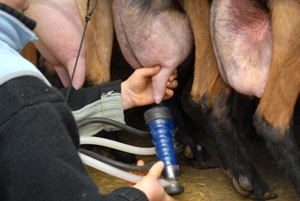
To determine how much of a nuisance any extra teats may be, you have to milk the doe yourself. If, when you do this, you find that one stream of milk goes into the bucket and the other on your face, or milk dribbles down the side of your hand (creating an unsanitary situation), or it’s hard to get all the milk out of the extra teats , save your money for another goat.
The basic rule to follow, then, is: Anything that doesn’t interfere with milking can be tolerated. Extra or malformed teats, however, do constitute a fault and are hereditary.
Tips on General Appearance
A goat can’t produce large amounts of milk if her “main processing plant” (her body) isn’t in good condition. Thus, the overall appearance of a nanny (especially a dry doe) can be extremely important.
Aside from the basics of good weight, shiny coat, bright eyes and a charming personality, you should look for a goat that appears “pregnant” all the time. That is, one with a long, deep, pear-shaped body (which is obviously capable of utilizing great quantities of feed) and a chest cavity big enough to accommodate a large, hardworking heart and expansive lungs. When you inspect the animal from the front, you should see nice, wide ribs engulfing a rotund torso.
Also look for sturdy, healthy feet and wide-spaced legs. (You should be able to fit the width of your hand between the animal’s two front legs easily.) And watch how the doe walks. If she limps, she may have foot rot, a contagious and difficult-to-treat disease. If, on the other hand, the doe rocks back on her heels (especially her rear heels) she probably has weak pasterns. This is common in older does, and could be an indication of a weak entire rear end, which, in turn, could mean kidding problems later on. (The animal’s owner may tell you that she just needs her hoofs trimmed — probably true, since goats of this kind need more foot care than others — but trimming alone won’t correct this inherent defect.)
Weak feet are OK in an older doe, but you should only purchase a younger animal with weak feet if she’s really super otherwise.
Horns or No Horns?
Horns, contrary to popular myth, are no protection against dogs or predators, and they have a way of getting stuck in fences, hayracks, other does’ udders and children’s eyes. Therefore, it’s best, when possible, to buy an animal that’s been disbudded at an early age. (Even a fully matured goat can be dehorned with little effort, however, so don’t let the menacing protuberances prevent you from buying an otherwise-fine animal.)
When in Doubt, Use a Checklist
It’s easy, even for experienced goat keepers, to be “dazzled” by a herd of goats. For this reason, I’ve compiled a checklist for you to use when shopping for a nanny. Use this list to grade your prospects individually, and keep in mind the various tips and suggestions I’ve given you in this article. So armed, I’m confident that you’ll eventually wind up with “the best doe for the dough!”
For More Information
The Dairy Goat Journal is devoted entirely to goatlore and is a must for any
serious dairy goat enthusiast. Countryside has a regular goat section in
addition to articles of general interest to homesteaders and
back-to-the-landers. Both magazines are published twelve times per year.
Although
there are numerous smaller dairy goat organizations scattered around
the country, the single largest national group is the American Dairy
Goat Association, which sponsors shows,
publishes a yearbook, and offers other services to goat owners.
As for books, Helen Walsh’s Starting Right with Milk Goatsand Jerry Belanger’s Raising Milk Goats the Modern Way are perhaps two of the finest dairy goat primers ever written.





