When I first started thinking about beekeeping, my knowledge of bee hives went something like this: stack some white boxes against a fence or tree line and bees will make honey. Ok, maybe I wasn’t quite that far off base but I had no understanding of how to begin. Most of the hives I saw appeared to lean precariously, ready to fall over in the slightest breeze. I did not know these boxes had names or why they looked so haphazard.
There is a learning curve with any new hobby. My mission is to help new beekeepers by describing some of these basic facts so you can avoid some of the early frustration I experienced. This post will walk you through setting up a hive that honeybees will want to live in.
Ready?
The most common hive style in use is the Langstroth design. Patented by Rev. Lorenzo Langstroth in 1852, the hive consists of stackable boxes with movable frames. The boxes have no top or bottom. This structure provides shelter for honeybees plus a system that allows the beekeeper to monitor the activity and health of the colony.
The Hive Stand
A hive can not sit directly on the ground. Ground moisture will seep through the wood and into the floor of the hive. Wet basements are not good for bees. Your base does not need to be fancy. A wooden pallet or concrete blocks will do. Some beekeepers will nail together a small wooden pad to support the hive. There are stands available for order that are made specifically for this purpose if you are inclined to go that route. As long as the hive is raised off the ground and not in direct contact with the soil, any type of stand is acceptable. Understand that if using wood you will need to replace it every few years as the wood deteriorates. The height of the stand is personal preference. Since I am on the rather short side of stature, an old pallet works for me.
Bottom Board
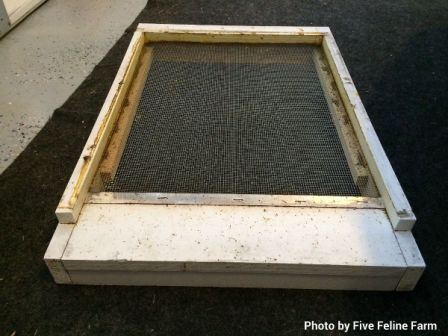
The floor of the hive may be solid wood or a screened board. Either are referred to as the bottom board. With the increase in varroa mite infestations, many beekeepers are using a screened bottom board as part of their mite control system. The bottom board has a ledge around three sides that supports the box above it. The open side is the entrance to the hive. A block of wood called an entrance reducer is used during cold weather and when establishing a new hive to close down part of the entrance.
Brood Boxes
A typical hive will have two brood boxes containing ten frames each. These boxes may also be referred to as hive body boxes and are exactly what it sounds like: where the brood is raised. The queen lays eggs in an semicircle on each side of the frames. Honey and pollen for the use of the colony are also stored in these frames around the brood area. Brood boxes are 9 5/8″ deep.
Beehive Supers
The term “super” was the most difficult for me to understand when first learning about beekeeping. Things finally clicked for me when someone explained that these more shallow boxes are called “supers” due to their position of being “super imposed” on the hive. Supers are where the bees store excess honey that the beekeeper removes and harvests. In a good year, you may see three or four supers on each hive. A typical set up will have one or two. A strong colony with good nectar flow fills 2 or 3 of these supers per year in my area.
Supers come in different sizes according to the expectation of the finished product. If the product is to have liquid honey the typical sized super is a medium or Illinois super. This box will be 6 5/8″. If the end product is comb honey a shallow super ( 5 11/16″) is used.
Beehive Frames
Both brood boxes and supers have inserts called frames. These are where the bees fill hexagon shaped cells with eggs for larvae, pollen, nectar and honey. At Five Feline Farm we use a plastic foundation stamped with the shape of honeycomb. This is coated with beeswax to encourage the bees to build on or “draw out” these cells for use. The exception to using a plastic base is when comb honey is desired, then a pure beeswax sheet is used. Frames are sized according to the box they will be used in. Brood boxes have 10 frames. Although supers can fit 10 frames, 9 are usually evenly spaced in the box. Bees will draw out the cells a little deeper and each cell will contain a bit more honey. The deeper cell is a benefit when de-capping the cells.
Beehive Covers
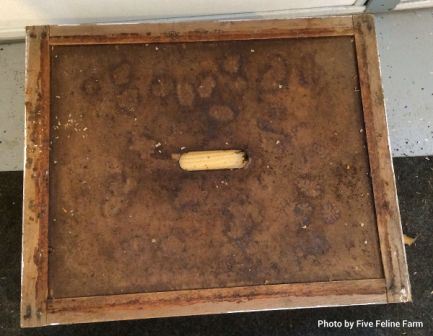
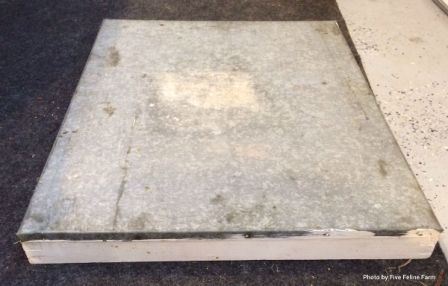
There are two lids to the hive: the inner cover and outer cover. The inner cover is rather flat with an oval cut out of the middle. This gives some insulation and ventilation space for the bees. The outer cover telescopes over the inner cover and provides a weather proof covering for the hive.It is typically weighted down with rocks or bricks to keep it secure in wind.So now you have a brief reference to get you started. And that haphazard looking tilt? Position your hives so there is a slight angle for drainage. Any condensation or other moisture that might collect in the hive will drain out and not pool in the bottom. The higher the stack of boxes, the more obvious the tilt.
Julia is the co-owner of Five Feline Farm where honeybees are part of the effort to return to a sustainable, more simple way of life. Visit our website: www.FiveFelineFarm.com and like us on Facebook.