

It has been very cold here in the Northeast and in many other parts of the country as well. One way to enjoy a little taste of summer in the middle of the winter is to take some time to appreciate the varied tastes of regional honeys.
Honey is an amazing product of the hive. A worker bee will make just 1/12 teaspoon of honey in her entire lifetime. It takes a lot of bees to make that honey you are stirring into your tea or spreading on your toast! The worker bees must collect nectar from flowers, and return it to the hive. The nectar mixes with enzymes in the “honey stomach” of the worker bees. The nectar is then placed in the honeycombs, and fanned to reduce the moisture content. When it is ready, it is sealed with beeswax to preserve it until it is needed by the bees, or harvested by the beekeeper.
What is Raw Honey?
A term you may come across when purchasing honey is “raw” honey. While there is no one definition of raw honey, it generally means that the honey has not been heated to above 118 degrees Fahrenheit. This honey retains all of the natural enzymes, vitamins, etc. that would otherwise be lost by heating. Raw honey will also crystallize, or become more solid, with time. This is a natural process, and does not mean the honey has gone bad. If you wish to reliquify the honey, you can gently warm it in a bowl of warm water. Honey that stays liquid indefinitely, such as what is commonly found in commercial grocery stores, has been heated to a high temperature. This keeps the honey in a liquid state, but also destroys the beneficial enzymes in honey. In my opinion, while still sweet, this “super-heated” honey is bland in taste in comparison to raw, minimally heated honey, and leaves a bitter aftertaste.
Another consideration when purchasing honey: I would encourage you to buy local, when possible, and from a reputable source if purchasing honey from outside your area. The news has recently been filled with stories about illegal honey imports from questionable sources. Find out the source of the honey you plan on purchasing!
Variable Tastes of Honey
The taste of honey varies with different locations, seasons, and weather conditions. At Bees of the Woods Apiary, we produce two types of honey. Our Spring Wildflower honey is light colored and delicate, and mostly derives from alfalfa, clover, and a variety of spring wildflowers. Our Fall Wildflower honey is a medium amber color, and has a slightly stronger taste. It is produced from the nectar of asters, goldenrod, and other summer and fall wildflowers. That being said, our honey is never exactly the same from year to year.
To expand my honey tasting repertoire, I began keeping an eye out for different types of honey that I could try. Friends and family caught on, and I now often receive interesting types of honey as gifts.
Some types of honey can be found locally at farmers markets or other local shops. In the northeast this may include Buckwheat – a rich, very dark honey, that reminds me a bit of molasses, or Maine Blueberry Honey, with a mild, fruity taste, or light, delicate Clover Honey, just to name a few. We have also been able to sample honey from further abroad. Some of our favorites include Hawaiian Kiawe Honey (raw and organic). This is unlike any other honey I have tasted. It is pure white, and incredibly smooth and creamy. It has a very mild, lightly sweet taste. I also enjoyed Scottish Heather Honey – similar in color and sweetness to our Fall Wildflower Honey, but with a distinctly different taste that I assume must be the heather!
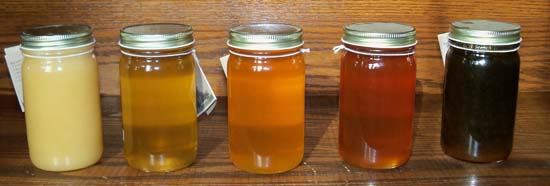
My husband recently bought me a gift set of varietal honey from “Grampa’s Gourmet.” This included everything from a dark, rich Tamarisk Honey to the very light Clover Honey. In the image above, you can see some of the different types of honey! It is also fun to try honey in different forms.
Comb honey is just that – honey still in the comb. It is cut directly from the frame, and is the most natural form of honey you can eat! Some beekeepers claim that this is the only form of raw honey.
Creamed honey is available in many flavors – two of my favorites are lemon and ginger! After you are able to find some different types of honey, consider hosting a honey tasting for your friends or family! All you need is a variety of honey, and sampling sticks. You can also experiment with paring honey with different foods. We recently discovered the very delicious combination of local blue cheese with honey drizzled over it.
Honey Books
If you are interested in learning more about honey, a great resource is a book called The Honey Connoisseur – Selecting, Tasting, and Pairing Honey with a Guide to More than 30 Varietels, by C. Marina Marchese and Kim Flottum. Another great resource is The Fresh Honey Cookbook by Laurey Masterton. Both books have information about honey, varieties of honey, honeybees, and recipes and food pairings.
If the winter blues get you down, be sure to take some time to enjoy honey in all its delicious forms, and thank the bees who work so hard to make it!





