You may have seen stepping stone kits at craft stores. They tend to cost around $10-20 each and come with a mold, pretty stones and mosaic pieces to embed in your project, and powdered stepping stone mix. There is nothing wrong with these kits, but they are good for making one stone at a time, at a pretty high cost.Many of you probably already know that you can buy some kind of concrete and a mold and make your own stones.You pour the concrete in and add the mosaic pieces as it dries.
I used that basic technique for many years with groups of children and adults with very mixed results. I would have the people assemble their mosaic pieces on a table, then I’d have to go mix the cement away from them, like in a hallway or outside, then I would fill the pie pans with wet cement and then panic would set in. Once it starts to harden you have to add the pieces quickly. If
you add them too soon they sink into the mix and disappear. If you wait too long they don’t stick well to the stepping stone. Carefully planned designs would go out the window as kids and their parents tried to jam their tile pieces into the stone in a rush. Also, using wet cement with groups is nerve wracking because they can get it on their clothes, on your clothes, and on classroom or household furniture. So, when we our school received a grant to make stepping stones for our butterfly garden I knew I needed to find a more reliable and simple technique. We would have to figure out a way to make the designs in advance and pour the concrete away from the kids.
A friend of mine directed me to the indirect (or reverse-cast) mosaic method. What you do is lay out your design in the pie pan right-side up, the way it will look when the stone is complete. Then you stick a circle of contact paper on top of the pieces and flip it over. This way the mosaic pieces are upside down in the bottom of the pan and the sticky side of the paper is up. You can assemble as many of these pans as you want, stacking them. With our preschool class we had 4 children make stones at a time, at a round table. We had a selection of glass nuggets, mosaic pieces and mirror squares in the middle of the table and they arranged them in the pans. When they were done the adults made sure to flip tiles so they were all face-up, then stuck the 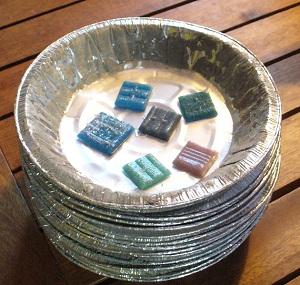
contact paper down. We had extra tiles so we put some pie pan in the teacher’s lounge and encouraged staff members to design some stones. After we had all of our pans ready we took them home for the next step.
A group of parents met one weekend and filled the pie pans with vinyl patching compound. This was mixed outdoors in a big tub using a drill with a mixing attachment. We filled them using spoons and spatulas and our hands. A day later we were able to turn the stones out of the molds and clean off the tops a bit and they look beautiful. Also, these stones are flat on top because of the reverse-casting so they are nicer to walk on.
Materials
Molds: You can use aluminum pie pans or purchase novelty cake pans for individual stones in shapes like butterflies and flowers. Reusable aluminum pie pans can be ordered inexpensively in bulk from the internet if you want to pour a lot of stones at once.
Concrete: I use the term “concrete” loosely to describe your choice of stepping stone material. You do not want to use actual plain concrete for your stones as it has rocks in it and will look really rough and porous. You can buy something called “stepping stone mix” at craft stores or online. This is slightly expensive but creates smooth and strong stones. This would be good if you were only making a few stones. You can also use Quikrete patching compound. It comes dry in bags like cement. You mix it to a thick “mud pie” consistency. You can also make your own mix using 1 part sifted cement, 3 parts sifted sand and enough water to make it a “brownie mix” consistency.
Mosaic Pieces: You can use mosaic tile of all types. For our stones we used mostly glass mosaic tile from Mosaic Art Supply, which comes in ¾ inch squares and every color of the rainbow. We also used cut squares of mirror purchased on EBay, and glass nuggets (found at craft or aquarium stores). You can also include things like keys, sea shells, beads, and plastic knick knacks. If you use unconventional materials (i.e. not actual tile) keep in mind that if an object is totally smooth on the back and has no way to grip the cement mixture it will pop out of the stepping stone, either immediately or eventually. You need to score it or sand it. Totally round marble also do not work well with this project because they won’t stay affixed to the contact paper.
Contact Paper
Optional Hardware Cloth: You can reinforce your stone with hardware cloth (this looks like wire screen). We did not reinforce our pie pan molds and they are holding up well. However it is pretty easy to add this extra step so you may want to include it.

2. Cut out circles of contact paper that are slightly smaller than the bottom of your pie pans•Give people an empty pie pan and have them lay out their mosaic pieces in the bottom. They should be right-side-up. (The smooth side of tiles is the top.) If you are working with children you may need to flip some of the pieces at the end.
3. Peel off the contact paper backing and lay it on top of the tiles. Press it down really well so that each piece is totally adhered to the paper.
4. Flip the contact paper so that it is at the bottom of the mold, sticky-side up, tiles upside down.
5. Collect the molds, stacking them carefully.
6. When you have all of your pans ready, prepare your concrete mixture.
7. Press the concrete firmly and gently between the mosaic pieces.
8. Fill half way and add optional hardware cloth.
9. Fill it to the top.
10. Get rid of air bubbles by tapping the side with a hammer
11. Release from the mold after a day then clean it up a bit. (Use an old toothbrush and water or a small wire brush and water.)
12. If you use one of the custom concrete mix, you need to cure it by keeping it moist for 3-5 days by covering in plastic and keeping out of the sun and wind. This curing process will really strengthen your finished stone. The patching compound does not need to be cured.
Photos by Sarah Hart Boone