Most
cooks could survive with nothing but a good stockpot, a skillet and a sharp
knife. Let’s be honest: No one really needs a melon baller or an asparagus
steamer. But there is a tool that makes itself worth the money and storage
space because it helps you prepare healthier food in less time for less money:
the energy-efficient pressure cooker.
Imagine
arriving home from work at 6 p.m. and serving your family a from-scratch beef
stew for dinner at 7 p.m. From hearty soups, rice and beans to braised meats,
roasted vegetables and whole grains, the pressure cooker is to wholesome
home-cooking what the microwave is to store-bought, packaged food.
If
money, time and energy savings aren’t enough to convince you, consider that any
meal prepared with fresh, whole ingredients will taste better and offer better
nutrition than anything made from processed food. Here are four reasons to give
in to the pressure.
1. You’ll Save Time
If
anyone really knows how to cook, it’s the French, and that’s who dreamed up the
amazing apparatus known as the pressure cooker. French physician Denis Papin
invented the machine in 1679. Pressure cookers speed up cooking time by
trapping the steam that escapes from boiling water, thereby increasing the
pressure on the liquid. When the pressure is increased, it takes more energy
for the liquid molecules to escape the surface and become a gas, so the
temperature at which the liquid boils is higher. Thanks to the laws of physics,
water in a pan can never exceed the boiling point — which
is usually 212 degrees Fahrenheit but varies slightly with altitude — because
that’s when the liquid begins to evaporate. The maximum temperature in a
pressure cooker, on the other hand, is approximately 250 degrees. The end
result of this scientific wonder? All foods cook much faster in a pressure
cooker. For foods that require an hour or more of conventional cooking — brown
rice, beets and dry beans, for instance — the
pressure cooker can slash cooking time by up to 70 percent. (See Pressure Cooker Resources.)
2. You’ll Save Energy
Those
quick cooking times also mean less energy use. Pressure cookers became popular
in the United States during World War II as a means of conserving energy. What
was true then is still true today: You’ll save as much as 60 to 70 percent of
the typical cooking time, which means you’ll use about two-thirds less energy.
Unless you’re using a nifty solar cooker or woodstove, there’s almost no way to
use less energy while cooking.
3. You’ll Save Money
Energy
savings translate into actual dollar savings. Because so little energy is used,
many meals made in a pressure cooker will literally cost one penny on your
utility bill. Kuhn Rikon, a pressure cooker manufacturer, estimates you can
save more than $325 a year with a pressure cooker. And guess what? Most
pressure cookers will last 20 years or more!
Pressure
cookers help you save money in other ways, too. You can make less-expensive
cuts of meat taste fabulous by stewing or braising. You can buy less-expensive
dry (rather than canned) beans. And you can make fantastic meals with
inexpensive staples such as pasta, whole grains, and dried fruits, vegetables
or mushrooms.
4. You’ll Eat Better Food
Finally,
pressure cookers help make food taste better. Many foods benefit from slow
cooking, which is essentially what you achieve in a pressure cooker — in
much less time. In fact, some people find they need less seasoning when
pressure-cooking because the flavors they get are so intense. Dry beans and
grains come to you without added salt and preservatives, and taste better than
their mushy counterparts in cans, yet a pressure cooker lets you prepare them
just as quickly.
If you’re cooking meals
from processed foods, chances are it’s because you need to save either time or
money. Any tool that does both, while still allowing you to start with whole,
fresh foods, will result in healthier and tastier meals. Period.
Pressure Cooker Features and Lingo
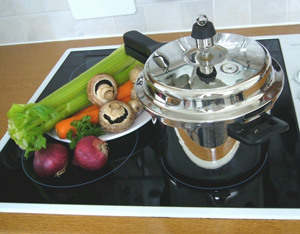
You should read the manufacturer’s manual and familiarize yourself with your pressure cooker’s main features. Most models have the following setup.
Rubber Seal. The ring that fits inside the lid should be clean, flexible and without cracks. When inserted, it should be dry and fit snugly. If you see steam escaping around the pan’s lid, replace the rubber seal.
Pressure Valve. Your model will either have a secure valve built into the lid or a free-standing plug that balances on top of the lid. A good pressure cooker will have valves that are attached to the lid with easy-to-read gauge lines that indicate the amount of pressure. The free-standing valves make it more difficult to determine when the appropriate pressure has been reached. Look for a model with a valve that can be removed and cleaned easily.
Pressure Release. Most new models have an easy method for releasing steam. Quickly pushing a button to release steam is a convenience you’ll definitely appreciate if you used a pressure cooker in the 1940s!
Steamer. Many units will come with a steaming basket that can be elevated above the liquid for delicate vegetables and fish.
Heat Diffuser. Many units come with a wire or metal plate that lifts the food just a bit above the cooking surface to prevent scorching. This is especially useful with rice and beans.
In order to understand pressure cooking recipes, you’ll also want to familiarize yourself with basic pressure cooking jargon. Here are the phrases you are likely to encounter.
Lock the Lid. Most pressure cookers have marks on the pan and the lid that align when the lid is locked into place.
Increase Pressure. Bring the amount of pressure in the unit up to the desired pressure for your recipe. This is where an easy-to-read gauge comes in handy.
Release Steam. With most pressure cookers, there are three methods of releasing steam.
Rapid release: Transfer the unit to the sink and run cold water over the top, with lid still locked into place. This method is useful for delicate fish and veggies that should not be overcooked.
Steam release button: Push the button to release steam easily. Wait until all the steam has escaped, and then open the lid. This method takes a minute or two, and is useful for soups and stews.
Slow release: Turn off the heat, remove from the burner, and allow the pressure cooker to stand until the pressure is released, which will take 10 to 20 minutes. This is the least common method, and should never be used with delicate foods that will overcook.
Interrupt the process: If you’re cooking foods that require different cooking times, such as meat and veggies, you’ll want to start with the food that requires the most time. Then you’ll need to interrupt cooking via the rapid or steam release option (above), add the additional foods, and increase pressure again.
See Also:
- Pressure Cooker Resources and Recipes
- Choosing a Pressure Cooker
- Pressure Cooker Altitude Adjustments
Do you use a pressure cooker? If you have any tips for other readers, please post a comment below.