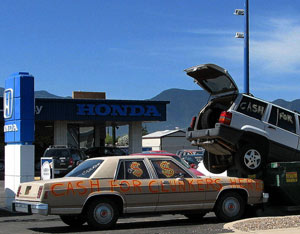
President Obama signed a bill last week that directs another $2 billion to the Cash for Clunkers program, officially known as the Car Allowance Rebate System (CARS).
Originally funded at $1 billion, the CARS program officially took effect in late July, but dealers were permitted to provide rebates starting July 1. The program proved popular, raising concerns that the rebates would need to be halted in early August. To keep the program going, Congress hurried to pass HR 3435, which draws $2 billion from the U.S. Department of Energy (DOE) Innovative Technology Loan Guarantee Program, under the assumption that DOE will not spend all the money allocated to that program by the end of the year. The funds are available to the CARS program through September 30, 2010.
Although critics of the program thought the fuel economy requirements were too weak, the results from July indicate that consumers are voluntarily purchasing more fuel-efficient vehicles than those required by the program. As Obama noted, “The initial transactions are generating a more than 50 percent increase in fuel economy; they are generating $700 to $1,000 in annual savings for consumers in reduced gas costs alone; and they are getting the oldest, dirtiest and most air-polluting trucks and SUVs off the road for good.” Those results also drew support for the added funds from the American Council for an Energy Efficient Economy (ACEEE), which noted that vehicles purchased under the program are averaging close to 10 miles per gallon better than the vehicles they are replacing.
The program also had a noticeable impact on vehicle sales in July: The seasonally adjusted annual rate (SAAR) of car and light truck sales for July reached 11.24 million vehicles. The SAAR adjusts the monthly sales data to account for seasonal lulls and surges in sales, and extends it for the full year. The SAAR for U.S. car and light truck sales fell from 12.57 million in September 2008 to 10.82 million the following month, and remained below 10 million for the first six months of this year before reviving in July.
Sales are still down from July 2008, although Ford Motor Company saw a 10.3 percent year-to-year increase in car sales, which it credited to the rebate program. American Honda Motor Company and General Motors Corporation (GM) also saw increased sales of their fuel-efficient vehicles, and Volkswagen of America saw increased sales of its clean diesel vehicles.
The CARS program did have one glitch, however: The U.S. Environmental Protection Agency posted more precise fuel economy data for older cars on fueleconomy.gov on July 24, causing 78 cars to become ineligible, while adding 86 previously unqualified cars to the list. To be fair to people who acted on the earlier information, those that traded in the now-ineligible vehicles on or before July 24 will still earn the rebate.