

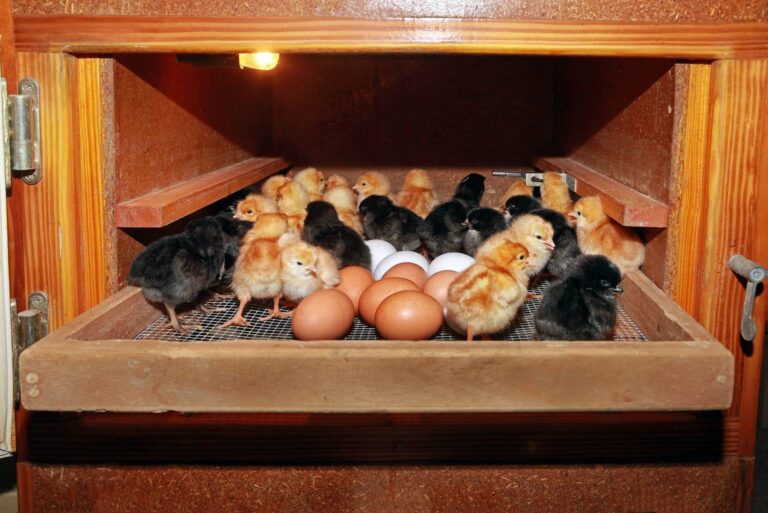
A poultry farmer offers up the lessons she learned after building a homemade egg incubator cabinet to hatch rare heritage chicks.
My current homemade incubator must be the fifth or sixth version I’ve built, though I’ve lost track of my total number of DIY adventures in incubation. Further, this homemade incubator has undergone three major redesigns. I’m now satisfied with its performance, but I’ll never quit tinkering with it. I use it to hatch approximately 600 chicks of rare heritage turkeys, geese, chickens, and ducks during the January-to-June breeding season each year.
When I set out to build my own egg incubator about five years ago, I had several goals in mind:
- Multi-stage incubation (incubate 150 chicken or duck eggs and hatch 30 eggs at one time).
- Steady temperature in an unheated garage in January.
- Attractiveness that would match a nice piece of furniture.
Designing a Homemade Egg Incubator
Originally, I wanted a multi-stage incubator that would do it all: incubate on automatically turned racks and hatch on a stationary bottom shelf. It didn’t take long for me to abandon that idea after realizing that hatching is a messy process and that clean, quietly incubating eggs shouldn’t have to deal with commotion and dander fallout. Also, it’s nearly impossible to maintain ideal, steady humidity and temperature conditions for both hatching and incubating within a single unit. These days, I transfer eggs from one of several incubators to this unit three days before the eggs hatch. As a incubator, this unit can keep up to 150 hatchlings healthy and happy. The self-turning mechanism isn’t used routinely, but it still works, and in case of an emergency, I can use the cabinet as an incubator once again. Here’s how I put together my homemade egg incubator (see my homemade Incubator Materials List for a rundown of the supplies I used).

The unit needed to be well-insulated to buffer it from big temperature swings while sitting in a cold garage, so I built a cabinet that’s a box within a box and that has fiberglass insulation. A big problem with operating an incubator in a cold room is the gradient from top to bottom; because hot air rises, the bottom of the incubator is often several degrees colder than the top. I thought about ways to overcome this as I planned out the cabinet design. First, I considered putting the heating compartment in the bottom, but common sense ruled that out because hatching waste and dander would pile up in the bottom, creating an impossible-to-clean fire hazard.

Ultimately, I opted for a top heating compartment with a duct to direct the warmed air down the back of the cabinet and vent it into the bottom. The duct is a “false back,” a wall of plywood enclosing a 2-inch space. A duct fan blows across the heating element toward the back of the cabinet, forcing recently heated air down the back duct. This works well, like a forced-air heating system in a home, but I still wasn’t happy with the 4-degree-Fahrenheit gradient from bottom to top. To provide supplemental heat, I placed an 11-by-29, 35-watt terrarium heat mat on the floor of the unit, and that did the trick. The mat is easy to clean and stays at a safe, steady 100 degrees. The temperature range from the bottom to top is now less than 2 degrees, even when the temperature outside the box is in the teens.
A Breath of Fresh Air

Embryos and hatchlings need plenty of fresh air, especially close to hatch time. I placed 1-inch PVC fittings on each side of the cabinet to bring fresh air into the heater compartment, which mixes with warm air before it enters the cabinet’s interior.
For the egg trays, I used 1-by-2-inch 14-gauge galvanized welded wire with 1-by-2-inch clear pine frames for the racks to promote good airflow. Pneumatic staples were super-helpful in assembling the wire and wood frames. For the axles supporting and turning the racks, I secured pieces of 1/2-inch galvanized conduit to the wood frames with conduit clamps.
Heating Equipment
The “brain” of the unit is a 110-volt electronic temperature control (ETC) that can be set to a 10-degree differential for precise control. The ETC I purchased was the most expensive item. The “guts” consist of a 6-inch in-line duct fan and a 250-watt positive temperature control (PTC) ceramic heating element (found on eBay — it’s the same thing that’s used in some hairdryers, personal heaters, and electric teapots).

In my first version of this incubator, I used a traditional resistance wire coil as a heater, but I discovered that the low-tech wire coil had a number of disadvantages in addition to being power-hungry. Over time, wire coil stretches and sags or corrodes and breaks. After a sagging element resulted in an alarming near-disaster, I installed — and now highly recommend — the safer, more durable, and more efficient PTC heater. This heater is suspended and fixed solidly to the ceiling of the heating compartment with a pair of metal corner braces.
Wiring Your Homemade Egg Incubator
Wiring the works is fairly simple, even for an amateur like me. The diagram has five circuits:
- 110-volt source to duct fan and return (grounded).
- 110-volt source to ETC to heating element and return.
- 110-volt source to rocker switch to interior fluorescent cabinet lamp and return (grounded).
- 110-volt source to rocker switch to supplemental heat mat and return.
- 110-volt source to toggle switch to turner motor and indicator lamp and return (grounded).
I’ll offer a couple of pointers so you can confidently complete the electrical work on this project. Pay close attention and follow the wiring instructions that come with the ETC and automatic turner. Avoid wadding a confusing bunch of wires into a single wire nut; instead, spend a few extra bucks and use terminal strip blocks to secure, organize, and distribute hot, neutral, and ground connections. Finally, before you plug in your finished project, make sure the circuit you plug into isn’t close to being overloaded. It’s heartbreaking to flip a circuit breaker on a full incubator and come home at the end of the day to find a cold cabinet.

I also recommend that DIYers keep a critical-spares kit that contains at least a spare fan and a new heating element. A spare ETC would also be a comforting backup, if you can afford it. Make sure you build your egg incubator so that if a part fails, you can swap out the incubator’s guts and brain quickly and easily to save your poultry babies. For example, my duct fan is secured with wire ties. Now, if only I had a good, cheap, and quick fix for power failures!
DIY Incubator Materials List
- 110-volt, single-stage electronic temperature control (ETC)
- 110-volt, 250-watt positive temperature control (PTC) heating element (plus 1 spare)
- 6-inch, 110-volt in-line duct fan (plus 1 spare)
- 6-foot grounded replacement appliance cord
- 14-AWG primary wire in white, black, and green, about 20 feet of each color
- Three 110-volt rocker or toggle switches
- 110-volt indicator light
- 110-volt, 75-watt hard-wired light socket
- Wire nuts, spade connectors, miscellaneous electrical connectors
- Cabinet-model automatic turner (optional)
- 3/4-inch-by-36-inch aluminum bar for turner arm (optional)
- Medium to large 110-volt terrarium heat mat for bottom of incubator (optional)
- Three 4-by-8 sheets birch-faced plywood
- 25-foot roll of fiberglass insulation (optional)
- Screws, nuts, bolts, staples, conduit clamps
- 2 swing arm latches
- 3 hinges
- 16 feet of molding for outside corner and casing
- 1 quart polyurethane finish or paint
- 11-by-14 Plexiglas viewing window
- 2 PVC fittings for vent holes
- 4 casters, 2 with locks
- Three 1-by-2-by-8 clear pine boards
- 10 feet of 14-gauge, 24-inch-wide, 1-by-2 welded cage wire
- 3 pieces 24-inch-long galvanized conduit for turning axle for trays, 1/2-inch diameter (optional)
- 6 plastic egg trays, 0 if incubator unit
- 3 plastic shoe-storage boxes, 12 if incubator unit
Julie Gauthier is a veterinary epidemiologist. She raises heritage chickens, ducks, and turkeys on her small farm in North Carolina.






