Over the past year, many readers have written in with
thoughtful questions about wood heat. We thought that all
of Mother’s readers would be interested in the answers to
several of the most interesting.
The Smoky Flue
Jean-Anne Sylvester from outside of Cloverdale, Indiana
asks how to deal with wood stove with “…a stove pipe that
is stuffed up into the chimney over a fireplace. When its
windy outside, it won’t catch fire without filling the
house with smoke, and it continues to puff out smaller but
eye-watering amounts throughout the fire’s life.”
This is a problem that has been around since Ben Franklin’s
day.
First, be sure the “stuffing” around the stovepipe is 101%
fireproof, airtight and firmly fixed in place. Then check
to see if the stove is getting enough fresh air to feed
fire and flue exhaust. Open a window; if that solves the
problem, consider installing an air-supply inlet from the
cellar, or via ducting from the outside in the floor in
front of the hearth. And leave that window open till you
duct air in some other way. A smoldering fire and too
little draft due to insufficient air can fill the house
with carbon monoxide that can kill you in your sleep.
If (in violation of building and fire codes and common
sense) the fireplace shares either a flue or a limited
supply of combustion air with a flame-operated
appliance–a gas water heater, say–the potential
carbon monoxide danger can be even greater. Check, and if
you have a shared flue, quit using the wood burner till you
can manage a separate flue for it.
Since your stove smokes both on start -up and during the
burn when wind blows (unless the problem is too little air
supply), it has insufficient draft–which means that
the chimney is not pulling well enough. This plus the
installation into a fireplace scares me. There are so many
potential fire hazards in old stove set-ups, so please have
the fire inspector and/or a qualified installer of
solid-fuel appliances check yours. The flue may be too
small for the stove, may be clogged or the fireplace damper
half-shut. An expert will remove the stove, clean out all
ash and soot from stove and stove pipe, clean the flue,
make sure there is a clear and adequate flue opening all
the way to the roof, replace rusted stove pipe, and
reinstall the stove correctly, making sure all connections
are air tight.
A fair warning: the installer or building-inspector may
find that the installation does not meet fire code, and can
shut it down till it qualifies. Harsh perhaps, but a law
that is intended to keep you safe and warm.
Your chimney may be located on an outside wall of the
house, so it is hard to warm up. Or, the house may be under
a hill or in a wind chute so natural air movement works
against you. And/or the chimney may be too short. It’s
cheating, but you can use your electric hair dryer to heat
a stubbornly cold flue… but not to keep it drawing. To
improve draft, add a foot or two of ceramic to the chimney
or install a metal flue-extender. To deflect wind or
falling air, put a wind turbine or revolving air vane on
the flue top.
Finally (or, perhaps first), be sure your fuel is
dry–at least 6 months off the stump, and out of the
woods and under cover long enough to be bone-dry on the
surface and cut ends. Wet wood is hard to start and green
wood will smoke.
Safety Fence around a Wood Stove
Mary Olson of Faribault MN operates a Day Care in her new
home that came with a Fisher Poppa Bear III, a big pre-EPA
welded steel stove that heats the whole house (with help of
a room-air-circulating fan). The stove is installed
according to code, and to the satisfaction of local
day-care regulators, but they won’t permit Mary to fire it
up during Day Care until a railing is installed. She wants
to know if there are any published performance comparisons
for wood stoves, how she can reduce the heat pumped out by
the Big Bear, how to put up a railing that isn’t an eyesore
and what price to ask if they decide to replace and sell
the stove (that is in good shape and has needed only to
have a fire brick or two replaced.)
This answer has three parts, so bear with us. We agree with
the Minnesota Day Care licensers; little kids and radiating
solid-fuel space heaters don’t mix. One of my favorite
young people will always carry scars on one hand from when
he bumped into a stove despite a room full of older folks
that were looking after him… and him alone. Just the
thought of relatively few grownups in a wood-heated Day
Care full of creepers, crawlers and toddlers should be
enough to cause cold sweats.
No stoves but Shenandoah, Rite-Way or Ashley-type
steel-boxed “Circulator”-type automated heaters (with metal
shells around the firebox) are remotely safe to stumble
against, and even they get too hot: a small stove gets just
as hot as a big one.
It’s tough to install a toddler-railing that doesn’t look
pretty obvious. It must be located far enough beyond the
stove that it stays cool to the touch–that means that
is should be at least three feet from a big stove like
Pappa Bear. It must fireproof and sturdy but needn’t be
permanent. A hinged lamb creep or sections of low hog pen
can be cut to fit and hinged together, then hung from
hinges or pintles on the wall at each side of the stove and
supported out front by splayed feet or pins set into holed
plates or simple drilled holes in the floor. Ask for
materials at a local feed/farm-supply store. But, draw up a
plan and have the regulating authorities sign off on it
before you carve up the floor
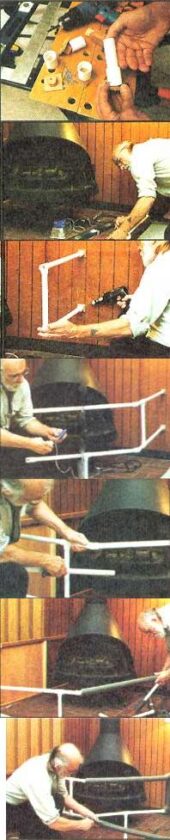
A better plan might be to install a fence like the one
below, made of white PVC plumbing pipe with grey styrofoam
pipe insulation as a cover. Both plastics are
“fire-resistant” in the face of open flame, but will melt
if they come in direct contact with a hot stove.
Restoring Metal Trim
Several readers have asked if there is any way to bring
back the shine to rusty finials, worn foot rests and other
once-bright-plated ornamentation of an old stove other than
expensive nickel-plating or spraying with aluminum
(“yuck!!”–as one lady puts it) spray paint.
We’ve seen quite a few stoves (usually rusted or over-fired
to the point they are no longer safe to operate) put on
display for their ornamental value, and painted with gloss-
or matte-black, aluminum and copper spray paints. Some are
decorated with hand-painted vines and flowers. A
wood-heating purist might disdain these “cast-iron flower
pots,” but they can be attractive in the right setting.
Conventional paints will not hold up to stove-heat, so we
tried treating some old iron with spray paint containing
actual powdered metal. This isn’t “Rustoleum” or an other
well-known brand you’ll find in every hardware store, but
is made by small specialty outfits and sold in auto parts
outlets. At about $10/spray can it isn’t cheap. All the
brands we tested claim to restore the shiny-bright sheen of
chrome. None actually replaces the chrome plate (which is
too hard and brilliant to replicate the soft luster of
nickel, anyway). But, over old iron they do a better job
than aluminum paint, and actually look more like nickel
than chrome. The paint will wear quickly if a painted foot
rest is used as intended, and it will gradually blacken
under intense heat. But, a respray in spring will last for
the six or eight warm months in any case.
Prepare the surface of old iron by removing rust and scale
with a grinding wheel or a spring-steel wire brush on a
powerful electric drill (be doubly sure to wear eye
protection; rusty scale in an eye can be bad trouble).
Then, to de-rust thoroughly, apply Naval Jelly (also from
the auto-parts store) according to directions. If iron is
badly pitted, you can try to smooth it with grinding wheel
or file and emery paper. Spray on several thin coats of
metal-powder paint (don’t try to cover 100% of the surface
with each pass). Let dry well between coats.
Rekindling the Romance
Finally, Doug Santaniello of Bridewater, NH writes:
“I’ve checked out the draft-controlled stoves, I’ve studied
the firestove diagrams, I’ve looked at the ads for
high-performance inserts. But I kept thinking, ‘What’s
wrong with theses pictures?’ and while reading in front of
our traditional fireplace it came to me. Every one of those
products involved fire under glass.
As a longtime woodburner, I love the efficiency and
environmental safety of these old and new alternatives to
the open hearth. But guys, that’s not the point. Fireplaces
are not for efficiency but for romance–the soul-deep
satisfaction of baking directly in front of the flames and
coals. You just can’t make an apples-to-apples comparison.
When we built our house, the fireplace was one of the most
brutal chores, costing many times over budget and dragging
on for months, not to mention the terrifying weight of
masonry to be hauled from basement to roof. But my wife and
I say over and over again, with the flames dancing across
the room, ‘It was worth it. Every bit.’
In constructing the fireplace, I think that we’ve arrived
at an ideal marriage, combining the romance of the
fireplace with all the advantages of wood heat. Our
solution was to combine a wood heater and a fireplace in
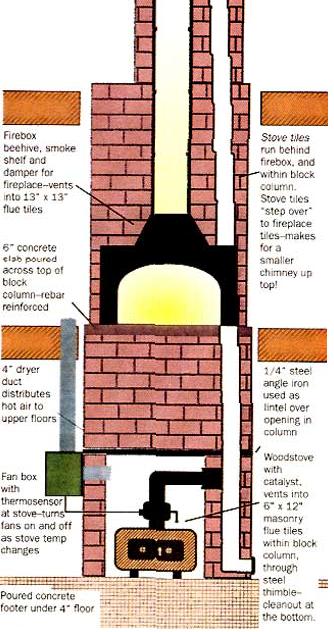
the same structure. The diagram shows how we did it: a
woodstove in the basement inside the fireplace column,
venting out through a separate tile stack within the
fireplace/chimney structure.
Here are the advantages. 1. You get both a stove and a
fireplace for little additional money. If you own the stove
(we did), the extra cost is about $300. 2. You get one of
the safest possible places for a woodstove in a house (what
could be safer than a concrete box?). 3. You keep all the
mess–sawdust, ashes, smoke, insects–out of your
living area. Actually, this was my main reason for doing it
in the first place!
I had considered plumbing the stove into the hot water
heat, but found that hot-air venting is much simpler,
quickly bringing heat to the upper floors. We also get a
nice thermal-mass advantage as the woodstove heats the
masonry and concrete.
We were concerned about an untended fire downstairs, so we
use smoke and temperature detectors throughout the house.
And I’ve been thinking about some enhancements–an
outside air intake for the woodstove, dust and humidity
control for the air system, a temperature monitor upstairs
to let us know when to re-fuel.
But as it stands, the system works just great, giving us
the satisfaction of wood heating and light gracing our
living room.
Used Stoves
Mary Olson’s Poppa Bear is the largest of the
firebrick-line “step-stoves” made by the Fisher Stove Works
of Eugene OR, before they and a lot of other makers of
airtight stoves were run out of business by state emission
controls and efficiency requirements. Some poorly-welded
early step-stoves were prone to warp (the lower, front
section of top became much hotter than the step-up at the
rear of the stove). However, late-model Fishers are some of
the finest welded-steel stoves made (guaranteed for a
lifetime–that is meaningless now, as the maker is
kaput) and will heat your house so long as you treat them
with respect. They are generally a good buy on the used
market.
Pre EPA airtight stoves such as the Fishers can produce a
greasy, noxious, creosote-laden smoke if operated in an
air-starved mode. According to EPA regulations implementing
the Clean Air Act of 1972, they may not be manufactured or
sold new in the U.S.A., but are “grandfathered”–legal
to buy, sell, own and operate as used appliances–and
may be operated nearly everywhere but a handful of cities,
coastal and valley inversion bowls where the smoke
accumulates and becomes a smog so virulent it has been
known to eat the paint off cars.
BUT, before you buy or sell, check the local building,
health (air-quality) and fire codes. Many smog-prone
jurisdictions (and a few that really don’t need the
controls, but want to legislate political correctness) will
approve nothing but “government stoves.” Even removing and
trying to put the stove back after remodeling can void the
grandfather clause that exempts stoves in place prior to
adoption of restrictions.
With thousands of stove models made since the 1700s, there
are no published value-comparisons that mean much. Besides,
the rule of thumb is simple; the bigger the stove’s
firebox, the more fuel it can hold, the more radiating
surface it has, thus the more energy it can handle, and the
more space it can heat for up to the maximum fire-life for
any stove: about eight hours. A big 1-ton black-iron
kitchen range has the same size firebox as a lovely little
green-enameled Jotul #100 box stove. Either will heat a
cabin or a room or two, but not a whole house.
A Poppa Bear will heat the house all night long in any
weather, but can cook you if temperature outdoors is balmy.
To produce less heat in any free-breathing stove, keep the
fire small, the door open and damper all or part-way
open–for less fuel-efficiency, cleaner stack-exhaust,
but less heat. Not till you close the door so the stove is
fully airtight, and ration air flow through a partly-open
draft control in front and damper in back, do you put the
stove into high-output air-starved (and, super-smoky) mode.
Used wood stoves are advertised in country-town newspaper
Classifieds and “Want-Advertiser”-type magazines. Asking
prices for good-quality c. 1970 airtight stoves in good
operating condition range from $150 to $1200 depending on
size, construction quality, finish, age, cosmetic
condition, location (they are HEAVY) and season of the
year.
The more a stove cost originally, the more it goes for
used. Cast iron models from Canada, the U.S. and Europe are
most expensive, welded steel next, and Asian-imports made
of thin iron castings least expensive.
All genuine antiques and some superior-quality modern
stoves–such as soap-stone parlor stoves and cast-iron
cook ranges–can appreciate with age.
A large-sized U.S. iron stove such as a Vigilant from
Vermont Castings or an Irish Waterford will go for perhaps
$750. A fair price for a Taiwan import of the same
capacity, and in good (uncracked) condition would be about
$250, while a big, top-quality steel stove such as the
Fisher Poppa Bear will sell for around $500. Smaller but
still top-quality models such as the Vt. Castings Defiant
or a Fisher Mamma or Baby Bear will sell for perhaps $50 or
maybe $100 less.
Why Sell?
For what its worth We’d would never sell a Fisher or any
other well-designed, well-made pre-EPA airtight if we had a
barn with a vacant corner. Clean it well, coat it inside
and out with axle grease and store it till the next
fossil-fuel crisis. Sure as the sun rises in the East, gas
lines will lengthen and heating oil will double in price
some time in the future. And, sure as the sun sets in the
West, fine old low-tech heaters like the FisherBears will
become as valuable as old stoves were back during the
1970’s Oil Embargo when folks were offering megabucks for
anything that would keep then warm with a wood fire.