Perhaps no other endeavor has captivated the 0minds of
MOTHER readers as much as living independently, free of the
indentured servitude of the electrical grid. For nearly
half a century, the photovoltaic cell, generating DC power
solely from the rays of the sun, has represented one of the
best avenues to that independence. At long last,
developments in those renewable energy systems have made it
easier for us to live within our solar income while
maintaining our quality of life …and without first
obtaining a degree in electrical engineering. As appliance
energy-efficiency continues to improve, better appliances
made more easily available to energy-conscious buyers, and
new equipment for managing homegrown energy (and selling
the excess to the local power company) finally taking the
intimidating learning curve out of system installation, the
dream of decentralized generation is now. Off-the-gridders
are being joined by nations and municipalities in declaring
this to be the year renewable energy becomes the people’s
power choice.
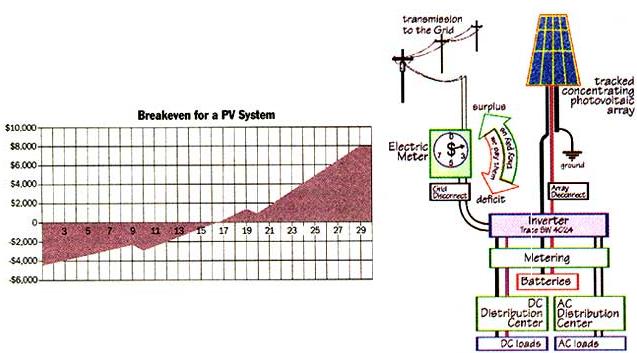
Can a home PV system, designed to be integrated into and
complement your existing grid power,
ever pay for itself? Yes, if the utilities agree to pay you
for the excess power you produce at the same rate that they
charge you for their own power. The chart assumes modest to
moderate initial system cost of $6,000, a kilowatt-hour
cost of 13 cents in the first year, and a conservative
annual increase of 5 percent thereafter. For example, a
kilowatt-hour of electricity in 2025, the endpoint of my
projection, would cost 54.3 cents. Batteries for the system
will need to be replaced every 10 years at a cost of about
$1,000, and results in the saw-tooths in the break-even
line.
Only a tiny fraction of a percent of American homes-just
over a hundred thousand-are off the electrical grid and
renewably self-sufficient, but that trend is quickly
changing. Programs designed to defrock the electric
priesthood by demystifying electricity, once attended only
by supposed environmental radicals, are now filled to near
capacity by tens of thousands nationwide, who quickly learn
how safe, simple, and rewarding it is to play productively
in the energy game. At the same time, the stakes have never
been higher: Electric rates poise on an uncertain brink,
and no one predicts that they will ever fall again. The
power brokers in this game of redefining our national
energy resources will still be the utilities, but they will
have to transcend their role as primary providers and
eventually come to terms with the fact that power has to
flow from where it is most naturally derived: from our
south facing roofs, seasonal streams, and windy
promontories where it is still free for the taking.
New Power Sources
While awaiting a dramatic breakthrough in power-source
technology, energy hobbyists and others who produce their
own power have been happy to see incremental improvements
in electrical source technology-smaller, quieter,
affordable wind turbines, refined micro-hydro, and enhanced
photovoltaic (PV) systems appearing in the past few months.
Stepwise refinements in PV efficiency, yield, and packaging
have decreased electrical cost per watt of installed
systems-generation, control, and storage-by about a dollar
from over five dollars a watt in 1993 to four dollars and
change today. Systems that might produce a kilowatt-hour of
electricity for 32 cents in 1992 may now produce a
kilowatt-hour for less than 30 cents. Federal neglect for
renewable energy programs continues to be, according to
insiders, the secret strength of the alternative energy
industry. Proudly unsubsidized, we get where we’re going
under our own power. Changes in PVs include minor tuning of
module frames, larger cell size (up to six inches from four
inches circa 1990), utilization of more of each cell, new
collection strategies (vertical traces in laser-etched
channels reduce the amount of cell shaded by the trace),
and better antireflective coatings. Silicon, a material
mastered because of transistor technology, remains the best
material for large-scale development, and current
technology approaches the practical limitation of that
material’s capabilities. Silicon cells are very good right
now.
Current improvement efforts focus more on the way light
gets to the cells than on improving photo-cells themselves.
Higher efficiency cells can be made, but the cost of making
them appears to be irreducible, so the challenge is to make
these cells work harder. By using fresnel lenses and
mirrors to concentrate sunlight as much as three
hundredfold onto small, highly efficient photovoltaic
cells, manufacturers have just begun entering the
marketplace with concentrating modules which promise a
breakthrough in yields, but do add to system complexity.
Concentrators must be pointed squarely at the sun to within
a degree or two to accomplish their light amplification,
which pushes cutting-edge tracker technology to its limit.
Since conventional flat-plane one-sun modules have
encountered problems in their adhesives, coverings, and
substrates when subjected to the stresses of collecting
sunlight over a prolonged period extending to a half
century, we can imagine how these problems will be
compounded by several-hundred-sun modules whose cells
absorb light and heat intensified by two orders of
magnitude. Since production concentrator modules have yet
to see a year in the field, pioneers who are installing
these devices can only hope the problems have been well
solved (see accompanying sidebar).
In Europe and Asia, a different strategy is being employed.
In Germany, glass roofs and south-facing curtain walls of
new buildings are now covered with photo-active materials.
In Japan, low efficiency roofing tiles are making building
tops into power farms. Swiss schools are graced with
fanciful sculptures of PVs to introduce children to the
inevitability of renewably harvested electricity. Observers
of the global energy scene worry that America’s
fossil-fuel-only policies are hurtling us toward an
inevitable wall.
For those wishing to generate some or all of their own
electrical power, an additional source of real excitement
this year centers around new controller-inverters (which
change solar panel-generated 12 or 24 volt DC power into
120 volt AC household current) that make it possible to
plug alternative energy sources directly into the grid and
get paid for our production. Grid-intertie technology has
been available but pricey for at least a decade, but until
recently has not offered a satisfying solution for a small,
self-powered home system. As MOTHER first reported in our
December/January 1994 issue [#141], however, industry
leader Trace was set to introduced their SW 4024 inverter,
a four-kilowatt 24-volt device perfectly suited to home
energy co-generation that promised to revolutionize the
field. Performance of the unit in its debut year has lived
up to expectations. Controlled by a microprocessor, the
4024 has shown itself capable of choreographing all the
entities in a complex hybrid power management scheme, from
PV arrays, wind and micro-hydro generators through battery
charging to control of a backup fossil fuel-fired generator
to keep the system alive. These units incorporate all the
controls we need to be our own utility, allowing small
independent power producers (IPPs) to actually pump excess
power back into the grid. Since most electric meters are
simple electromechanical devices which turn whichever way
the current flows, guerrilla power producers can simply
install one of these units and spin electric meters
backwards without the utility’s knowledge. Because of real
dangers to utility workers and the federal fines of up to
$30,000 per incident, we do not recommend this course.
On the horizon: smaller and friendlier balance-of-system
components, self-contained renewable power systems,
photoactive shingles for new roofs, and even tiny on-board
inverters that convert direct-current PV electricity into
alternating house current so that modules can be directly
connected to a home’s wiring.
Some of the most exciting action has been precipitated by
the easy availability of home-scale power management
equipment. PURPA, the Carter-era law, requires utilities to
buy privately generated electricity at “avoided cost.” Some
utilities, recognizing that the contribution is small and
perfectly coincident with their peak load requirements,
have adopted a generous “net metering” policy, whereby the
IPP’s meter spins in the utility’s favor when the customer
consumes electricity, and in the customer’s favor during
excess production. Revealing dinosaurian shortsightedness,
most utilities require IPPs to provide two meters, buying
kilowatts for a pittance and selling them next door for
four times as much. Public utility regulators in several
states, including Minnesota and Wisconsin, have ended the
argument by mandating equal metering for small producers.
Fairness probably falls somewhere between, as in the
European models in which utilities pay about 85 percent of
the retail rate to IPPs. This is a favorite issue of mine,
and a great opportunity for exerting pressure on state
regulators.
As massive large-scale generation projects become rarer and
more problematic, equitable treatment for local small
independent power producers will become more important in
comprehensive utility planning. Conventional grid engineers
like to point to “problems” of integrating many, small,
independent producers, but others regard these as
opportunities to reform and improve electrical service,
which has declined in reliability in recent years.
This winter, along California’s windy north coast, a series
of storms felled hundreds of unhealthy exotic trees across
Pacific Gas & Electric’s aging and overextended power
lines, plunging 100,000 customers into darkness for as long
as six days. In 1980, such a prolonged outage was
unthinkable, but during this “disaster,” PG&E
executives admitted that they and other large Utilities
have reduced crews, laid off dedicated veteran linemen, and
neglected maintenance for economic reasons. “Islanding,”
cited by the same engineers as the greatest danger of
decentralized power generation, can be a problem during
maintenance. In the classic islanding scenario, a small
pocket of homes at the end of a branch line might remain
energized during an outage affecting all their neighbors
because one or more of them had IPP arrangements with the
utility. The utilities must then be able to
dispatch–turn on and off the contributions of small
power producers the same way they dispatch their larger
generation assets in order to bring local lines down for
maintenance. But such a problem is not nearly as complex to
remedy as the utilities would have us believe.
The grid, extending right down to the point where house
current is delivered to the ratepayer’s buss-bar and
electric meter, is designed to follow the historical
precedent in which all power comes from a few large,
distant, point sources-nuclear, hydro, wind- and PV-farms,
or fossil-fueled plants under the control of the utilities
and their peers. Since electricity cheerfully flows from
wherever it’s in surplus to anywhere it’s required,
redesign of these systems to accommodate many smaller local
sources is practically trivial, involving no changes to
big-ticket infrastructure like power lines and
transformers, only minor changes to utility switching
equipment. Since utilities across the country already
employ their own renewable systems to energizing sagging
transmission lines, the technology is obviously available.
In fact, simple technological measures can turn the
“danger” of islanding into an opportunity for small
isolated communities to be electrically self-sufficient
during the inevitable grid failures which will become more
common in the future. In my view, the grid, once it becomes
a mechanism for moving power democratically between
sustainable sources and those who need to light the
darkness, will eventually be considered a treasure, not a
liability, by our children, provided reforms to its
structure are begun now.
Planning For Power
Batteries, the only cost-effective storage technology,
continue to be the weakest link in stand-alone systems.
Proponents of flooded lead-acid batteries, a technology
nearly a century old and as common as the battery in your
car, say that these units are more than adequate, providing
efficient storage with only modest attention. Incremental
improvements are doubtless possible, but since bulk energy
storage is such a small part of the battery market,
manufacturers are only now, with the promise of electric
vehicles on the horizon, beginning research in improved
energy density and deep-cycling longevity.
Even utilities, traditionally stolid and conservative
champions of massive power schemes, are getting into the
domestic scale act: In Sacramento, California, the
Municipal Utility District’s “Give Us Your Roofs” program
continues to be oversubscribed by homeowners willing to pay
more for sustain ably harvested electricity. Rather than
extending power lines gracelessly across the landscape,
Southern California Edison and other giant utilities are
offering home power systems exactly like the ones that
off-the-gridders have been installing for a decade.
Disasters in California, the upper Mississippi, Hawaii, and
Florida have made many homeowners aware that it is nice to
have enough electricity to pump a little water, listen to
emergency bulletins on the radio, and see in the dark. At
the same time, increased availability and simplicity of
small-scale applications for remote water pumping, power
for seasonal cabins and wireless communications, and other
standalone electrical applications are thrusting
photovoltaics into public awareness. By far the largest
proportion of new solar cells manufactured each year go to
power calculators and watches, but more off-the-grid
swimming pool pumps and roommates, attic fans, garden
fountains, pool aerators, cabin electrical systems, and
roadside communications stations have been installed in the
last t? months than in all previous years.
Conservation: The Measure of
Success
Controlling the energy we consume continues to be, for all
of us, the single most productive way to making renewable
energy a reality, and a necessary prerequisite for a
stand-alone power co-generation or a grid-deprived remote
community. In the face of an unprecedented housing crunch
recently, huge and poorly designed retail outlets have
gobbled up Juneau, Alaska’s comfortable surplus of sustain
ably generated hydroelectricity, forcing them to increase
their awkward petroleum addiction. In Juneau and elsewhere
across the country, citizens, ratepayers, and power company
officials are wondering how long will it be before we learn
that we must reduce waste before we try to reform
production?
And the market is just beginning to respond in force. New
appliances continue to perform better while consuming less
and less energy, enlarging the Conservation Power Plant. If
we follow our energy dollar, starting with our most
outrageously wasteful habits, space heating and cooling,
refrigeration, domestic hot water, and lighting, it becomes
clear that at least half of the power consumed in the home
is virtually wasted on inefficient appliances and
technology. Opportunity for efficiency is abundant: Total
consumption can consistently be reduced by at least that 50
percent mark in most American homes. Windows are commonly
our most wasteful appliances; replacing antique single-pane
glass with high efficiency windows reduces heating and
cooling costs by 50 to 70 percent in almost every climatic
regime. New windows are as much as eight times as resistant
to heat loss as traditional glass.
When an appliance is shown to be as blatantly wasteful as
the single-pane window, conscientious energy minders
replace it. Even break-even analysis, a technique usually
resorted to by apologists for petroleum and nuclear
exploitation to explain why nothing should be done, shows
that all costs of rewindowing can be paid back within an
average of three years, with everything considered. Those
who have rewindowed report unexpected rewards: Unusable
space near large windows has been reclaimed, and depressing
window coverings can be abandoned, improving day lighting
and reducing cabin fever. They say that rooms feel bigger,
quieter, more secure. Schemes for community rewindowing are
being tested and perfected in Alaska, Pennsylvania, and
elsewhere. Similarly, improved refrigerators;
solar-assisted instantaneous water heating; halogen task
lighting; and smaller, brighter compact fluorescent bulbs
make conservation ever easier. Not only will the business
of producing more efficient appliances ultimately help
those very appliance manufacturers, but also utilities and
consumers, as they begin to breathe easier, no longer under
the gun of half-century-old technology.
Reinventing the Solar
Panel
When the French scientist Edmund Becquerel discovered that
mere sunlight falling on certain materials produced a
steady flow of electricity, the American Revolution was
about 50 years old. His quiet invention of photovoltaics
(PV) drifted through academic halls, virtually
unexperimented with, until the space program began to
gather steam in the early 1950s, and the modern,
silicon-based solar cell was born. That cell, composed of
single crystal silicon and a supporting base of metal or
composite with positive and negative terminals, has since
enjoyed varying, though more substantial government and
private research and development, but the basic design and
that design’s overall capabilities haven’t really changed
substantially. Manufacturers have managed to make cells and
solar panels, collections of cells on a supporting surface,
a bit more efficient-about two percent more with each
decade-but never has the PV industry experienced the kind
of breakthrough that demands headlines and turns the heads
of those who already have an investment in conventional,
“on the grid” power. This year may bring exactly that brand
of change.
In just about the most unlikely place imaginable, the cold
and wind of Chicago, Midway Labs and its seven employees
announced in mid 1994 the design of the PowerSource, a
solar collector which was not only less expensive than
conventional panels to purchase and install, but promised a
20 percent increase in electrical output. After less than a
year on the market, our research has shown that Midway has
indeed managed to do what companies with a hundred times
their research power couldn’t: make more efficient PV
available and affordable. But the revolutionary design that
makes the system possible might well be part of an enduring
problem for Midway down the road.
Where conventional panels try to maximize efficiency by
encasing larger and/or more numerous cells per panel,
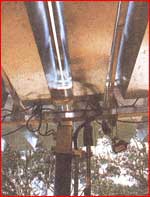
Midway drastically sized down their cells to little more
than one inch square and installed a series of magnifying
glasses over each. The focal point of each cell is
bombarded with light and heat energy equivalent to three
hundred suns, and results in an impressive rate of
efficiency-nearly 18 percent. That is to say, of the 710
watts of light energy striking the panel on a typically
sunny day, you’ll get 127 watts of electrical energy out of
the panel. The best efficiency rate that conventional rigid
panels have been able to muster to date is about 14
percent. Midway’s four percent improvement achieved in one
effort all the research and improvements in cell efficiency
for the past 20 years. Yet as far reaching as the new
collectors are, they are utterly dependent upon one piece
of technology that conventional systems often do without: a
mechanical way of finding the sun.
The Tracker’s the Thing
Motorized sun trackers, instruments capable of aiming
panels directly at the sun throughout the course of the
day, are as old as solar cells themselves. Used with
conventional panels, they can boost system output
substantially and easily pay for their $1,000-$2,000
purchase price. Yet they are still merely an avenue of
augmentingpower . If you own
conventional panels and your tracker breaks, your power
output will gradually fall off, but continue nonetheless.
PowerSource panels, however, must be aimed exactly at the
sun’s center to within one degree in order to achieve
maximum output. If the tracker aims incorrectly by more
than a few degrees, the system shuts down entirely, leaving
your toast half-browned in the process. If your system is a
stand-alone, meaning that you generate all your own power
with no tie to the electrical grid, repairing that tracker
before the stored energy in the battery bank runs out
becomes something of the utmost importance.
Midway has tried to do an end run around this problem by
including a tracker with systems that both they and their
distributors sell. Thankfully, these Wattsun FS-III
trackers have an impressive reputation for reliability, but
they do add to system cost, partially negating Midway’s
efforts at price reduction. The bottom line varies
according to the size of system purchased (generally, the
bigger the system, the cheaper per watt), so we decided to
go shopping for a very modest system capable of powering a
remote cabin inhabited periodically. We saved nearly $1,000
by picking a 460 watt (4module) array of PowerSource
modules and tracker at $2,859 (taxes not included) over a
450 watt (6-module) array of Siemens PC-4 conventional
panels and the same tracker at $3,979 (taxes also not
included). The system is not complete, however, until a
storage bank of batteries, a DC to AC inverter, a power
controller, and miscellaneous wiring are thrown in, adding
about $2,500 to the price of both systems. A larger system
(800-900 Watts) sufficient to power a family home that
conscientiously watches its power consumption and runs
propane for heat and refrigeration will cost approximately
$3,000 more than both system prices listed above.
Does the Midway price savings offset the odd possibility of
being left in the dark for a couple of days by a faulty
tracker? Yes and no. As much as we’d like to believe
otherwise, the process of installing your own electrical
generating system is as much an expression of technological
dependence as independence, right from the beginning. If
you are the type of person who just wants to have a
contractor come and set the whole .thing up while you
admire from afar, depending upon a motor you know nothing
about to move your panels is most definitely a perilous
proposition. But getting hands dirty from the very
beginning will reduce even serious problems to minor
annoyances in the long run, and that is why most dealers
want you to install systems yourself.
Though promised for a months, Midway has yet to publish a
more coherent version of its installation instructions. The
current version manages to do what few manuals can emulate,
making the process of assembly read more complicated than
it is. Instead, depend upon the dealers for technical
support until Midway finishes typing. Many will actually
provide a technical advisor for a modest fee. And fight off
that first wave of discouragement when the pieces arrive;
they really can be assembled by any careful person (see
“Northern Exposure” [Feb/Mar 1994, # 142] for a description
of soup-to-nuts system installation by a rank amateur).
Take into account that trackers are typically ground based.
Mounting them on the roof as you would stationary
conventional panels is a possibility, but you’ll probably
end up penciling in a loss of about 200-300 square feet of
backyard, as well as the trees that keep it shady.
PowerSource modules are even more insistent upon avoiding
shade than normal ones.
Lingering Questions
Ask anyone who has bought a new car in its first model
year, and you’ll have a key to our concerns and questions
about the PowerSource modules. What quirks and unexpected
surprises can we expect along the way? If everyday wear and
tear on normal PV panels makes their usable life something
in the neighborhood of 20 -30 years, what kind of life can
we expect from a panel subject to such hugely increased
temperatures and resulting stresses? If they break 10 years
into operation, that initial price advantage is going to
seem …very Yugo-like.
Robert Hoffman, vice president for engineering at Midway,
interrupted after the first two questions. “Testing is
ongoing with both the individual components in the module
and the entire module itself, but independent lab tests
have given us a clean bill of health for a 20-plus-year
life on module components. Any module though,” he quickly
added, “experiences some minute power output variation over
the course of its life. Some actually increase output, but
most drop by about a few percentage points over the course
of their lifetime.”
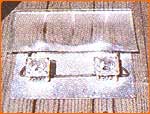
After taking apart one of the modules, the simplicity and
functionality of its design bears Mr. Hoffman out. The heat
extremes in the cell’s “eye” do not seem to affect the
overall temperature of the module or its aluminum casing
substantially, so it should last as long as a conventional
housing. The cells are a slightly more complicated matter,
however. Each silicon cell has a metal structure and wires
incorporated into it, but the silicon expands and contracts
at different rates than the metal, and over time, this
difference can crack the cells. Robert assures that the
cells were put through particularly rigorous temperature
tests. Thankfully, a lab’s ability to simulate 20 years of
temperature extremes is a lot more reliable than its
ability to simulate 20 years of bike collisions and errant
kickballs.
One last longevity question concerns Midway’s price goals
over time. Are they expecting to sell for less in 1997 than
today?
Talk to almost any dealer and they’ll tell you that the
prices of silicon cells and their modules have been
dropping by anywhere from 5 to 15 percent every year for
the past five, and that they expect that decrease to
continue. Hmmm. Let’s see. At that rate, we should be
paying nothing for solar panels by 2005. Unfortunately,
their price-reduction mantra makes a interesting statement,
but doesn’t hold water. A quick trip back through price
guides of years past indicates that if anything, prices for
a great many industry-leading models have either held
nearly rock solid or were subject to actual increases
in the last five years. Admittedly, we’re not taking
inflation into consideration, but you get the point.
Our modest recommendation is that you stop holding your
breath until those free-fall price drops arrive. We’ll bet
both module and whole system costs for
conventional equipment will remain relatively
stable over the next few years, though a slight reduction
is a possibility. Whatever the outcome, if Midway continues
to make a go of it, their price advantage should hold,
perhaps until the turn of the century. Their one charley
horse is the price of aluminum. Much more aluminum per
module is used in Midway’s construction than in
conventional design, and if that particular metal starts to
climb significantly in price, things could get dicey.
Mr. Hoffman was quick to point out that Midway is just
beginning to gear up for production, and in no way expects
his prices to hold where they are once the market begins to
take notice. “You’ve got to remember that we are currently
pricing based on an output of four or five modules a day.
Once we really get going, we are gunning for a module and
tracker cost of $2-3 per Watt in as few as three years,”
That’s going to be a tough goal to meet, as their prices as
of June were approximately twice that. Let’s see. At that
rate….
Trumping the Utilities
On average, utilities charge $10 per foot to extend the
electrical grid to new homes. Pockets will have to be even
deeper if you want to bury your lines, an aesthetic option
that typically increases costs by 10-20 percent. The lunacy
of signing such a check when all you are paying for is a
lifetime of bills is something MOTHER has been waging war
against since 1970. Either a conventional or PowerSource
system installation–take your pick-will have already
paid for itself the moment it arrives at your remote home
and begins operating. After that, never paying another
utility bill will just be a permanent reason to smile when
you get up in the morning.
But have we finally, at long last, reached the age when
technological improvements, ease of installation, and
affordability combine to make renewable energy practical
for those already paying for their power’? Well, if the
only consideration whatsoever is the bottom
line–not yet. If you buy a Midway system today
sufficient to power your home, install it tomorrow, and
stop paying utility bills next month, you might pay for the
system in 15 years. But one major fluctuation in grid power
prices, one more embargo, and stand-alone solar systems
will be a practical option overnight. And there’s no need
to wait even that long to enjoy the benefits of a small
system designed to complement your grid power. For
instance, extending your household grid to pump a distant
well, stock tank, irrigation system, or to power an
electric fence, gate, or perimeter lighting is an expensive
proposition. It is better and more inexpensively done with
a few modules. Keeping those critical appliances working,
even in the midst of a neighborhood blackout, will make you
grateful for the investment …and sooner than you imagine.
-Matt Scanlon