
The Green Gazette column focuses on renewable energy living topics, this issue includes solar cooking, agritourism and ethanol fuel.
Cooking with The Sun
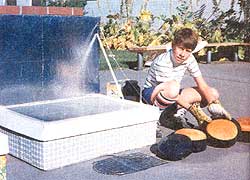
For solar ovens, cooking conditions couldn’t be better than
during the summer months. Not only does cooking with
sunshine mean lower energy costs and cooler temperatures
indoors, but many solar oven champions say food simply
tastes better.
Practically anything you can cook in a conventional oven
can be made with a solar cooker. Solar ovens follow a
method similar to slow cookers, so food doesn’t bum or dry
out. On a clear day, temperatures in a solar oven can reach
300 degrees. Cooking times depend on what goes in the pot.
Eggs, rice, vegetables, fish and chicken can take as little
as one to two hours on a sunny day. The same conditions can
also cook potatoes, bread, beans and most meat within four
hours. Large roasts, soups and stews take the longest at
five to eight hours. Even a cloudy day has solar cooking
potential, as long as there’s at least 20 minutes of sun
per hour.
Solar ovens come in three models. The most common are box
cookers ($200 and up), which trap heat
using an angled reflective surface, such as a mirror,
aluminum foil or Mylar, and a dark, metal tray bottom. One
downside of the box cooker is having to adjust the box’s
position during long cooking times. The concave reflectors
of a parabolic oven cook food twice as fast as a box
cooker, but the high price tag ($700) and potential for
bums and blindness from the directed rays make them
impractical for home use. Panel cookers ($20) combine
elements of both models. These ovens concentrate light
using flat instead of concave reflectors while an oven
roasting bag placed around a black pot acts as the heat
trap. At $20, panel cookers are much more affordable than
box cookers or parabolic cookers.
You can buy box or panel solar ovens from several U.S.
manufacturers or build your own. Solar Cookers
International, a nonprofit group in Sacramento, has a
comprehensive solar cooking website, including detailed
instructions for both models. The address is
www.solarcooking.org.
— Julie Monahan
More Great Ideas on Renewable Energy Living
A magazine promoting the “nourishment of soil, soul and
society” ought to be right up most MOTHER EARTH NEWS
readers’ alley. So we recommend you take a look at the
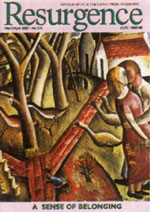
beautiful and satisfying Resurgence magazine,
founded 35 years ago by Satish Kumar, a former Jain monk.
Resurgence thoughtfully investigates renewable
energy, ecological economics, the endangered environment
and other ideas on the cutting edge of current thinking.
Promoting creativity, ecology, spirituality and frugality,
Resurgence argues for politics with principle and
science with a soul in beautifully illustrated articles by
some of the world’s leading writers, such as Jeremy Rifkin,
Vandana Shiva and Wendell Berry. Subscriptions are $50 for
surface mail ($62 for airmail) and are available at
www.resurgence.org or by mail at Resurgence;
Rocksea Farmhouse; St. Mabyn, Bodmin; Cornwall PL30 BR,
UK.
Resurgence has teamed with the Omega Institute for
Holistic Studies to offer a series of annual conferences
where visionaries, authors and activists can come together
to renew their vision and inspire each other. The second
annual Resurgence conference will be held September 5-8 on
the Omega campus near Rhinebeck, New York.
Speakers include Thomas Moore, best-selling author of Care
of the Soul, Rituals of the
Imagination and Soul Mates; Paul Hawken, author of
Natural Capitalism, The Next Economy and The Ecology
of Commerce; Juliet Schor, author of The
Overworked American and The Overspent American;
Cathrine Sneed, founder and director of The Garden Project,
a program providing job and life training for former
prisoners; Frances Moore Lappe, author of Diet for a Small
Planet and her new book, Hope’s Edge: The Next
Diet for a Small Planet (See page 44 in this issue); and author, inventor
and entrepreneur Gunter Pauli, founder and director of the
nonprofit Geneva-based Zero Emissions Research Initiatives.
For information, visit www.eomega.org.
— K. C. Compton
Agritourism: Profit From Your Lifestyle
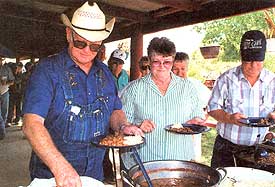
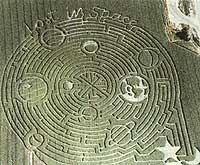
From Maine to Illinois, buses filled with schoolchildren
and conventioneers visit farms to pick a bunch of lavender,
go maple sugaring, harvest a personalized pumpkin, pet baby
animals or take a picture of grandchildren running through
a corn maze. It’s called agritourism, and it is providing
an alternative source of income for many families. The work
is often seasonal and varies depending on what the farm or
ranch has to offer tourists.
New York State provides advertising and promotion of
agritourism along the 500-mile St. Lawrence Seaway Trail.
Some Northeast farmers offer bed and breakfast
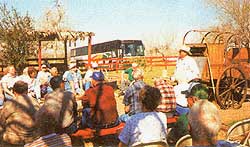
accommodations for skiers or hikers. The western
United States with its vast mountain ranges and rugged
natural scenery specializes in ranching, camping, trail
rides, hunting and fishing, large animals and the
chuckwagon.
After surveying Texas farm entertainment opportunities,
Texas A&M University converted pan of its 2,700-acre
ranch near Alice, Texas. Dubbed LaCopita Ranch, it’s the
first university-connected facility for training landowners
and managers for agritourism. According to Miles Phillips,
the program includes economic training and preparation for
jobs on ranches where the owners may want to develop an
ecotourism enterprise, but not manage it themselves.
LaCopita Ranch started offering tours this spring. Hiking
through native “South Texas mixed brush,” tourists see
white-tailed deer, javelina, bobwhite quail, doves and
numerous nongame species. LaCopita plans half-day guided
tours of the ranch for groups, as well as overnight stays
for groups and individuals, with bunkhouse accommodations,
a short guided program and free time to explore the ranch
by bicycle or on foot, and a chance to hear country music
nearby.
— Katherine Adam
How to Survive Lightning
People hit by lightning suffer both extreme heat and
damaging electricity from the bolt. Few survive. Direct
hits are not the only danger however. In open terrain,
nearby strikes also can electrocute. But it is possible to
survive unscathed — by following a special rule.
The best way to avoid lightning is to take shelter. But
sometimes we’re caught in open terrain by sudden lightning,
with no safe haven in sight. Most of us are tempted to hit
the dirt. Of course, being a tall target is bad, but
electricity flowing horizontally from head to foot on a
person lying on the ground can be lethal.
Your best bet for survival: Crouching way down with feet
together and hands off the ground. Sound a little weird
(and awkward)? The answer is in the physics.
When a wandering cow is killed by nearby lightning (which
strikes the ground or a lone tree), ground current
traveling from the strike point is usually blamed. The main
culprit is voltage: the electrical force that causes ground
current to flow. Current is merely electrons bumping each
other along an electrical path. The higher the voltage, the
greater the current flow.
Lightning striking earth is the result of a stormy
sky — which electrifies clouds with many million volts.
When a bolt of lightning hits the ground or trees, the bolt
sends current from the strike point (or tree base) out over
a sizeable circular area. This happens because the bolt
distributes a very high voltage across that
surface — but just for an instant. (Close to the
strike, that can be many thousands of volts per square
foot!) Cows roaming the area (especially those facing
directly in line with the strike point) receive a lethal
jolt between their widely separated legs.
For anyone standing near a lightning strike, the distance
between their feet is also critical. Humans might appear
safer than cattle — yet 600 or 800 volts flowing
between soggy shoes is just like stepping on the third rail
of an electric railway!
During a thunderstorm, nobody should be in open terrain or
under lone trees. A lone tree is the tallest electrical
path in an area and, if struck, a tremendous voltage fans
out from the tree’s base. For a golfer near the strike,
with feet 10 inches apart, it could be curtains. (Going
into dense woods is somewhat better; inside an automobile
is best.)
If you can’t get to shelter, make yourself as small as
possible and limit the amount of area you cover. So don’t
lie down or stand up. Become a ball instead.
— Walter S. Andariese
FuelFrom Straw
Ethanol fuel was hailed as the savior of both farm country
and the environment — in 1992. Since its introduction,
ethanol hasn’t exactly stolen the renewable energy
spotlight.
The problem isn’t performance: Ethanol does burn cleaner
than petroleum products. For environmentalists, the problem
lies with production.
Mostly made from corn, ethanol production eats up a good
deal of fuel. U.S. cornfields are addicted to oil: oil for
pesticides, oil for fertilizers, oil for planting and oil
for harvesting. All that oil use takes a little of the
shine off ethanol’s clean record.
But corn isn’t the end-all and be-all of alcohol fuels. The
logen Corporation of Ottawa, Ontario, has developed a
process that produces ethanol from much less
energy-intensive sources, such as wood chips and straw. The
process is very similar to ethanol production from
corn — or, for that matter, alcohol made for human
consumption.
Logen’s demonstration plant went online earlier this year.
The plant turns straw from nearby wheat and barley fields
into ethanol that is then sold to local reblenders. The
plant is currently the only one of its kind in the world,
although logen is looking for places to expand, including
the Canadian prairie, U.S. Midwest and the United Kingdom.
For more information, go to logen’s website at
www.logen.ca.
— Sarah Beth Cavanah
Resources:
Entertainment Farming and Agritourism
www.attra.org/attra-pub/entertainment.html
Miles Phillips, Extension Ecotourism
Specialist at LaCopita Ranch
mdphillips @ ag.tamu.edu
agfacts.tamu.edu/-mphillips
The Farm & Ranch Recreation Handbook
uwadmnweb.uwyo.edu/RanchRecr
The MAiZE, corn maze makers
Springville, UT
www.cornfieldmaze.com
La Mota Ranch
Hebbronville, TX
www.lamotaranch.com