

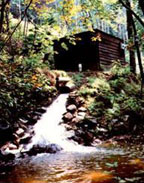
Since the heyday of the Rural Electrification
Administration, power production has been pretty much left
to big business . . . but the trend towards creating a private microhydroelectric plant may have begun to reverse this situation.
It would be easy to get the impression, in the face of the
controversy and publicity that have been generated by
nuclear energy of late, that fission-derived electricity is
the main source of generated power in the United States.
Therefore, you might be surprised to learn that only about
10% of this country’s electrical needs are actually
provided by reactors . . . and that a renewable resource,
hydroelectricity, actually outstrips the atom in terms of
total watts produced.
Unfortunately, most major rivers were dammed decades ago,
and little hydropower capacity has been added in recent
years. And that’s a real pity, because water power has
consistently proved to be the least expensive way to
generate electricity and is–many authorities
believe–the most environmentally benign method, as
well. However, there is significant untapped hydropower
potential in small streams, and this source of energy may
be particularly appealing to enterprising individuals with
an eye to the future.
Microhydropower is the Department of Energy’s term for any
installation with less than 100 kilowatts (KW) of capacity.
(To put that number in perspective, consider that most
households use an average of about 1 KW per hour, while a
nuclear plant might generate about 1,500,000 KW per
reactor.) In the past, the expense of building these very
small private microhydroelectric plants couldn’t often be justified by the
value of the power generated . . . but, as most of us are
painfully aware, the cost of electricity isn’t what it used
to be. Today, a resourceful person with access to some
capital can put together a microhydro site for a price that
makes sense as a long-term investment.
DO IT ON PURPA
One of the main factors making it possible for a small
hydro site to become a moneymaking proposition is a
federal regulation: Section 210 of the Public Utilities
Regulatory Policy Act of 1978 (PURPA). Among other things,
the edict specifies that power companies must purchase
power from independent producers at what is called “avoided
cost”. This means, very briefly, that the utility is forced
to buy the power (which wasn’t the case previously) and
that the producers should be paid what it would cost the
power company to generate the same amount of electricity.
[EDITOR’S NOTE: This is all a great deal more complicated
than it sounds . . . so much so, in fact, that the
regulation has been challenged in the Supreme Court.
Nonetheless, nearly all utilities do buy electricity at
this time.]
Of course, few companies are paying as much for power as
they’re charging for it. (After all, the utilities have
such additional expenses as supplying the lines, customer
service, billing, etc.) But PURPA has made it possible for
small producers to receive at least some payment for the
electricity they’re capable of generating. And with
buy-back rates (the price paid by utilities to small-scale
power producers) running between 2 cents and 10 cents per
kilowatt-hour (KWH) across the country, microhydropower is
capable of becoming a paying proposition.
LAUREL CREEK HYDROELECTRIC
Perhaps the best way to understand the potential of
microhydropower is to examine a successful example. Several
of MOTHER’s staff members have been keeping an eye on one
such project since its beginnings, and recently paid a
visit to the finished site to see it in full production.
The Laurel Creek microhydropower installation was started
back in 1980, when a group of individuals–working
under the auspices of the Blue Ridge Group Sierra Club and
Appalachian State University (both of which have their
headquarters in Boone, North Carolina), and cosponsored by
the Blue Ridge Electrical Membership Corporation
(BREMCO)–got a $21,416 Department of Energy
Appropriate Technology grant to study the microhydropower
potential in Watauga County, North Carolina and build a
demonstration site.
Laurel Creek, the waterway they chose, is a cascading
mountain stream in the western part of the county. The
group erected a tiny (two-foot-high) dam, which diverts
water into a penstock . . . and from that point, 1,640 feet
of 8″-diameter plastic sewer pipe stretches down the
mountainside next to the creek, for a total drop of 178
feet.
The crew had several good reasons for deciding not to build
a more typical tall dam. First and foremost, they were able
to avoid the primary disadvantage–in the
environmentally oriented minds of the developers–of
large hydropower installations: the need for flooding the
land behind the dam. Second, from a practical standpoint,
the diversion and pipe arrangement allow much more drop (or
“head”, in hydro terminology). Third, getting permission
for their project–which required only a verbal OK
from local wildlife agencies–was less complicated
than it would have been if construction of a larger
installation had been planned. And finally, the
expense–even though the pipe alone cost more than
$5,300–was a small fraction of the investment that’s
necessary to build a big dam.
Of course, before any work was done, the rate of water flow
in Laurel Creek was measured on a regular basis and its
profile compared with that of other streams in the area (as
gauged by the U.S. Geological Survey). Once all the data
were analyzed, Dr. Harvard Ayers (the program director) and
builders Andy Feimster and Bob Powell decided to take no
more than 2.5 cubic feet per second (CFS) of water–or
1,125 gallons per minute–from the creek. That amount
equals about one-third the mean flow in the stream . . .
and will leave sufficient water for aquatic life, while
allowing the plant to operate about 90% of the time.
(Should a severe drought occur, a partial or complete
shutdown of the system would be required in order to
maintain flow in the creek.)
Once friction losses in the 8 inch-diameter pipe were
calculated, the designers found that they had 145 feet of
head to work with. And since any figure over 60 feet is
considered to be within the efficient range of a Pelton
wheel, that popular and widely available turbine was the
obvious choice. The 15 inch-hydraulic-diameter runner (which
was supplied by Canyon Industries in Deming, Washington)
looks much like a thick plate with a number of oddly shaped
spoons attached to its periphery. Water shoots at the
buckets from two 2 inch-diameter nozzles to spin the manganese
bronze casting. The shape of the cups splits the jets and
ushers the water out to the sides of the housing . . .
where it falls (having given up its energy) and exits
through a drain in the floor.
This rather primitive-sounding device spins at 720
revolutions per minute (RPM)–under the force of the
roughly 156 pounds per second of H 2 0, moving at just
short of 65 MPH, that strikes it–and the net result
of all this action is the generation of about 30 horsepower
at the 1-5/8″ shaft. The turbine is linked to the generator
by a pair of V-belts that run on adjustable pulleys sized
to provide a speed increase of 2.54:1.
The generator itself is actually a 50-HP, three-phase
induction motor that–since only two of its “legs” are
used–is run as a 30-HP, single-phase generator. It
was purchased used, but entirely rebuilt, for only $500 . .
. a price that represents a saving of about a thousand
dollars when compared with that of a new synchronous
generator.
Besides its low cost, the induction generator has another
very useful property. When operated as a motor, it receives
power from the grid and spins somewhat slower than the
standard synchronous speed of 1,800 RPM (this difference is
known as its slip speed). But if the induction motor is
driven to the slip speed above 1,800 RPM, it begins to
generate power. Furthermore, at that point the utility
line’s signal still regulates the voltage and frequency of
the power being delivered (a process called grid
excitation), so no complicated and expensive speed control
is needed to insure that generator and utility stay in
phase.
There are, however, a number of protective circuits needed
to make the two-way hydro/utility hookup safe. The Laurel
Creek control panel–the design for which was donated
by an electrical engineer, Richard Suhre–includes
over–and undervoltage relays, a frequency relay, and
a starter used for getting the system up to speed. In
addition, because the generator depends on the power
company’s grid for voltage and frequency regulation, it was
necessary to devise a way to shut down the plant in the
event of utility failure. (This also protects any power
company workers from being shocked by water-generated
electricity when they’re repairing defective utility
wires.)
The arrangement the team developed consists of a simple,
fail-safe bypass that diverts water from the turbine in the
event of a power failure. During normal operation, a valve
in the diverter pipe is held closed by compressed air and a
solenoid. But if grid power is lost, the solenoid
automatically kicks open . . . releasing the air, opening
the valve, and thus allowing the water to go around the
turbine. When it’s time to start up again, the diverter
valve is closed, with the help of either a footoperated
pump or a small compressor.
Two meters monitor Laurel Creek Hydro’s performance. One
unit registers the amount of power consumed at the site for
lighting, compressor operation, etc., and the other
measures the current going back into the grid. Of course,
the former reading indicates the electricity charged out at
BREMCO’s retail rate, and the latter refers to that paid
back at the contract price of about 3¢ per KWH. (This
two-meter method is the most common utility-accepted
arrangement.)
THE DO-IT-YOURSELF CONTINGENT
Thousands of hours of volunteer labor went into the
construction of Laurel Creek Hydroelectric, and this “sweat
equity” was vital to the project’s maintaining an
attractive “bottom line”. However, careful selection of
materials and equipment also played a big part in keeping
costs down.
For example, Andy and Bob built the powerhouse from
recycled timbers and rough-cut siding in order to save on
lumber costs. They also made such components as the
equipment lifts, the turbine housing, the belt guards, and
the control box . . . instead of purchasing them. At the
intake end, no more ready-mix concrete than necessary was
used. The dam was tied to bedrock with rebar . . . poured .
. . then covered with hand-laid rock.
The group also showed considerable ingenuity in dealing
with the often tricky problems of pipe mounting. The top
three supports are made of reinforced concrete and rock,
but those down the remainder of the run consist of
hand-split locust poles. The posts were pounded into the
ground with’a wooden sledge, and the pipe was lashed to
them with cable. At one point, where the penstock had to
span a small ravine at a height of 7 feet, several pairs of
thick locust poles were set in concrete to support the
needed bridge.
The secure mounting of the pipe is particularly important
in a high-head hydro site because of a potential problem
called “pipe hammer”. This disturbance can occur if a valve
is inadvertently shut off too quickly . . . it’s akin to
the banging that sometimes takes place when a tap is closed
in a poorly plumbed house. However, whereas “faucet rattle”
is merely annoying, even minor pipe hammer in a hydropower
penstock can easily destroy a poorly mounted system.
Another disaster that had to be guarded against was pipe
implosion, which can be caused by the vacuum created behind
water flowing from a pipe with its intake closed. To
prevent such a calamity, Andy and Bob installed an air
bleed near the top of the penstock. A 3 inch-diameter polybutyl
pipe is connected to the 8 inch-diameter plastic and runs
uphill to a point 10 feet above the intake. Thus no water
can escape through the tube, but air can be drawn in if
necessary.
FINANCES FOR A PRIVATE MICROHYDROELECTRIC PLANT
Dr. Ayers estimates that, if the group hadn’t saved money
through the use of donated labor and careful equipment
selection, the finished price for the site could have
totaled more than $50,000. He hastens to add that one
cannot, today, hire an engineering firm to develop a plant
of this size and expect to make a profit.
As it stands, though, the ratio of dollars invested to KW
capacity is quite favorable at Laurel Creek. With just
short of $22,000 spent and a delivered output of 17.5 KW,
the price per KW is well under the widely accepted
guideline of $1,500. In fact, as a point of reference,
Laurel Creek Hydroelectric was put on line for less money
per KW than it costs a utility company to build a
coal-powered plant.
In purely economic terms, the generator will deliver an
average of about 132,000 KWH to BREMCO each year, bringing
in a gross income of about $4,000 annually. (This figure
will, of course, rise as electric rates go up.) Maintenance
should be minimal–including bearing lubrication, belt
dressing, trash rack cleaning, and inspection–so the
major expense to be considered is capital. If the money
used for Laurel Creek’s construction had been borrowed at
prevailing rates (which, of course, it was not . . . being
a grant), the system would net about $200 each year (and
more as rates rise) for ten years, at which point it would
be paid off: From that time until the end of equipment
life–a minimum of ten years more–the income
produced by the site would be largely profit.
Still, the most difficult aspect of developing a
private microhydropower plant site–beyond acquiring or getting
access to the necessary expertise–is raising the
money. Grants similar to that which provided Laurel Creek
Hydroelectric’s source of capital have dried up with the
“new austerity”, and the possibility of federally backed
loans is doubtful (the mechanism is there but no funding
has yet been provided). And since the costs will run at
least $1,000 per KW of capacity, the total sum would add up
to more than most folks’ savings accounts. Furthermore,
banks are likely to be reluctant to make loans, simply
because the concept of a profitable small–scale
power–generating facility is so unfamiliar. For now,
sites such as Laurel Creek offer the best references you
can provide to lenders.
Finally, unless you’re lucky enough to find one of those
increasingly rare “small hydro” sites (the DOE’s
designation for those between 100 and 3,000 KW), you’re not
likely to be able to retire on your mini-utility’s income.
Yet there are tens of thousands of locations along small
streams in the U.S. that could be developed profitably, and
their net power production might well eliminate the need
for several nuclear plants. (For example, in a 24-county
area of western North Carolina alone, it’s been estimated
that there may be as much as 10,000,000 watts of potential
. . . enough to supply several thousand households.)
A few years ago, experts interested in very small
hydroelectric site development were concerned with the
question of whether developers could afford to build such
installations. The question that’s more frequently heard
today is, “Can we afford not to build them?”






