



A short while ago, most North Americans thought solar energy
too exotic to be put to any practical use. In the past few years our worsening energy situation has
changed the picture considerably. Sun power is now becoming a
standard means of heating homes and domestic water, and
its popularity is no doubt due–at least in
part–to the feelings of self-sufficiency and wellbeing
that an “independent” energy source can provide. In fact,
harnessing the sun has become so widely accepted that a
number of regional governments (California’s San Diego
County, for example) now require that solar features
be incorporated in all new construction.
However, when
someone mentions producing electricity from
sunlight, most of us are probably still inclined to be
skeptical. We assume the technology isn’t ready and photovoltaic applications are better
left to the latest Buck Rogers episode. “Not so!” I say. For many people, practical solar electric power is
here today and at affordable prices! And how, you may
ask, do I know? Well, for one thing, a bank of solar cells
provides all the electricity used in my family’s
home!
How It’s Done
Changing sunlight (photons) into electricity
(electrons)–the process called photovoltaic
conversion–was pioneered by Bell Laboratories in the
mid-fifties. And the silicon solar cells that Bell first
developed for the space program are still the workhorses of
the industry.
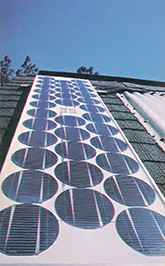
The cells are sliced from a cylinder of
ultra-pure silicon crystal, which is nothing more than (
highly ) refined sand. Every wafer is then
chemically treated and processed to form a semiconductor
junction (the technique is similar to that used in the
fabrication of common transistors). It’s within this thin
semiconductor junction that electricity is generated.
And
just how is the power produced? Well, photons strike the
junction, liberating electrons (the action involves a
mechanism that can be fully explained only by an excursion
into quantum physics that I’d rather not make). The freed
electrons are then collected by a conductive grid placed over
the face of the cell. When a wire is connected from the front
grid to the back of the cell, current flows.
Each cell
generates about 1/2 volt of DC electricity, while the amount
of current (amperage) depends upon the number of free
electrons–which is proportional to light
intensity and the size of the cell.
Since each unit is
capable of producing only about 1/2 volt, the cells must be
connected in a series circuit in order to increase the
voltage to a useful level. (The procedure is similar to
stacking flashlight batteries.) Hence, 24 cells will, in
theory, give a total output of 12 volts. In actual practice,
however, each cell’s output is closer to 0.46 volt, so 26
cells are required to produce a full 12 volts. And, though
amperage varies from manufacturer to manufacturer (depending
on the efficiency and size of the cells), a typical 12-volt
panel might produce 2 amperes.
If left unprotected ,
silicon photovoltaic cells would be susceptible to damage
from moisture and airborne contaminants. So, after they’re
wired together, the wafers are laid face down on a sheet of
safety glass. A piece of plastic (such as Mylar) is then
stretched across the back of the assembly and heat-bonded.
Last of all, the 3/8″-thick panel is crimped into a metal
frame… both to protect the glass and to help conduct heat
away from the cells. A perfect seal is then insured by
applying a liberal bead of silicone sealant along the joined
edges.
Dollars Per Watt
With the background information pretty much taken care
of, let’s examine a couple of the practical aspects of solar
electricity: the size and type of setup you
might consider installing. And, since most folks will allow
cost to determine just how far they go in developing a
photovoltaic system, let’s start by talking dollars and
cents.
Currently, the market prices for panels vary from $10
to $20 per watt of capacity. That is, a 30-watt panel
would cost between $300 and $600. But remember, that’s
for prime, first-quality collectors.
There are ways,
fortunately, to purchase panels for less money. One
possibility is to buy surplus equipment. Because the
photovoltaic industry is expanding so rapidly, today’s top
seller may be replaced by an improved version at any time,
and the obsolete units often sell for less than $10 per watt.
Look for existing photovoltaic systems that are being
updated–the Department of Energy has a few scattered
throughout the country–or check directly with
manufacturers to find out whether they have any unsold
obsolete panels in stock.
“Manufacturer’s seconds” (any
panels whose performance isn’t up to one or more of the
maker’s specifications) can also be bought at reduced prices.
The most frequently found defect in such units is the
production of a lower current output than was expected, although in rare cases a defective cell may reduce panel
voltage too. You might even be able–if you can do
business with a vendor who has a government contract–to
acquire panels that have been rejected merely for cosmetic
reasons (such as discoloring or blemishes), which in no way
affect the performance of the units!
If you shop prudently,
you can probably find imperfect collectors for as little as
$5.00 per watt. And, if you are able and qualified
to inspect them before you lay your money down (or know
someone else who is), seconds may prove to be the best way to
start a home photovoltaic setup. But be forewarned: the
increased interest in solar electricity is rapidly drying up
the surplus-and-seconds market. Therefore, bargains are
getting harder and harder to come by, and you’ll have to
do your homework.
There is, however, still one more way to
save on the cost of solar cells: quantity buying. Because
manufacturing expense drops dramatically with increased
production, companies are usually willing to give a
significant discount on large orders. As a matter of fact, as
much as 50% can be lopped off the sticker price when groups
of homeowners buy cooperatively.
But, you may want to know,
why would someone opt to use solar electricity in the first
place? Even at $10 per watt, a photovoltaic system can hardly
compete with readily available utility power. (Of course,
folks who are facing steep installation charges for long
service entrance wires may find that solar cells are
already a bargain.) But consider for a moment: Oil
prices have been rising and will certainly continue to do so, and over two-thirds of the electrical generation
capacity in the United States is petroleum fueled.
Photovoltaic cells, on the other hand–while subject to
short-term price fluctuations–are generally becoming
less expensive. Many experts think that the costs
associated with the two systems will be equal before the turn
of the century. Some even believe that the prices will
balance out within five years.
My point is that
today is a good time to begin building the
groundwork for your home photovoltaic system by setting
up a small powerplant that can be expanded as panels
become less expensive.
Practical Photovoltaics
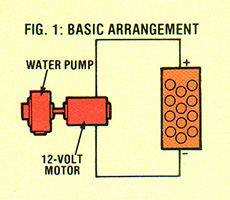
A basic solar-electric system consists of nothing more
than a photovoltaic collector and a load. Such arrangements
are commonly employed to pump water in remote areas. In this type of setup the wires from the
solar panel connect directly to the motor. When sunlight
strikes the collector, it generates electricity, which
in turn powers the pump. Now to get acceptable performance
and reliability out of such a setup, it’s important to be
sure that the pump motor is compatible with the panel’s
output. The voltage must be the same, and the collector must
be capable of supplying enough current to match the pump’s
rated capacity. However, in order to make such comparisons,
you’ll have to know just how the demand and the output are
related.
Photovoltaic panels are, for technical purposes,
rated in volt/amps rather than watts. One volt at 1 amp
equals 1 volt/amp. Consequently, 12 volts at 1 amp will
work out to 12 volt/amps. Of course, the motor used in a
pumping system may be rated in watts, but it should also have
separate voltage and amperage ratings.
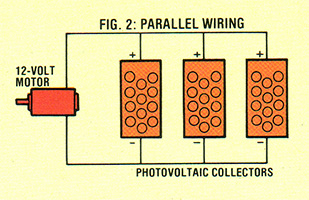
Let’s say that we want
to use a motor that has a listed capacity of 12 volts at 5
amps. First, keep in mind that most commercial panels are
standardized at 12 volts, so the voltage will likely match.
Next, let’s assume that we have a 2-amp panel, which results
in a collector with a 24volt/amp rating (12 volts times 2
amps equals 24-volt/amps). The requirement of the motor is 60
volt/amps (12 volts times 5 amps). Thus we’ll need three
panels hooked in parallel to
operate our pump properly. And obviously, in order to expand
this system, we need only add more panels in parallel to
achieve any current level necessary for a specific job.
High-Voltage Systems
Thus far we’ve discussed only 12-volt systems, and you’re
probably wondering whether a low-voltage collector can be
practical. Well, there are numerous devices that
operate on 12 volts–auto radios and stereos, small
motors, and recreational-vehicle refrigerators are just a few
examples–but there are also a number of appliances that
just won’t work at such a limited potential.
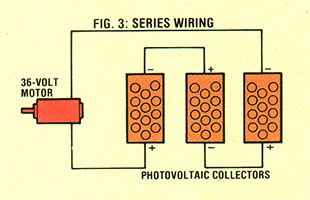
However, the
voltage of a photovoltaic system can be increased by
connecting panels in series. You must
remember, though, that amperage will seek the level of the
weakest panel in the group. Therefore, if you hook a 1-amp
and a 2-amp panel In series, the resultant amperage will be
only I amp. If two panels of 2-amp rating are hooked in
series, the output will be 2 amps.
Obviously, connecting
panels in series can make solar electricity much more
versatile than can a simple parallel setup. There’s a great
deal of 24-volt, 36-volt, and 48-volt equipment available.
Furthermore, if you hook nine panels in series, you’ll have a
110-volt DC unit. Many common 110volt AC appliances
will operate on DC current (small hand tools, kitchen
gadgets, heating elements, light bulbs, and radios and
televisions that specifically claim AC/DC; compatibility).
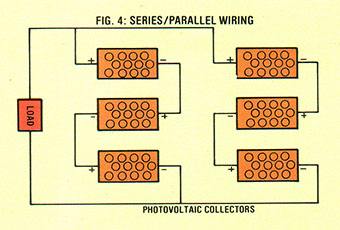
In
addition, groups of series collectors can be wired
in parallel as long as they’re stacked in
incrementsof the total voltage . For example, you must add three panels at a time, wired in series, to a
36-volt system. No less!
Saving for a Rainy Day
But–most would-be photovoltaic purchasers
ask–what happens when the sun doesn’t come out? Well,
believe it or not, solar-electric collectors do produce power
on cloudy days … but at only about 50% of their “normal”
rate. And, of course, the semiconductors take a well-earned
rest each evening. Consequently, while a power storage system
isn’t absolutely necessary, it certainly can be useful.
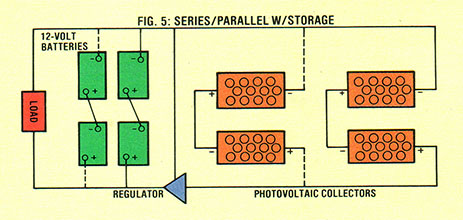
There
are numerous ways of storing electricity, but the lead/acid
battery is the least expensive and most widely available.
And, although we’ve referred to panel output as 12 volts up
to this point for the sake of convenience, nearly all
manufacturers have had the foresight to design panels that
put out the 14 to 16 volts necessary to charge a 12-volt
storage battery.
The batteries needed for photovoltaic
systems are the deep-cycle type commonly employed to provide
storage for windplants and power for electric vehicles.
They’re different from standard automobile batteries in that
they were designed to withstand numerous discharging/charging
cycles. The storage cells are available in 2-volt, 6-volt, or
12-volt units.
In the same way that panels can be grouped to
produce the output required, any number of batteries may be
connected in parallel as long as they match the
voltage of the system. And when wired in series, the
batteries again need to match the panel voltage.
To prevent the deep-cycle units from
overcharging, a specially designed regulator can be placed in
line with the electricity-generating circuit. However, if you
set up a well-balanced system–one that consumes the
same amount of power as it generates–a charge regulator
shouldn’t be necessary.
AC Too?
Some electrical devices–such as powerful electric
motors and color television sets-can’t be operated on direct
current. Fortunately, you can produce alternating current
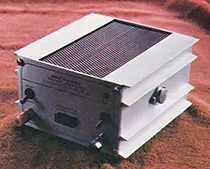
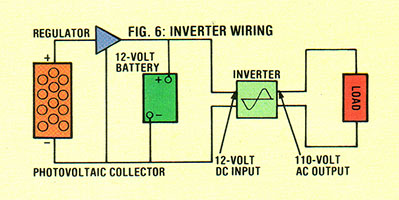
from photovoltaic DC power by using an inverter. Such a
device employs a pair of switching transistors to change the
direction of the current 60 times per second. This form of
electricity is known as 60-cycle (or-hertz) alternating
current.
The AC voltage is then run through a step-up
transformer to yield the equivalent of household current.
Although you can find inverters in a wide variety of power
ranges, units of less than 500 watts are usually the easiest
to locate and the least expensive. The smaller inverters can
get by with 12-volt input current, while
higher-wattage inverters generally require substantially
greater input voltages to overcome internal power losses
caused by the larger unit’s heavier circuitry. For example, a
48-volt input is common for a 2.5KW inverter. Consequently,
when you’re mapping out an expandable photovoltaic
installation, you need to design your series/parallel
arrangement to match any future inverter purchases. My own
system now consists of a 12-volt parallel setup with six
panels, batteries, and a couple of small 12-volt to 110-volt
AC inverters. Eventually I plan to expand it in
order to have a 110-volt DC array.
A Hybrid System–the Ultimate Marriage?
“That’s all very interesting,” you may be saying, “but
won’t it still cost me an arm and a leg to get
started in photovoltaics?” The answer is that it might well
do so, save for the fact that solar electricity has one
further remarkable property: It is perfectly compatible with,
and can supplement, another generation package.
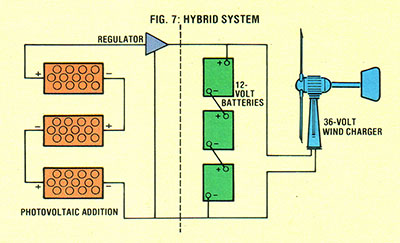
Let’s say,
for instance, that you have a 500-watt wind charger, and the
system hasn’t quite been able to meet all your needs.
Replacing it with a larger, more powerful generator would
likely require a new tower plus the new windplant.
In such a case, it’s quite probable that solar electricity
could supply the needed extra energy at a substantial saving.
The panels can be made to match the wind generator’s voltage
by linking the solar units in series. And if your wind
charger happens to be a 36-volt model, the addition of three
panels in series will almost double your power!
Now that
claim might sound a bit far fetched. Bear in mind, though,
that windplants are designed to stall in periods of
relatively calm breezes–such as often occur in the
middle of the day–during which time you must rely on
stored power. But it just so happens that solar cells are at
their peak at noon, so the panels can “fill in” for the idle
wind machine. And the reverse is frequently true under
adverse light conditions: During a storm the sun doesn’t
shine much, but the wind sure does blow.
What’s more, when
you’re augmenting a wind system with photovoltaics, the
wiring is not at all complicated. If you anticipate problems
with overcharging, by all means include a
photovoltaic charge regulator along with any other
regulating unit that may already be in the system.
Commonsense Reminders
It should go without saying that you’ll want to place
your panels in unshaded areas. But if you can’t quite catch
every bit of the early or late sun, don’t worry too much Rhe most productive hours are between 10 a.m. and 4 p.m.
(If you set up your system so it can track the sun,
you can increase its power output by about 40%.)
Locate your
storage batteries in a sheltered area that’s well ventilated
(explosive gases are given off by active batteries) and
protected from extremes of temperature. The storage
site–as well as the panels–should also be as
close to your house as possible to limit the line
losses that occur when electricity travels through wire. It’s
a good idea to check the charge in the batteries regularly
with a hydrometer. Don’t forget to add water as
needed.
Even though the panels themselves shouldn’t require
maintenance, it doesn’t hurt to dust the covers every so
often to let as much sunshine in as possible. And while
you’re doing so, it’s easy to make a quick inspection of the
connections.
A Bright Future
Yes, photovoltaic power is here … and with a little
scrounging, you may well be able to set up an affordable
system today. Furthermore, the odds are that in a few years
solar-electric homes will become commonplace. ARCO Solar, for
example, claims that it will be selling economical home-sized
arrays by the mid-1980’s. Perhaps not long after that, the
most common powerplants will be those right on our own
individual rooftops!
EDITOR’S NOTE:
T.J. Byers’s own photovoltaic system consists of six panels
rated at 16 volts and 1.2 amperes each. The setup is
currently wired parallel to provide 7.2 peak amps of charge
to a 12-volt battery bank. From there, the power is
delivered both to 12-volt appliances and to small 110-VAC
inverters.
The panels themselves are “B” grade (cosmetically
defective) and consist of 32 obsolete 3-inch-diameter cells
… which T.J. managed to obtain for about $5.00 per watt
several years ago. On a monthly basis, the system provides
about 25 kilowatt-hours (KWH).






