We face many dangers associated with climate change and we hear about them all the time: glaciers melting,
cities drowning amidst rising sea levels, ominous natural disasters looming, and precious species like the polar bears losing their homes. We hear warning signs of the effects of climate change that have yet to fully unravel at least tens of times before, but even with viral initiatives like the Climate Name Change, the problems don’t go away and we need more solutions than ever.
Reducing CO2 emissions has been on the agenda for quite some time to curb the harmful effects of climate change, but getting countries to commit to their goals is difficult. Years will pass before investments and impact on CO2 emissions materialize, which means CO2 levels won’t be stabilized for decades more. However, there is another approach to curbing climate change that yields substantial benefits in a shorter amount of time: reducing Short-Lived Climate Pollutants (SLCP). And already there are bottom-up solutions that have proved to effectively get the job done.
Black Carbon: The Short-Lived Climate Pollutant to Watch
For a detailed analysis of the bottom-up approaches to mitigate climate change, check out this Stanford Social Innovation Review (SSIR) article from the summer 2013 issue. Some solutions that are listed whose successes and challenges are thoroughly discussed include reducing traditional cookstove emissions (e.g., Project Surya clean cookstove projects), reducing open burning of agricultural waste (e.g., India’s Husk Power Systems), and reducing methane production in agricultural context.
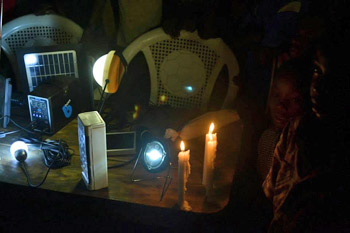
However, I’d like to focus on a single SLCP that I think is the lowest hanging fruit of all: black carbon. I work for SunFunder, and our job is to provide low-cost financing to solar companies that work to provide solar lights and solar home systems to unelectrified communities in developing countries. The majority of these communities rely on burning kerosene to use as their primary source of light at night. Not only does burning kerosene pose serious health risks (think respiratory problems), they are also expensive and dangerous to use (kerosene-induced fires are quite common). But there’s even more harm to burning kerosene, and that is its negative effect on the environment because of its black carbon emission.
According to a recent study by researchers in UC Berkeley and University of Illinois, one kilogram of black
carbon produces as much warming in the air in a month as 700 kilograms of carbon dioxide does over 100 years. In the same study, researchers performed field and lab tests and found that 7 to 9 percent of the kerosene in wick lamps ends up in the atmosphere as black carbon; when you consider the 250-300 million households worldwide that still use kerosene lamps because they lack electricity, the significance of this figure cannot be ignored. In fact, the study authors project that black carbon emissions from kerosene lamps makes up 3% of total global black carbon emissions and is twenty times higher than what was previously thought. In comparison, only half of 1 percent of the emissions from burning wood is converted to black carbon. It is no wonder that Kirk Smith, one of the study’s co-authors from UC Berkeley School of Public Health, makes the following statement:
There are no magic bullets that will solve all of our greenhouse gas problems, but replacing kerosene lamps is low-hanging fruit, and we don’t have many examples of that in the climate world.
The Implication for Off-Grid Solar in Developing Countries
Many people enter the field of off-grid solar lighting in developing countries for different reasons. For me personally, it was the economical sensibility that attracted me first: if a household is already paying so much money for poor quality lighting like kerosene — I’ve seen figures as high as 25 percent of their income — does it not make sense for that household to switch to cleaner and brighter lighting that costs the same amount or less, pays for itself in about a year, and is eventually free to use? Others may have joined because of a jaded outlook on rural electrification: seeing how the current rate of mostly coal-powered grid rural electrification cannot break even with the rate of population growth (especially in Africa), new solutions need to be brought to the table. More and more, that new solution points to decentralized renewable energy, namely off-grid solar.
However, as I recently learned, it’s slowly emerging that off-grid solar is also a solution for mitigating climate change, and it’s one that has been right under our noses without realizing its full potential. While of course the true impact of replacing kerosene with decentralized solar still needs to be further researched in the grand context of solving climate change, it’s easy enough to understand that in this scenario there is more good to outweigh the bad. I always try to be the kind of person to put my money where my mouth is, and in this case, I am putting my money and time where my mouth is. I hope you join me in doing so, or at the very least, check out SunFunder’s projects so you can learn more about the amazing work solar companies are doing to bring universal energy access to the world.
Photo (top) by Zamsolar
Photo (bottom) by Kopernik