




Exchanging Heat With the Planet
One of the most frequent comments we hear from our
customers who have switched from conventional heating
systems to geothermal is that the system’s so quiet they
cannot tell if it’s operating. Many customers tell me they
feel the need to check the thermostat and system in the
basement to be certain that everything is still working.
(Another thing they often say is, “we only wish we had
decided to switch to geothermal long ago.”)
Since soil temperatures several feet below the surface
remain at a nearly constant 50°F year round, the earth
actually acts as a massive low temperature solar storage
unit — cooler than surface temperatures in the summer,
warmer than the surface in the winter. Geothermal energy,
also known as geoexchange, is literally the transfer and
storage of heat from the earth.
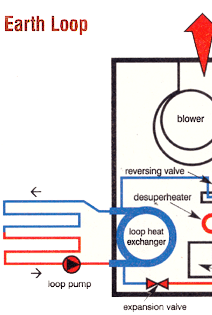
Similar to your kitchen refrigerator, a residential
geoexchange system uses water or a nontoxic refrigerant
that circulates through a ground loop where it absorbs
heat. A compressor then amplifies this heat to a higher
useful temperature before rejecting the heat through a
finned heat-exchange coil into the household duct system.
This system also allows the cooled refrigerant to flow into
an expansion valve so that a “reversing valve” can
automatically change the direction of refrigerant flow to
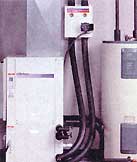
provide air conditioning. Many residential systems also
incorporate a small auxiliary heat exchanger called a
desuperheater to heat the domestic water supply, providing
60% of the normal household hotwater load. In the summer,
the hot water is a byproduct of air conditioning and in
winter, hot water is made at one-third the cost of
operating an electric hot water tank.
While a geoexchange system will not relieve you completely
of dependence on grid power, it will dramatically reduce
the amount of electricity you need from your local utility
without sacrificing comfort. Indeed, this type of system
can provide heat up to 100°F and air conditioning down
to 45°F. In summer months, if the compressor in your
basement has to work only to reject heat to the cool earth
rather than the much hotter outdoor temperatures, it can
provide two to three times as many cooling BTUs per watt of
power consumed. That equals a savings of 50% to 66% in
cooling cost and a dramatically reduced electrical load for
the utility.
Moreover, since the Earth provides 75% of the heating and
cooling energy, analysts are discovering that noise and
thermal pollution from outdoor units is minimal. Electrical
generation, transmission loads and power plant emissions
can be reduced by 400% per household. All around,
geothermal energy is a win-win option for the environment,
utility companies and the homeowners.
The Birth of Geothermal
The idea for geothermal heating and cooling dates back to
the early 1940’s when water-cooled heat pumps and air
conditioners first evolved. Engineers and technicians
realized that water had a high rate of heat transfer that
allowed for smaller heat exchangers and minimal refrigerant
charges. From the 1940’s to the 1970s, however, energy was
cheap, and not everyone had access to large volumes of
clean water or a place to discharge it. Consequently, most
of the early watercooled systems were used in commercial
structures where well water or process water was in
continually available. Meanwhile, the notably less
efficient air-source systems enjoyed a major market growth
due to their ease of installation.
These days, geothermal energy has become a major industry,
used in the creation of schools, hospitals, churches,
military bases, public housing and high-rise office towers.
Virtually every sector of the market with concern for
operating costs has come to recognize that energy expense
is significantly less with geothermal than with
conventional heating and cooling methods. In many
instances, public buildings are reaping return on the
initial investment in as little as four to five years.
Loop to Loop
There are two primary types of geothermal systems:
open-loop and closed-loop. Open loop systems operate from
well water and require space for water discharge.
Closed-loop methods, however, circulate water and
antifreeze through a series of buried polyethylene pipes.
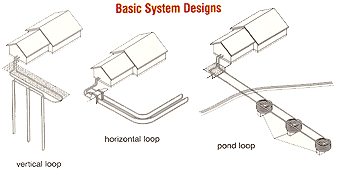
The closed loop varieties include pond loops, horizontal
trench loops and vertical loops.
Open-Loop Systems
The open-loop variety requires a source of feed water, such
as a well. They are less expensive to install, but may cost
more to maintain if your water supply is unreliable. At
Geo-Source, a typical open-loop system ranges in cost from
$8,200 for the best 2.5-ton system to $11,400 for a
two-speed, 6-ton unit. That includes interior plumbing
materials, complete installation and a ten-year warranty.
While the majority of rural wells can be used with a
geothermal system, there are exceptions. One problem can be
the presence of iron bacteria in your water. Though not fit
for human consumption, they will cause a troublesome
buildup of iron deposits inside plumbing. If your water
source contains iron bacteria, you might want to consider a
closed-loop system.
If you’re considering an open-loop system, make sure your
water supply or well can meet the following guidelines.
(Note: More specific questions regarding the chemical
content of nonpotable water and its suitability for use are
best directed to an equipment manufacturer.)
Untreated water must be potable (no brackish or
rotten egg odors).
The water table should be within 100 feet of the
surface.
The volume of available water should be equal to
twice the peak household use.
Wells drilled into shallow bedrock and specifically
into karst (cavernous limestone) formations function best
if the casing can extend below the pumping water level.
(Shallow water is easily contaminated.)
Wells drilled into sand and gravel formations
function best if a well screen is installed. (Well screens
dramatically increase the capacity of a well and assure a
longer lasting and more reliable water supply.
Lastly, always avoid the use of galvanized pipe
fittings and steel pipe with any water system. Galvanized
steel is easily corroded by electrolysis and will fail
within a few years.
Closed-loop systems are clean, very low-maintenance
and usually carry a loop materials warranty of 25 to 55
years.
Closed-Loop Systems
The good thing about closed loop geoexchange systems is
that they can be installed almost anywhere. The loop is
filled once with clean water and nontoxic antifreeze, and a
small pump recirculates the antifreeze solution between the
loop and the exchange system. Closed loop systems remain
clean, are very low on maintenance and usually carry a loop
materials’ warranty of 25 to 55 years. The three types of
closed-loop systems are pond, horizontal and vertical.
Pond Loops For a six-ton geothermal system
a pond loop typically requires a pond size of at least half
an acre and a minimum depth of eight feet. Smaller ponds
may experience thermal fluctuations from the geoexchange
system, which can be stressful to aquatic life. In central
Ohio, we find our larger ponds typically run temperatures
of 70°F at eight feet in the summer, and 38°F in
the winter.
Pond loops are typically the lowest costing design of
closed loop heat exchanger. The average cost per ton of
capacity runs $500 to $600 for materials, antifreeze and
labor. A complete installation of equipment, a 10-year
warranty and a loop attached to existing ductwork costs
from $10,400 for a 2.5-ton unit to $15,300 for a two-speed,
six-ton size unit. To make trenching to a pond practical,
the pond should be at a lower elevation than the home and
no more than 300 feet away. Soil conditions should allow
for trenching without encountering bedrock or difficult
terrain.
Pond loops are typically constructed from 300-foot rolls of
0.75-inch polyethylene pipe that carry SDR11 rating. The
rolls are prepared with spacers between each layer of pipe
— once all spacers are in place and the rolls are banded
tightly, the spacers are attached to a manifold constructed
from one-inch SCH 40 polyethylene pipe. This manifold uses
a connection method called “reverse return”, in which the
first circuit on the supply line is connected as the last
circuit on the return side. This requires more manifold
pipe but assures that each parallel circuit of pipe on the
manifold receives equal flow.
Horizontal Loops Horizontal loops
typically require two or more acres of unrestricted open
area for installation and the cost of a horizontal loop
will vary according to the loop design and the local site
conditions. Typical costs range from $600 to a little more
than $1,000 per ton of loop capacity. Complete systems with
ten-year warranties, installed with loops and attached to
existing duct work range in price from $11,700 for a
2.5-ton system to $18,500 for a six-ton, two-speed system.
The simplest horizontal loop is a single pipe loop
constructed from 1.25-inch polyethylene pipe. Single pipe
loops of up to 1,600 feet may be constructed and placed in
the bottom of a simple out and back trench dug to three to
five feet. Typically, the deeper the pipe is placed, the
more stable the soil temperature will be. The length of
pipe required for horizontal loops ranges from just under
750 feet per ton for light dry soil to as little as 350
feet per ton for heavy, saturated soil.
More involved horizontal loops may assume any number of
configurations depending on lot and soil conditions. In
addition to the single-pipe trench, there are two-, three-,
four- and six-pipe trenches. As the number of pipes in a
trench increases, of course, so does the width, which
allows geoexchange contractors to lay extended-pipe loops
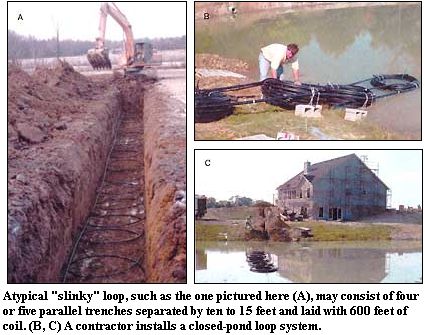
in what is known as “slinky” loops.
A typical slinky-loop field may consist of four or five
parallel trenches separated by ten to 15 feet and laid with
600 feet of coil. with an experienced crew of four —
track-hoe operator, safety-man and two loop installers —
the average work time to install a slinky loop is about an
hour and 20 minutes per ton of coil. After all costs are
accounted for, slinky loop installation averages $800 per
ton.
Vertical Loops
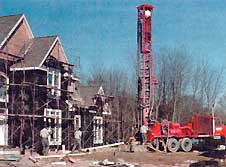
For small lots and locations with little acreage, vertical
loops are an economical alternative. They require the use
of a drilling rig to bore a four-inch diameter hole for the
heat exchanger piping. Depending on soil and rock
conditions, the depth of a vertical loop bore can range 130
to 245 feet per ton of equipment capacity. Drilling costs,
with manifold connections and antifreeze fill, average
$1,500 to $1,800 per ton. Local drilling costs vary, so
vertical loops can range from $12,600 for a 2.5-ton system
to as much as $21,870 for a six-ton, two-speed system with
a ten-year equipment warranty.
Resources
International Ground Source Heat Pump Association (IGSPHA)
Office of Power Technologies U.S. Department of
Energy
When possible, vertical wells are separated by 15 feet to
avoid thermal interference between wells. The closed-loop
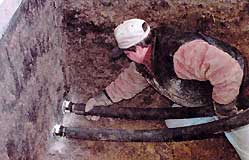
heat exchanger is constructed from two parallel lengths of
0.75-inch polyethylene pipe, and a “U” bend is welded to
the bottom end to connect the supply and return side of the
exchanger. Once the exchanger is assembled, it is
pressure-tested and a ten-foot section of re-bar is taped
to it to keep the lead section straight. Next, a grout line
is loosely attached and the exchanger is filled with water
to prevent it from floating back out of the well if the
well begins to fill with water. Once inserted into the
well, the bore is grouted up with a bentonite clay slurry
and the grout pipe is removed for reuse on the next well.
The bentonite grout serves two functions: to seal the well
and prevent contamination from surface sources, and to
provide a medium for heat transfer between the exchanger
tubing and the side wall of the well bore.
Related info:






