

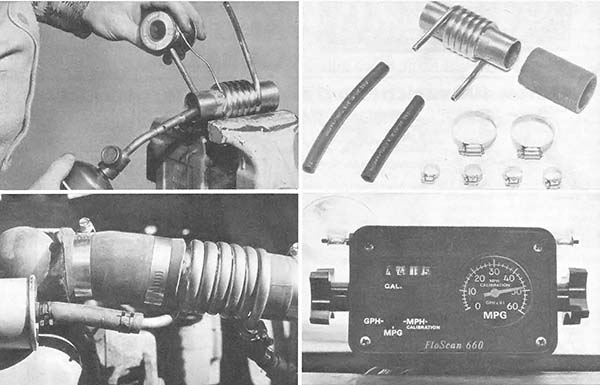
In a previous issue of this publication, we explained how to make a cold weather starting system for an alcohol-powered vehicle. Now, we’ll go on to detail an uncomplicated device that will not only warm the liquid alcohol to provide smooth operation in frigid weather, but will save you precious fuel in the bargain!
The gadget is merely a preheater that uses the engine’s cooling system to warm the fuel just before it flows Into your vehicle’s carburetor. Although such a warmup isn’t really necessary in MOTHER EARTH NEWS’ relatively temperate climate, there are folks in other parts of the United State–sand especially Canada–who will appreciate the benefits that our easy-to-make alcohol fuel preheater can provide.
How It Works
Cold alcohol from the fuel pump is–rather than being routed directly to the carburetor–“detoured” through a length of copper tubing that’s coiled around a short section of copper pipe. This piece of conduit, in turn, is spliced into the upper radiator hose of your automobile.
Naturally, as the fluid within the engine’s cooling system reaches normal temperature (which may be–depending on your vehicle– anywhere from 160° to 195°F), the warm liquid transfers a good deal of its heat to the copper-pipe-and-tubing assembly … where, of course, the alcohol fuel can pick up the warmth while on its way to the carburetor.
Because ethanol doesn’t vaporize as well as does gasoline (and such poor vaporization is, of course, aggravated by low temperatures), the preheating device actually serves two purposes: [1] It allows warm fuel to enter the carburetor, which makes that “atomizer’s” task easier and prevents cold weather carb problems … and [2] the more efficient “mixer,” in turn, provides increased fuel vaporization within the intake manifold, which improves engine economy. (The powerplant’s inlet piping will, of course, become warm itself soon after the vehicle starts running, but the fuel preheating process does provide another helpful “boost.”)
Build It Yourself
The copper ethanol warmer takes less than an hour to make and install. Start by cutting a piece of 1 3/4″ O.D. (outside diameter) copper pipe to about 5″ in length. (The external diameter of this conduit section will, of course, be dependent on the inside diameter of your upper radiator hose, since the hose must fit snugly around the ends of the pipe.) Try to use conduit with an approximately 1/8″-thick wall … to prevent the pipe from collapsing when you begin to force the softer tubing around it.
Next check the diameter of the fuel line, and cut yourself a 42″ length of copper tubing with the same diameter (most automobiles use 5/16″ or 3/8″ line). Clean the metal tube off with steel wool, then wrap it tightly around the 5″ length of conduit that you cut previously. (Be sure this pipe’s surface is also thoroughly cleaned.) Six full coils should be sufficient, but remember to leave a 1 1/2″ “tail” at each end of the copper “spring” to affix a fuel line inlet and outlet. (By the same token, allow some room at both ends of the large pipe … to use when you splice your preheater into your cooling line.)
Once that’s done, heat the 5″ pipe with a torch, brush some paste flux onto both copper surfaces, and sweat the coils to the pipe with 50/50 general purpose plumbing solder. Of course, every loop doesn’t have to be completely fastened to the conduit, but it would be a good idea to attach at least the extreme end coils with a continuous bead. (The solder not only holds the copper coils fast, but also assists the heat transfer between the tubing and the pipe.)
From that point it’s just a matter of installing the unit in your vehicle. Locate a 3 1/2″ length of rubber radiator hose that fits snugly around the large pipe, then clamp the conduit to this flexible coupling, remove your existing upper radiator hose at the engine, and fasten the new assembly to the thermostat housing. Complete the junction by reclamping the radiator hose to the preheater’s free end.
Your fuel line can be hooked into the system in the same manner. It your auto already has a flexible neoprene hose, simply cut it and fasten the ends to the coil’s inlet and outlet fittings. However, if your car’s fuel lines are steel, you’ll have to remove a small section of the metal “hose” and use two short lengths of neoprene tubing–and four small clamps–to attach the existing line to the warming loops.
Try It Out
As the ethanol fuel passes through the coils, it will naturally gain heat … but–even if the coolant within the engine approaches the boiling point–the warmth will never completely transfer into the moving fluid. Ideally, the alcohol’s temperature should not be allowed to rise over the boiling point of that liquid–which is about 173°F–since this would cause a vapor lock condition within the fuel lines and carburetor … but warming the ethanol to well above the ambient temperature is fine. (Actually, with six coils incorporated into the preheater, the temperature of the fuel will rise only to about half the temperature of the engine coolant.)
As MOTHER EARTH NEWS’ truck is equipped now, the preheating device improves fuel efficiency by up to 11% … raising the average alcohol miles-per-gallon from 10.1 to as high as 11.4 at 55 miles per hour. Now, a total of 11.4 MPG might not sound like big news, but for a truck–and especially one that gets an absolute maximum of 13 MPG (unloaded) using gasoline–this figure is somewhat impressive.
There’s a chance that your vehicle’s alcohol mileage might be increased further by adding to the number of coils in the preheater … but–after a certain point–such additions become ineffective and could result in engine hesitation and power loss when the accelerator is depressed. And, of course, you may have to experiment to get the best balance of engine economy and performance. However, we’re sure you’ll find that–even if you’re not looking for high mileage exclusively–MOTHER EARTH NEWS’ preheating device will help your alcohol-powered vehicle operate better during the winter season.
WARNING: Be advised that MOTHER EARTH NEWS’ fuel preheater is for use in alcohol powered vehicles only. If you try to use the heater with gasoline powered vehicles, you run the risk of a dangerous fire, since gasoline is a great deal more volatile than ethanol.






