
Going off-grid is about to get a whole lot easier. A handful of companies across the nation and around the globe are racing to bring to market dishwasher-sized appliances capable of meeting all of a home’s electrical needs. Remarkably reliable, cost-competitive, energy efficient, environmentally friendly, virtually noiseless and as easy to install as a new furnace, these units will change forever the way we think about — and generate — power.
This is no pipe dream, nor is it some futuristic technology still light-years away. In fact, the science behind these new wonder units is more than 150 years old and fairly basic. We’re talking here about fuel cells, devices that make electricity from hydrogen and oxygen, emitting as byproducts pure water and heat. Fuel cells have for years been on the minds and drawing boards of big-name automakers seeking to produce a near zero-emissions passenger car. But the technology remains too bulky and expensive for widespread automotive use.
Which is why, though a latecomer to the fuel cell field, stationary power systems will be first to go commercial, as soon as January 2001. And while the initial units will likely sell for $7,500 or more, that price is expected to quickly tumble below $4,000 as manufacturers move into mass production.
“There are no fundamental technology breakthroughs [still] required to make this product; they’ve all been done.” says Dr. William P. Acker, vice president of product development and commercialization for the Latham, New York-based Plug Power, a leading developer of fuel cells. “Now it’s just good, roll-up-your-sleeves engineering, designing, building, testing and product development.”
Fuel Cells 101
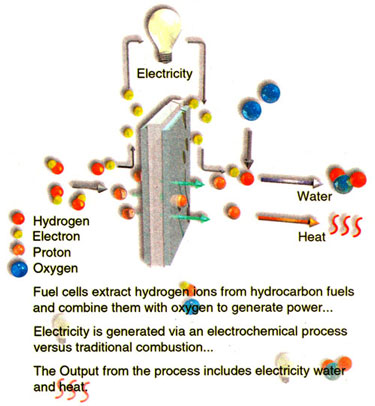
Like batteries, fuel cells create electricity through a rather simple electrochemical process. Generally, a fuel cell consists of a positive electrode (cathode), a negative electrode (anode) and an electrolyte that conducts ions between the two. There are at least five kinds of fuel cells under investigation for various applications, each using a different electrolyte, but the type garnering the most attention for residential use is called Proton-Exchange Membrane (PEM).
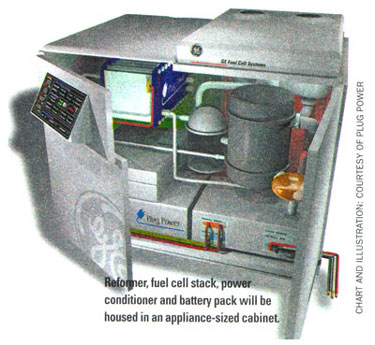
A PEM fuel cell employs as its electrolyte a polymeric membrane — it looks, says Acker, much like a piece of Saran Wrap — coated with a catalyst. Hydrogen is introduced at the anode, then passes to the membrane, where the catalyst splits the hydrogen molecules into protons and electrons. The protons then pass through the membrane to the cathode, where they react with oxygen to form water and heat. The electrons, unable to pass through the membrane, are forced to travel around it, creating DC electricity in the process. The fuel cell systems being developed by Plug Power and others will come equipped with a conditioner to turn this DC current into usable AC power.
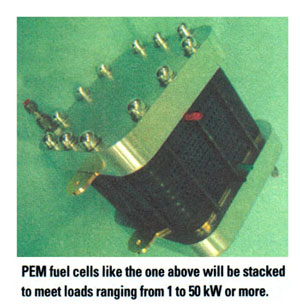
Fuel cells can be stacked — think of a club sandwich — to meet loads ranging from 1to 50 kilowatts (kW) or more. And unlike batteries, which generally have to be recharged or eventually replaced, fuel cells will continue to generate electricity so long as there is a supply of hydrogen and oxygen. Acker predicts his company’s fuel cell systems will see useful life spans of 15 to 20 years, or about what you’d expect to get from a typical home furnace.
So what has stood in the way of so simple and seemingly logical a technology for more than a century? And why now the flurry of activity? Part of the answer lies in our comfortable dependence on fossil fuels, which only in recent decades has been disturbed by the gnawing realization that humankind’s future may well depend on developing clean, renewable energy sources.
But on a more tangible level, the recent leaps and bounds in fuel cell technology can be traced to two major developments: one involving the universe’s most abundant element, hydrogen, and the other having to do with one of Earth’s more precious — and expensive — elements, platinum.
Cracking the Nut
Two key obstacles have historically stood in the way of widespread fuel cell use. First, fuel cells run on hydrogen, which exists in abundance, but almost never alone. What this means is that before hydrogen can be employed to produce energy, it must be separated from whatever element it happens to be bonding with. In the case of water, for example, the H 2 S would need to be separated from the Os. This is hardly an impossible task, but current methods are cumbersome, expensive and ill-suited for large-scale production.
Other sources of hydrogen include fossil fuels. Natural gas, for instance, is one part carbon for every four parts hydrogen, or CH 4 .
In the past few years, scientists in the U.S. and Europe have produced devices broadly labeled “reformers” that can efficiently recover hydrogen from a variety of fossil fuels, including natural gas, propane and methanol. Researchers are also working on reformers for gasoline (for automotive applications), as well as for diesel.
Plug Power and its competitors have integrated these reformers into their fuel cell systems, enabling on-site hydrogen production and eliminating the need for hydrogen transport and storage. The other huge upside, of course, is that households already hooked up to natural gas lines or equipped with propane tanks are essentially set to make the switch to fuel cell power.
But the hydrogen dilemma was only half the riddle. All PEM fuel cells require platinum as a catalyst. In fact, until recently, these fuel cells required so much platinum that their mass production was an economic impossibility.
“Ten or 15 years ago, we would have needed close to $10,000 worth of platinum to make this device,” says Acker. “Today, we need well under $100 — and it has absolutely nothing to do with the price of platinum.” The difference, says Acker, is in the amount of the metal needed. Recent technological breakthroughs have made it possible, he explains, to produce a residential fuel cell system that can power a house, using only about twice the amount of platinum found in the catalytic converter of every car.
But what does using platinum, a nonrenewable resource, do to a fuel cell’s environmental score sheet? Acker notes that while platinum is not renewable, it is recyclable. And since the platinum used in fuel cells is neither diminished nor degraded, it can, at the end of a system’s useful life, be retrieved and used again.
The Race to Market
With the biggest technological obstacles overcome, the race to market was on. At least five companies in the U.S. have pledged to commercialize residential fuel cell systems within the next 15 to 36 months. And all are backing that pledge with thousands of man hours and millions of dollars.
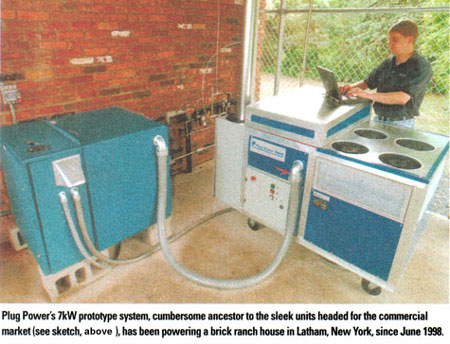
Leading the pack is Plug Power, which in June 1998 became the first company to completely power a house with a residential fuel cell stack. The three-bedroom brick ranch, home to a trio of company engineers, has been running on the 7kW system ever since.
Plug Power’s progress has impressed some deep pockets. Last February the company launched, along with General Electric Power Systems, a joint venture company to handle worldwide sales and distribution. And in April, Plug Power attracted a $7.5 million investment from the southern California Gas Company, the nation’s largest natural gas distributor. It is the kind of support that has enabled Plug Power to break ground on a 55,000-square-foot manufacturing facility, bringing the company a giant step closer toward mass production.
But while Plug Power may be ahead by a nose, it’s got competition in the field.
The Woburn, Massachusetts — based American Fuel Cell Corporation aims to hit the consumer market with a 3kW residential fuel cell system in 2001. Already, the company has successfully demonstrated its product at a home in Germany, and over the next year, it plans to build some 20 more prototype “alpha” units, followed by 600 “beta,” or second-generation units, to be tested at sites both in the U.S. and abroad.
Energy Partners of West Palm Beach, Florida, and its subsidiary, NuPower — which holds the distinction of having been the first U.S. company to run a PEM fuel cell on hydrogen produced from natural gas — is also planning systems for residential use. And Northwest Power Systems of Bend, Oregon, has for the past year been testing and demonstrating a 5kW system at sites throughout the Northwest.
Also in the running is Avista Labs of Spokane, Washington, which is experimenting with a unique, modular design that will permit fuel cells to be added or removed from a stack while the system continues to operate.
All of these companies are banking on a ready and eager market. Plug Power spokesman John Mousaw points to four key arenas where fuel cell systems will beat out conventional electrical power: reliability, efficiency, ecology and economy. We’ll add one more: autonomy.
Power You Can Count On
The story has become the stuff of legend in the offices and laboratories of Plug Power. As Mousaw tells it, about a year ago, a Bennington, Vermont, airy farmer pulled into Plug Power’s parking lot, hopped out of his pickup truck, walked into the company’s reception area and plopped a paper bag down on the counter. “I’m here to buy a fuel cell,” the man declared, prompting the receptionist to inform him that they weren’t yet for sale, that they were still in the testing and development stage. “You don’t understand, I need a fuel cell,” the man reportedly told her, explaining that he lived at the very end of the distribution lines in an area prone to power outages and that, because he is the last customer on the line, he’s usually the last one back up-and-running — sometimes going without power for days or even weeks. He then announced that the bag contained $10,000 in cash, the price he was willing to pay for the reliable power he just wasn’t getting from the grid.
While the farmer ultimately drove away with the bag full and the back of his truck empty — forced to wait till 2001 with the rest of us — the episode does illustrate the lengths to which some folks will go to keep the lights on.
Residential fuel cell systems will offer immunity to blackouts. They will also provide a “clean” power, far less prone to the disruptive and often destructive surges associated with grid power. “A lot of the surges that you see with traditional power happen because everyone is hooked together,” Acker explains. “One person rocks the boat down the street, you feel the ripples at your house.”
Moreover, residential fuel cell systems will be sized to not only meet, but beat the peak demands of the average home (most homes generally function in the 1to 2 kW range). Plug Power’s 7kW system, for instance, will come equipped with a built-in battery bank giving it a 15kW surge capacity, while American Fuel Cell’s 3kW system will incorporate a battery pack allowing it to meet I0kW peak loads. Which means you’ll be able to cut ties from the grid — and still run your air conditioner and toast bread at the same time.
And with systems designed to run on natural gas, propane and/or methanol slated for commercialization within the next few years, no matter your fuel of choice, you won’t be left in the dark.
Efficiency at Work
Fuel cells are extremely efficient power producers. They create electricity in one simple step, with no moving parts and — at least in the case of PEM fuel cells — at a very low temperature. (Compare this to the combustion process employed by traditional power plants: A fuel is burned at high temperature to create heat, the heat energy is then converted to mechanical energy and that mechanical energy is finally converted into electricity.)
Plug Power’s 7kW system will run at about 40% efficiency (a standard being matched virtually industry wide), meaning that four-tenths of the fuel it takes in will be converted to electricity, while the remainder will be converted to heat. Most coal-fired plants are lucky to see efficiencies of 35% — and then they lose another 7% to 8% during transmission across the grid.
Newer, natural gas turbine plants can achieve efficiencies of 40% or more, and some combined-cycle plants can even get up into the 50% range, but again, these plants still have to get that power to your house, and so suffer the attendant transmission losses.
The end result is that, when it comes to producing electricity efficiently, fuel cell systems will top most and match even the best power plants on the grid. But electricity production is only half the picture. The real potential for upping efficiency lies in harnessing the collateral heat and using it, for example, to heat your hot water or part of your house. Once this happens and it will happen according to virtually every fuel cell developer out there efficiencies will reach 85% to 90%.
“When you make electricity, no matter what the method, you always make some heat,” notes Acker. “Power plants can’t do anything with that heat; it just warms up the Hudson River or whatever happens to be nearby.”
Calling this another “huge advantage” to on-site power generation, Acker predicts, “The ability to capture and use the waste heat is what makes it absolutely inevitable that this technology will eventually be better than central generation.”
How Clean is My Power?
Fuel cells are exceptionally clean power producers. Because fuel cells do not combust fossil fuels, they emit none of the acid rain or smog producing pollutants that are the inevitable by-product of burning coal or oil or natural gas.
“The temperature of the fuel cell stack is below the boiling point of water,” Acker explains. “It’s warm, but not real hot like combustion.” The result is power with none of the sulfur dioxide, nitrogen oxides, unburned hydrocarbons and particulates that are spewed by conventional generating plants — and that makes the electricity industry one of the heaviest polluters on the planet.
Fuel cells that use “reformed” hydrogen from fossil fuels do, however, emit CO2 , a major culprit in global warming. Take again the example of natural gas: For every four hydrogen atoms that go to power the fuel cell, there’s a carbon atom to be dealt with. “The carbon atoms have to come out, and they come out as carbon dioxide,” admits Acker.
But even so, he stresses, fuel cells will emit no more—and in most cases far less — CO2 -per-kilowatt than do central power plants, particularly given the industry’s heavy reliance on carbon-rich coal. “They’ll also produce a lot less CO2 than your home furnace,” adds Acker, noting that this is especially true if you heat with oil or propane, each of which has a higher carbon-to-hydrogen ratio than does natural gas.
While reformed hydrogen is by no means a perfectly “green” energy solution, it’s a giant leap in the right direction.
Of course it would be preferable to separate hydrogen from water using, for example, solar or wind power. But until governments and industries have an irresistible reason to spend billions converting the existing fossil fuel infrastructure to one centered on hydrogen, we’re probably not going to see efficient, renewable hydrogen production on a mass scale.
“Changing an infrastructure is very difficult, it hasn’t happened very often… and it usually requires some kind of massive, underlying economic event to make it happen,” observes Plug Power CEO Gary Mittleman. “Given that, we are developing products that will work with the infrastructure that is in place today.” It’s one of those rare instances where it actually makes sense to put the cart before the horse.
How Much Will I Save?
According to industry estimates, fuel cell systems will save you a fifth or more on your electricity costs, given the current rates. Factored into this estimate, says Acker, are the price of the fuel (i.e., natural gas), the fuel cell system, its installation and routine maintenance.
“If you amortize these costs over a few years,” says Acker, “what you find is that for tens of millions of households, there is a good 20% savings over what people are paying for electricity now.”
The hitch here, of course, is that the ongoing deregulation of the electricity industry could and likely will drive down electricity prices. So it’s hard to know what real savings fuel cell systems will offer until we see what electricity rates look like a few years down the road.
Also, the 20% savings promised by the industry won’t be realized in most cases until the price of the systems drop to about the $4,000 mark. “But,” notes Acker, “for millions and millions of people, the price could be ten times that and it would still be [cost-effective].” He points specifically to rural applications, where, he says, if you are more than a mile off the grid, it can cost $20,000 to $40,000 to run a wire to your house. And even if you don’t pay directly for the installation and maintenance of that line, you’ll almost certainly pay for it indirectly with higher electricity rates.
You Want to Build Where?
Whether there was actually ten grand in that Bennington farmer’s bag is anyone’s guess, but the tale does point to what is expected to be one of the first large markets for residential fuel cells: folks who live, or want to live, on the edges of or beyond the power grid.
Last summer, Flint Energies, a nonprofit rural electric cooperative with some 60,000 customers in central and southern Georgia, signed on to become the exclusive distributor of Plug Power fuel cell systems in 100 of that state’s 159 counties.
“This is a great opportunity for us to be able to provide a very clean type of energy to those people who want to live two or three miles off the road,” says Jimmy Autry, Flint’s vice president of marketing, noting that the counties to be served under the agreement are mainly rural. “We are going to be able to put generation on-site in a customer’s home or cabin, be it way out on a farm or back in the woods.”
In the past, says Autry, Flint had no choice but to run long line extensions out to folks determined to live beyond the existing grid. And until last year, the costs involved in stringing those lines were absorbed by the cooperative.
But last October, Flint changed its policy, taking the burden out of the hands of current customers and putting it squarely — and heavily — on the shoulders of the property owner requesting the line Under the current rules, a new customer still gets the first quarter mile of line free, but every foot thereafter costs $3, with each additional mile totaling a shopping $15,840. And that, according Autry, still leaves the cooperative to pick up about $2,160 per mile. “It’s not going to take us long to figure out that fuel cells are going to be a much more cost-effective option,” he adds.
The first, though surely not the last, of the nation’s 1,000 or so rural electric cooperatives to enter into a fuel cell distribution agreement, Flint Energies expects to begin selling residential systems in2001, at a price of about $8,500. But, like others involved in the industry, Flint predicts that price will drop to less than $4,000 by 2003.
Autry envisions four possible avenues of distribution: outright sales, financing arrangements, leasing options or contract service agreements. For the last of these, Flint would maintain ownership of the fuel cell system and would charge the customer a flat, monthly fee for electrical power, based on average fuel, capital and maintenance costs.
“Not every customer is going to be able to dig into his pocket and pull out $8,500 or even $4,000,” says Autry, “so I have to maximize every opportunity to put one [of these systems] in a person’s home.”
Which Raises the Question
Just how big a role will electric utilities play in the distribution of fuel cell systems? That they will play a role seems certain, and not just because of deals like the one forged by Flint.
Four of the five residential fuel cell developers poised to go commercial in the next few years have deep financial ties to the electric industry. EPRIGEN — a for-profit subsidiary of the industry’s nonprofit Electric Power Research Institute — owns a 30% interest in American Fuel Cells Corporation. Avista Corporation is umbrella to both fuel cell developer Avista Labs and Avista Utilities, an electricity and natural gas provider serving more than 550,000 West Coast customers. Northwest Power Systems recently sold a majority interest to IDACORP Technologies Inc., a subsidiary of IDACORP Inc., which is the holding company of Idaho Power Company, an electric utility providing power to some 700,000 customers in Idaho, Nevada and Oregon. And Plug Power counts as one of its two parent companies DTE, Energy, parent company of Detroit Edison, which, with two million customers, is Michigan’s largest electric utility.
So what does all of this industry involvement mean? Are electric utilities, faced with an increasingly deregulated market, simply looking for another product to offer consumers who will soon face a wealth of power choices? Or are they looking to corner the fuel cells market by attaching a meter or contract to every unit, thereby blocking the route to true power independence?
We put the question to Bernadette Geyer, deputy director of Fuel Cells 2000, a nonprofit, educational organization that tracks the industry. “Fuel cell developers are not putting all of their eggs in the utility basket,” assures Geyer. “They are looking at retailing these [systems] to consumers.”
But the two scenarios are not mutually exclusive. After all, Flint Energies has already announced that it will double as retail marketer, selling fuel cell systems outright to customers who opt to go that route. And, while only time will tell, other utilities are likely to follow suit.
Plug Power’s Mittleman says that electric and gas utilities may well be a part of the distribution network, but he also predicts that consumers will eventually be able to walk into their local home appliance or hardware store and buy a system — and as manufacturing improves and markets boom, for as little as several hundred dollars (though he admits these bargain-basement prices may be ten or 15 years away).
Geyer says that utilities have “smartly taken an interest in the technology so that they are not totally usurped,” and she foresees room in the market for various modes of delivery. “There are going to be people who want to be totally grid and utility independent,” she says, “but there will always be people who find it easier to have someone else handle installation, service and upkeep issues, and so will prefer to have [these systems] offered as another function of their utility.”
Also to be hammered out with the utilities are interconnection standards, says Geyer, noting that some fuel cell system owners may prefer to stay wired as backup, while others may find themselves with net metering opportunities, or the ability to sell excess power back to the grid.
Whatever the details, one thing’s clear: Fuel cells are coming… and power as we know it will never be the same. Hallelujah!