

In my last blog, I noted that vertical axis wind turbines (VAWTs) leave much to be desired. My point was that these designs, which have been around for thousands of years, just haven’t panned out. Buyer beware: they’re not all they’re cracked up to be (See An Open Letter-To inventors of Vertical Axis Wind Turbines and Rooftop Wind ‘Technology Breakthroughs’.) I wasn’t trying to discourage people from tinkering with them, but I was trying to warn folks who think they’re going to be making a wise investment from buying one.
Many of you posted comments to the contrary, either accusing me of stomping on the dreams and aspirations of young inventors or simply not knowing what I was talking about. Some readers accused me of making baseless claims without any science to back up my assertions. Let me provide some more information on VAWTs.
While many modern VAWT inventors show videos of their turbines spinning, which convince news organizations and potential buyers of their value, it’s not spinning blades that matter. What matters is energy output. Because wind speeds are low at ground level, VAWTs won’t produce much energy — nowhere near as much useful energy as a well placed horizontal axis wind turbine. That’s why horizontal axis wind turbines are the technology of choice for most applications.
The main reason that wind speed is so low at ground level is ground drag. Ground drag is caused by friction when air flows across a surface. Friction is the force that resists movement of one material against another.
When wind flows across land or water, friction dramatically reduces the speed with which wind flows over land. Ground drag due to friction varies considerably, depending on the texture or roughness of the surface. The rougher or more irregular the surface, the greater friction. As a result, air flowing across the surface of a lake encounters less friction than air flowing over a meadow. Air flowing over a meadow encounters less friction than air flowing over a forest.
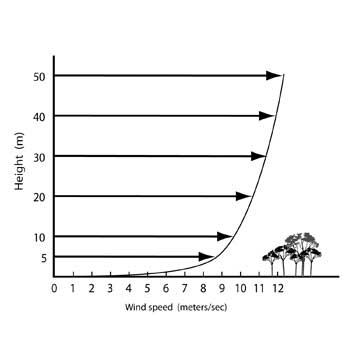
Interestingly, friction slows wind speed to a height of about 1,650 feet above the Earth’s surface. However, the greatest effects are closest to ground — the first 60 feet (20 meters) above the ground over a relatively flat, smooth surface.
The effect of friction is quite profound. A 20-mile-per-hour wind measured at 1,000 feet above the surface of the ground covered with grasses, flows at 5 miles per hour at 10 feet — where most VAWTs are located. It then increases progressively until it breaks loose from the influence of the ground drag or friction at around 80 feet.
Because the effects of friction decrease with height above the surface of the Earth, savvy installers typically mount their wind machines on towers 80 to 120 feet (24 to 37 meters). This removes them from the influence of energy-robbing ground drag. At these heights, the winds are substantially stronger than they are near the ground.
Savvy installers also avoid suburban and urban environments because the surface texture is quite rough in these areas. Trees and buildings dramatically lower annual average wind speeds. They also create a lot of turbulence and eddies — pockets of relatively dead air. Place any turbine in this environment and you can expect significantly reduced energy production.
I like the looks of a lot of VAWTs and wish inventors success, but don’t lose track of the fact that there’s very little energy in ground-level winds during a given year. In fact, a recently published study of wind turbines mounted on buildings in England showed that many turbines failed miserably when it came to energy output. Average wind speed at these levels were just too low to produce a significant amount of electricity. The inverters in many of these systems consumed more energy than the wind turbines produced in a year. See the results of the Warwick Wind Trials.
When you invest in a wind turbine, you want energy output. It’s not spinning blades, but electricity that most of us want — and lots of it — to make our investment worth the while.
Power available from the wind is a function of the wind speed cubed. If the average annual wind speed is low, which it is at ground level or even on the roofs of homes, you just won’t get much energy from a turbine — any kind of turbine. (See Rooftop Wind-Determining Your Resource.) Mounting a turbine at ground level places it in much weaker winds at most locations. It is a bit like mounting solar panels in the shade! NREL’s wind energy expert Jim Green says, “For a given swept area, VAWTs just don’t extract quite as much wind energy as a well-designed HAWT.”
I’d be happy to be proven wrong. Show me the data that indicates that a ground-level or even a roof-top turbine of any sort produces a sizeable amount of electricity during a year!
It is important to note that years of experience with VAWTS has been rather discouraging, to say the least. “Hundreds of commercial VAWTs were installed in California in the late 1980s and early 1990s,” according to energy consultant Bob Aram. “They all failed and were removed from service. These were not experimental units, but production units.”





