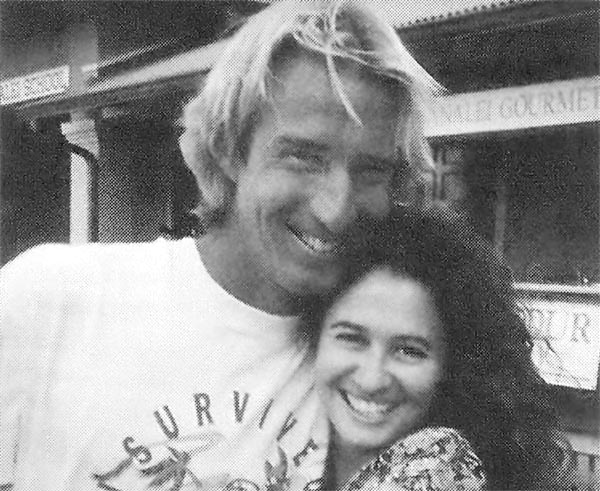
Charlie and Felicia Cowden live “off the grid” in a house they built on the North Shore of the Hawaian island Kauai. In the aftermath of Hurricane Iniki, which bludgeoned Kauai and many other parts of Hawaii in September 1992, they used their newfound expertise in domestic solar power to help their neighbors get their power back. As you will see in their story, the move to an off-grid solar system required adaptation, but the conclusions they have drawn will work for anyone who uses electricity.
Felicia: The biggest stumbling block on the way to power independence is our culture’s custom of wasting incredible amounts of energy. We waste more than we use. You simply can’t buy energy independence: you have to make a brain investment, and learn some things. We started moving toward conservation when we were living on the grid by replacing incandescent lights with compact fluorescents.
Charlie: When we were deciding whether to buy our property and build, whether to pay the money to trench and connect to the power lines at the highway or go solar, I didn’t know anything about alternative energy sources. So I asked my contractor, should I do it? He didn’t know much about it either, but he said, “It’s the future. You gotta do it:’
Felicia: So we throttled back our energy use when we moved to our new house. We were limited financially and could get only six panels (modules). We had figured we would need more, but during the sunshine months our batteries are full by noon — and we haven’t given anything up. When I visit other people, I see incandescent lights and can’t help but notice all the things being done inefficiently. It feels sinful! Solar power’s biggest gift to the environment is showing people that it’s possible to live well without being wasteful. Since moving in, I’ve become an energy evangelist, always trying to get more people into conservation.
There are so many things we wish we’d known. Nobody told us about phantom loads — things that use electricity whenever they’re plugged in, like the clock on a microwave. Four little clock radios can use up everything our panels produce in a day. We use battery-operated clocks with rechargeable batteries. The real energy criminals of the small-appliance world are the remote products that require chargers, like electric toothbrushes and cordless razors. They draw substantial current to charge their batteries, and then when the batteries are full, they continue to trickle energy. That’s a lot of burnt, dead dinosaurs for a few minutes of minor convenience — and we all have to breathe the smoke. Much better to use appliances that plug in directly and burn power only when in use. If push comes to shove, you can always brush your teeth yourself.
We’ve learned a lot since we built our house, most of it what the power company calls load management or demand side management. I can’t run the stereo when I’m doing a wash, because I chose a power-hog, double agitator washing machine. Now, I’d buy smarter and get a front loader.
Charlie: I saw a front-loading washer in the store, and I thought they’d made a mistake because the tag said it used one-tenth the power of the top loaders.
Felicia: It’s all in the torque. You’ve got to understand the difference between inductive loads, like motors and little transformers, and resistive loads, like lights. Inductive loads are power hungry, especially when they start. For example, you can’t run the vacuum cleaner when the washer’s running. The garbage disposal puts a big strain on our system —
Charlie: — and the television picture gets real small.
Felicia: If I wake up in the morning and see the batteries aren’t depleted, I look for high-demand things to do, like washing and vacuuming. Load management depends on weather. If it’s cloudy and the batteries are depleted, I think about conservation.
Charlie: At first, demand-side management is hard for people to think about. They still want to act as if they had infinite power, and they have equipment —
Felicia: — like their old refrigerator, which would take 24 modules by itself.
And when you’re buying a gas stove, it’s going to be a real problem if you have to plug it in.
Charlie: Those glow plugs on electric gas ranges burn an awful lot of energy. We tell people that they just can’t take that kind of equipment along.
Felicia: I tell people what the average household uses, and that it would require a $300,000 solar installation, so you need to start managing. People think they’ve got to make sacrifices, give up TV, live in the dark. That’s not necessary. They just have to pay attention.
When we talk about energy self-sufficiency, we try to get people looking away from money issues. Maybe you save money going off the grid, but there are more important things. When you go to sleep at night, there’s a zero electromagnetic field. And think of the stuff you aren’t putting into the atmosphere. And it’s a bonus if you save money.
Excerpted from: The Independent Home (Chelsea Green Publishing; 1993) by Michael Potts, Copyright © 1993 by Michael Potts.