
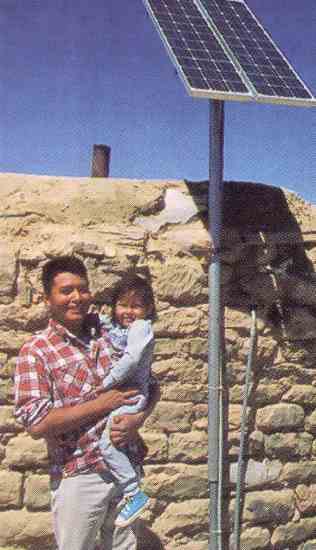
To most Americans, the simple act of flicking on the light is as taken for granted as breathing air — without so much as a thought about its possible environmental consequences. But to Sylvia Brownskill and hundreds on the New Mexico Navajo Indian reservation, accessing electricity without harming the environment is of the utmost importance — and until recently, virtually impossible.
Four years ago, however, practical technology for producing “clean” electricity became available, and now even those in the most remote locations of the reservation can flick on a light switch, knowing that the electricity generated is produced in its entirety by the power of the sun.
Sylvia and approximately 200,000 other Native Americans are members of the Navajo Nation. They live near or on 25,000 square miles of land allotted to them by the United States in treaties written years ago. The reservation spans parts of New Mexico, Arizona, and Utah and it was there that I visited three years ago.
In 1989, Tom Volek, a solar installation specialist from Albuquerque, New Mexico, approached the elders of the Navajo tribe and introduced the idea of installing photovoltaics in their community. He explained the procedure and its benefits and answered all of their questions. Excited about the idea, the elders asked Volek, who was working for a local solar-electricity distributor called Photocomm, to install power systems in over 650 of their homes. While Volek set up the systems, each of which consists of two 3.5-amp panels, two deep-cycle batteries, battery boxes, and power control units, he took the time to show many of the young Navajo men how to do the installations themselves. Says Pauline Peshlakai, a Navajo Community Health Representative for the Indian Health Services, “What the Navajo youth need more than anything else are career opportunities. Solar installations, which Tom Volek has trained many young men to do, is one excellent way of training our youth for their future.” She hopes these young men will eventually be able to use these new skills outside of the community for extra income.
Navajos now have access to fluorescent lighting, fans, 12-volt radios, TVs, sewing machines, and power tools. For the most part PV can run any electric items that are able to operate from a low-voltage power source. Many of these solar installations were set up on roofs covered with sheep dung, which hardens like adobe, The incongruity of high-tech solar panels on structures made of such primitive building materials is interesting, to say the least, but confirms once again how suitable solar electricity is for almost any installation.
The price for all 650 installations was $1,250 apiece. Because the Navajos did not want to ask the government for financial assistance, they paid for the installations with money they earned from leasing mineral rights to coal and oil companies. It’s ironic that the dollars Navajos used to buy renewable solar systems were the same dollars they had earned selling nonrenewables.
What does this new solar power mean for the Navajos? Most important, it means they can continue to live close to nature without being tethered to modern trappings. To many Navajos, the “white man’s” obsession with making their social lives, food, and all other necessities fit into an image of processed perfection causes the loss of connection with nature — a price that, for the Navajos, is too high to pay.
The Navajos can now breathe cleaner air as well. Before photovoltaics, tribe members were forced to rely on gas lanterns for light. Families awakened at 5 A.M. each morning to light a fire in their lanterns — at one time using a dish of fat, then an oil lamp, and eventually a pressurized gas lantern. Not only did all of these lanterns foul the air — giving off dangerous and irritating exhaust fumes — but they were also all but ineffective, offering only a dim, flickering light source. Today, Navajo families have safe, clean power provided by the same sun that they have worshipped as a deity for millennia.
A Navajo mother expressed her satisfaction with this new power source: “My sons no longer have red eyes and chest pains from breathing in lantern fumes. They see better and can do their homework without these health hazards; they have the clean light provided by our sun and the sand from beneath our feet.”
Photovoltaics also allow Navajos to continue living their semi-nomadic lifestyle. Each year, the Navajos move during the summer to the cooler hills and greener grasses of the highlands, and then move back to their hogans in the plains during the winter. The portability of the power equipment gives the PV owner such flexibility in moving the lightweight system that it can be used anywhere. The 3.5-amp solar panel is approximately 3′ x 4′, and weighs less than 10 pounds. It can either be bolted or laid flat on any pitched surface with Velcro, wire, or any secure but temporary fastener. Navajos use the two-panel system, which creates 7 amps per hour from direct sunlight. Together with a deep-cycle battery that stores electric power, the entire package weighs in at 50 pounds and can be moved with little effort to any location.
Last, the Navajos can maintain simplicity in their lives, one of their highest priorities. During my trip I had the chance to see the importance of this firsthand. It was a joy to watch the nimble fingers on a weaver’s loom creating a prized rug made from just a few pounds of wool. Master carvers created magnificent products formed from pennies of wood; others crafted priceless pottery from free clay. I marveled at their skills and began to realize that the essence of these people’s heritage is the combination of simplicity and beauty, provided by Mother Nature’s bounties — the good earth.