


Focusing on real costs and savings, Home Sweet Zero Energy Home by Barry Rehfeld (New Society Publishers, 2011) is a practical guidebook that clearly identifies all the pieces of zero energy homes and explains how homeowners and buyers can take smaller steps towards reducing the energy use of existing buildings. This excerpt from Chapter 12 discusses the various kinds of solar panels from thin film to solar shingles and will help you find the best solar panels for the job.
You can purchase this book from the MOTHER EARTH NEWS store:Home Sweet Zero Energy Home.
Types of Solar Panels
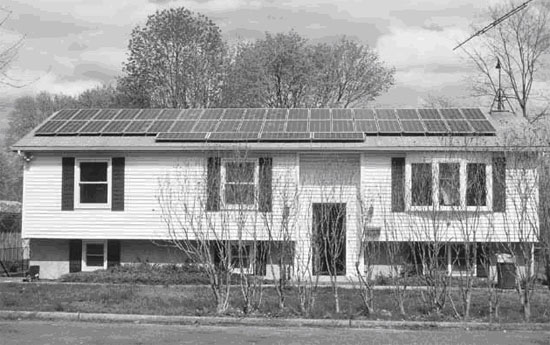
To look at them, panels are fairly indistinguishable from one another. They’re all blue-black slick-faced rectangles. The most common are made of mono- and polycrystalline silicon. They don’t have a standard size, but they’re likely to be in the range of from about 175 watts to 225 watts. At the midpoint, they’ll weigh in at about 40 pounds and measure about 3 feet by 5 feet. Panels are mounted on metal frames attached to the roof and, barring trees falling on them, are good for 25 years, so say the warranties.
A couple of alternatives exist. One is called thin film solar, which is produced in panels or flexible sheets. It’s a newer product that was supposed to take over the solar market.
With solar panels, efficiency and price track each other closely. The more efficient a solar electric collector is, the more it costs. The crystalline family is the most efficient and most expensive, with mono costing more than poly. Thin film is cheaper and less efficient, but its efficiency was supposed to gain on the crystallines while the price stayed down and the savings would be passed onto the consumer — or, at least, that was the idea. However, while it has been priced competitively, it’s still a work in progress and so takes up more space to catch the same amount of sun. Some roofs may just not have the space, and the roof of a zero energy home in particular shouldn’t have that much room. (SunPower and Sanyo are the leaders in efficiency. Both produce mono-crystalline panels.) Also, the leading thin-film solar material carries a heavy burden inside. It contains cadmium, one of six infamous hazardous substances recognized worldwide. (A less well-known thin-film, which is known by its acronym, CIGS, contains no cadmium.)
Solar shingles, the other alternative, are only worthwhile for anyone interested in a solar installation that looks good rather than performs well. They’re smoothly integrated into the roof with all the other shingles, as opposed to mounted on supports attached to the roof’s surface. Since they are part of the roof, there is nowhere for the sun’s heat to go once it hits the shingles, and that hurts their performance, whereas there’s a couple of inches of air space between panel mounts and the roof so the heat is dissipated. Choosing shingles also limits the choice of roofs: no steel or tiles, mostly just asphalt. They’re also a bit shinier and darker than the asphalt, giving the roof a kind of spotted look that in the end may not be so attractive after all.
Installers may have a particular brand of panel or module they use because they’ve established a good financial and service relationship with the distributor. This is not a problem. The Florida Solar Energy Center (FSEC) has certified nearly 100 solar panels, so there’s plenty to pick from. It may be a problem if the installers under consideration favor panels not on the list.
If each installer contacted uses FSEC-certified panels, shoppers may want to lean towards installers that only use solar panels produced in the US or Canada. This isn’t “Buy American” (or Canadian) jingoism. Indeed, they may just as easily be produced here by foreign companies like Sharp (Japanese) or SolarWorld (German). The point is that many companies, wherever they may be headquartered, manufacture good panels, but buying ones made in the US means less fossil fuel is used in transporting the panels, lowering the amount of embedded energy in the products.
This excerpt has been reprinted with permission from Home Sweet Zero Energy Home: What it takes to develop great homes that won’t cost anything to heat, cool or light up without going crazy, published by New Society Publishers, 2011. Buy this book from our store:Home Sweet Zero Energy Home.





