Photo by Getty Images Plus/mountainberryphoto
May and June bring flowers, and with each new scent, waves of nostalgia; delicate violets, irises, peonies, lilacs … all favorites of mine.
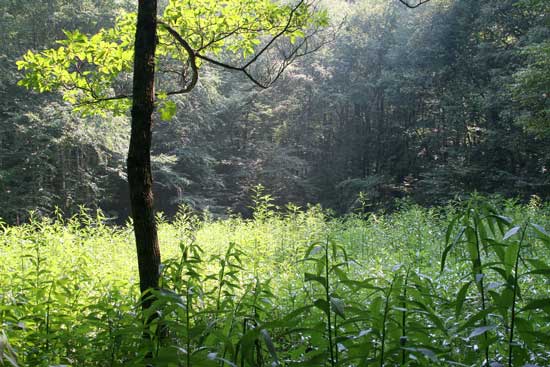
I grew up roaming the soft hills of the Catoctin Mountains, not far from Harpers Ferry Gap, where the Potomac and Shenandoah Rivers converge. It’s a gorgeous area, and an ancient subrange of the larger Appalachian Mountain chain. While it was boredom that sent me into the woods around these mountains, it was curiosity that kept me there. Spring meant that there were discoveries to be made, and two discoveries were so sensorial that each remains permanently etched in my olfactory glands: pipsissewa and sassafras.
Pipsissewa (Chimaphila umbellata), a cousin to spotted and striped wintergreen, grows close to the ground and sends up one or two tiny flower clusters that smell amazingly good: bright, but not too floral, with a mild menthe-like crispness (not unlike Beeman’s gum, if you’re old enough to remember the vintage candy). Pipsissewa flowers don’t keep, so I stopped trying to bring them home. They don’t transplant either. Instead, I learned to seek them out, belly and nose to the ground, from June to August.
Sassafras (Sassafras albidum), on the other hand, was prolific; once the leaves came out, it was easy to spot saplings large enough to have a root worth digging up — and small enough to actually get out of the ground. I’d chew on small roots as I hiked, and I’d save larger roots to make tawny-pink tea that needed no additional sweetener. It was magical.
The experience of discovering these plants rooted me in those mountains; they’ll always be home. They also led me to read Jethro Kloss’ book Back to Eden — an introduction to both herbal lore and the healing nature of plants in general — when I was 12. Here in Kansas, I can’t grow either of these woodland medicinals, but that hasn’t stopped me from experimenting each spring. This year, I hope to test some other plants mentioned in “Medicinal Woodland Shade Plants.”
What plants have rooted you and given you a sense of home? Share them with me at JDenney@MotherEarthLiving.com.
Mother Earth Living Book Club
Join us as we read The Art of Asking, and explore how Amanda Palmer changes the rules for (and provides insight into) the ways we exchange empathy and creativity in a geographically global, but technologically immediate, world. With a foreword from Brené Brown, this book will inspire new thoughts about how to ask for help, how to examine how you give assistance, and how you currently perceive and experience love and community in the 21st century.
Join us from May 1 to June 30 by searching for the “Mother Earth Living Book Club” Facebook group. Ask to join, and we’ll connect!