

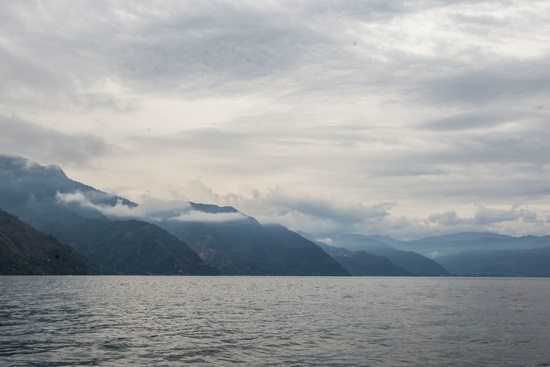
Lake Atitlan view. Photo by Atitlan Organics
This is Part 1 of a four-part series. Part 2 looks at these issues and ideas from the locals’ perspective, and explore more ways that for-profit is better suited to do non-profit work
It’s early morning in Tzununa, Guatemala — a small Mayan village nestled in a valley on the scenic shores of Lake Atitlan. At this early hour, fishermen in handmade canoes have been engaged for a few hours. Some cast line by hand, others check traps buoyed by plastic bottles, some lob handmade nets.
The rising sun colors the eastern horizon an entrancing orange that begins to illuminate a purple sky. Three inactive volcanoes on the lake’s shoreline catch this early light and emerge from darkness to cast their reflections upon the surface. Venus is the last star to fade, leaving the moon alone in the sky. More and more species of birds wake and join a growing chorus.
The lake is placid, the scene ancient. An observer a thousand years ago would have witnessed the same. But in an instant, the morning stillness breaks. The whine of an engine is heard in the distance and grows in volume until it is the dominant sound. The flat lake surface gives way to the lancha boat’s wake. The modern world has awoken.
It’s 6am. The bustle begins. Lanchas with outboard motors will cross the seven-by-eleven-mile waters as long as daylight remains, picking up locals and tourists and dropping them off at various village docks around the lake. At the docks, tuk-tuk drivers in their motorized rickshaws will jockey for positions and compete with good-natured smiles for the $1 fee to carry people and cargo further inland.
Case Study in Cultural Shift
This scene is an apt analogy for what’s happening in Tzununa, which is a revealing case study to contemplate greater changes afoot in the world as modernization and globalized market economies reach the indigenous world. Tzununa, “The Valley of the Hummingbirds,” was until recently a sleepy Mayan village. While the Mayan have held onto their cultural identity in spite of a half-millennium of Spanish colonization, it’s the consumerist coaxing of modernity that now whittles away at their core values.
Central America is home to millions of Maya people. Mayan refers to the indigenous people who have continuously inhabited southern Mexico and much of Central America. Their story of is not the story of a civilization that disappeared. It is story of holding tight to language and tradition despite centuries of pressures to abandon them ever since the Spanish arrived half a millennium ago.
The sophisticated architecture, astronomy, and mathematics of the Maya has been well recognized. But archeology reveals their agriculture was equally cutting edge. “The Maya coped with tough environmental conditions by developing ingenious methods to grow crops” (Mascarello, 2010).
In his book, The Maya, Yale University professor writes that the Maya had, “Really effective farming, in the sense that densely inhabited villages were to be found throughout the Maya area, was an innovation of the Pre-Classic period” (Thames and Hudson, 2011). But as modernity, market economies, chemical agriculture, and factory farms become the norm, what remains of this knowledge is being lost.
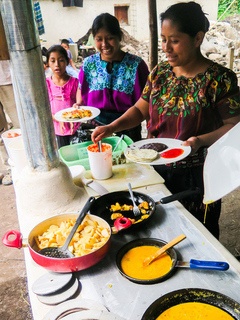
Photo by Luke Maguire Armstrong
Permaculture for Community Development
But in Tzununa, what the modern world is taking away it is also bringing back in a surprising way. Here, passionate foreigners have come to call the village home and are finding a balance between permaculture, the local culture, and ecology.
Shad Qudsi from was the first Western permaculture pioneer here. In 2009 he started Atitlan Organics, a small-scale, highly diversified, permaculture-inspired, low-input, direct-to-consumer, downright “ninja farm.” Their main products are triple washed and disinfected salad greens and cooking greens, eggs, chicken, honey, and coffee. They produce pork seasonally, taro root, tree tomatoes, limes, avocados, and loads of culinary and medicinal herbs, selling to over 30 families, 18 restaurants, and about a dozen stores in the region.
Beyond the small-scale profitable farm, they are active in community service. Most small-scale farmers in the region grow coffee, which is susceptible to both dramatic price fluctuations and to diseases like coffee rust. Atitlan Organics has a project that helps small farmers diversify their coffee fields, using selected varieties of rare, but productive local avocados, along with turmeric, tree tomatoes, and pigeon peas. This combination of plants helps the coffee grow better, while also providing a set of nutrient dense harvests and side streams of income for the local farmer.
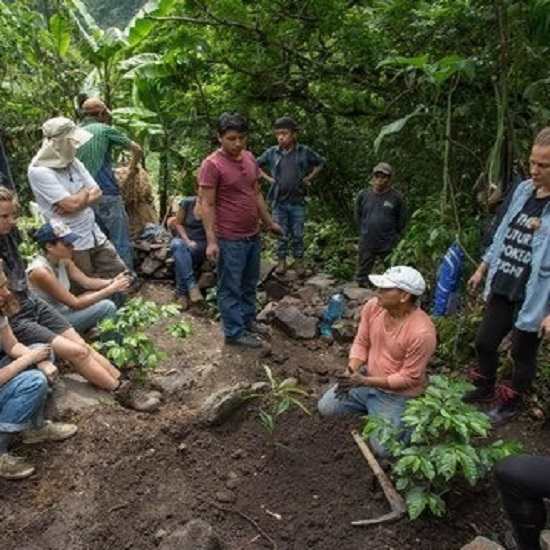
Further, they offer international volunteers the chance to come and help small farmers implement these changes, which improves the food security and local economy of Tzununa, while allowing volunteers to learn and leave a lasting positive impact during their visit. A newer arrival to the growing regenerative living scene in Tzununa is Abundant Edge, an organization that promotes Natural Building and Regenerative Design around the world while making their base of operations here in The Valley of the Hummingbirds.
“Here in Tzununa is where we want to attract the foreigners dedicated to permaculture and ecological principles,” says Abundant Edge co-founder Neal Hegarty, an Irishman born on a dairy farm who has worked in farming projects around the world.
Neal was first attracted to Guatemala when he learned of the Mayan system of “forest gardens,” which appeared to the Spanish as unmanaged systems. “It took a long time,” he says, “for people to realize that the local Mayans were farming by working with the fact that ecosystems in this part of the world want to be diverse.” He adds, “The more diverse the ecosystem you are in, the more diverse your productive ecosystem needs to be.”
His business partner, Oliver M. Goshey is a natural builder with experience in 11 countries on six continents. “It’s clear that people are still importing most of their calories,” he says, “This might not be a very good place to grow grain or corn staple crops, but it could be managed to the point where the vast majority of nutrient rich vegetable and animal products come from the valley, including a surplus for export.”
Abundant Edge’s client scope is international, but they are firm believers in thinking globally, while acting locally. They aren’t coming in from the outside to implement notions they’ve merely read about. Here in their Mayan expat village, they have been carefully and slowly learning how to germinate their ideals into positive change.
“It’s unteachable,” says Neal. “You can’t learn it in University. Those things can get you started, but the cultivation of this kind of wisdom is a journey that you have to go through.” Both Atitlan Organics and Abundant Edge hires locals, pays them living wages, learns from them, and intelligently applies their expertise free of cost to endeavors that lift the whole community.
Jose Armando teaches an international volunteer group. Photo by Atitlan Organics
Community Alliances form a Stronger Place-based Economy
They’re in good company on the environmental frontlines of Tzununa. A mile hike up a mountain from the center of town, you’ll find Max, a Californian who has been successfully living off-grid on his land for years, cultivating chickens, vegetables, and peace of mind. Throw in two yoga schools, a spiritual herbal center (The Seed), an ethically run hotel (Los Lomas de Tzununá) that has founded a locally empowered community learning center and is working on a community garden, and you begin to grasp the unique blend of conscious-living dreamers who are putting down roots on these Mayan shores. Everyone is diverse and agenda driven, yet like-minded and collaboratively open company.
“We’re part of a movement whether we like it or not,” says Neal. “We all have to do what we’re best at and work together. This is a game and we have to get good at it. We have to get very good at making big things happen. It’s about doing less work, but more effective work.”
The game in question is a game of human survival and whether or not our current global agricultural paradigm is sustainable. The more we move to densely populated cities, the more global market connectedness causes the food we need to be grown far away, the further we might have to fall.
It’s said that on a long enough timeline, anything that can happen will happen. Some believe when it comes to our food, humanity is playing a game it will eventually lose. Eventually something — war, natural disaster, flood, economic crash, banks too big to fail failing — could happen. And if it does happen, indigenous cultures, crazy hermits in the hills, and ninja farmers not relying on subsidized chemicals to grow food might just inherit the earth.
After all, who’s idea was it to grow the food we need for survival hundreds or thousands of miles away from where we live? If food stopped showing up on the grocery store shelves, most Mayans will be fine. How will Westerners fare? Shad believes small-scale “ninja” farms that use very little industrial inputs are the key to the future of sustainable farming and food security.
He explains, “Farms like Atitlan Organics encourage the development of local economies, while creating buffers that protect small farmers from international factors that are beyond their control. These types of farms also encourage the conservation of natural resources such as soil and water, which enable plants to grow better each year, with fewer and fewer inputs.”
Photo by Luke Maguire Armstrong
Cultivating Traditional Wisdom
Neal sees his own heritage in serious need to reconnect with the lands they live on. “When we talk about indigenous people,” he says, “we’re talking about people who have a wisdom connected to the place where they are. The local people, whether we want to admit it or not, don’t really have that. It was taken from them. A few of them still have it, but the vast majority of indigenous people in Guatemala do not. They farm coffee, which isn’t from here. It’s from Ethiopia. And their diet is dominated by chips and Coca-cola.”
Part of Abundant Edge’s mission is to return to locals that knowledge which was taken away. Shad and Neal spent time working in development, and both found themselves more effective in making the impacts they desired by running for-profit businesses that care and give back to the community.
Neal pursued his Masters degree in international development, but his experience working for charities led him to witness the undesired side effects of the current global development paradigm. No matter how well crafted a program, a program that involves outsiders coming in will always face the challenge of “How do you enact from the outside changes which tend to only take hold when they emerge from within?”
Atitlan Organics and Abundant Edge create the change they want to see in the world by funneling their ideals through a sustainable business model that educates/empowers/ both locals and Westerns, creates more abundance for everyone and operates on sustainable and ecological principles.
“We live here,” says Oliver, “We have made this community our home. With NGOs many projects that get started only take on one aspect of a project, instigation or installation. But we are here to see the projects we implement through because this is our community too. The locals we work with we know as friends. Trust and mutual understanding is built before houses and gardens.”
“Healthy communities, and healthy people,” Neal adds, “These are emergent properties, you don’t have one without the other.”
If this type of work inspires you, visit Atitlan Organics and Abundant Edge’s websites to get involved with their work. And check out The Abundant Edge permaculture and natural building podcast.
Luke Maguire Armstronghas worked in development everywhere from Guatemala to Kenya, Uganda, and the Bronx, N.Y. He lectures on topics ranging from human trafficking, economics, philosophy, creative writing, and international affairs. He is the author of the intrepidly acclaimed travel anthology The Nomad’s Nomad. Follow him @LukeSpartacus and read all of his MOTHER EARTH NEWS posts here.
All MOTHER EARTH NEWS community bloggers have agreed to follow our Blogging Guidelines, and they are responsible for the accuracy of their posts. To learn more about the author of this post, click on their byline link at the top of the page.






