

MOTHER’s summer naturalist takes you on a wildlife journey through the garden.
Muir, Bartram, Burroughs, Thoreau, Audubon — they were all good naturalists, true, and you have to admire their industry. On hot summer days, though, I prefer not to follow in their trail-trudging footsteps. instead this summer naturalist will choose the more supine observational methods of those two other great American naturalists, Pa Kettle and Snuffy Smith.
Although I have not fully achieved their mastery of passive nature study, I practice hard in the hammock slung between two trees in our back yard. Occasionally I must close my eyes and rest, of course, because sustained scrutiny of one’s surroundings can be taxing and is made none the easier by the hammock’s incessant, gentle sway.
Nonetheless, by sheer dogged determination I have managed to observe and cogitate on a number of summer’s wonders.
Tame-Foods Foraging
If I lift my head slightly I can make out a couple of pepper plants peeking among the dandelions, sow’s thistle and quack grass in our garden. Some would call the latter three weeds, of course, but having read books about organic gardening I know they are actually companion plants and living mulch. No sense in pulling those up.
But even misguided souls who labor in their gardens are to be admired, for they’re making far easier work of what was once a life-or-death pursuit. Looking at a garden, it’s easy to forget those carrots, peas, corn and other vegetables in neat rows or beds are all descended from wild, free-ranging plants. Whenever you pick a tomato or pull a carrot, you’re actually for aging — albeit the easy way — for the same foods nomadic tribes roamed vast distances to gather centuries ago.
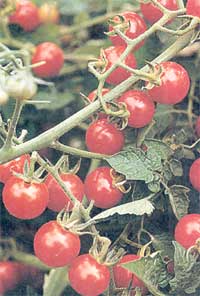
You probably know, for instance, corn, tomatoes and potatoes originated as wild plants in Mexico and South America, and became widely used as food in Europe after explorers took the domesticated plants home. Ears of wild corn were barely an inch long and bore only about a dozen kernels before Mesoamericans started working on them thousands of years ago. Tomatoes originally were about the size of a marble.
The wild cousins of many garden vegetables still can be found in their homelands. Celery grows wild in marshes in Asia and northern Africa. Cucumbers thrive in the foothills of the Himalayas. Wild asparagus is so common in parts of western Asia that cattle graze on it like grass. And in India, wild eggplants are considered weeds.
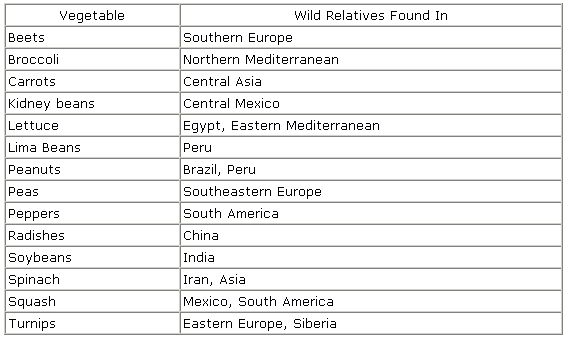
In the chart (in the image gallery) are some other familiar vegetables and the places they came from. As you can see, you’d have to travel a long, long way to gather the ingredients for a good dinner salad.
Wasps: Nature’s Papermakers
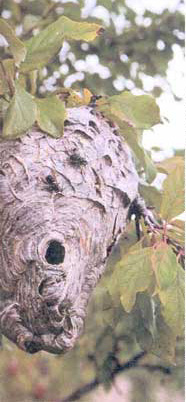
On the north side of our house, where the paint is peeling, I see a bald-faced hornet has returned to a favored patch of exposed wood. It’s been shuttling back and forth for a couple of hours now from there to an ever-growing nest beneath the eaves above our kitchen door. I suppose I’ll have to knock the nest down someday, since hornets are territorial and they buzz about awfully every time someone goes in or out the door. For now, though, I’m content to consider the nest as an example of our species’ tendency to take credit where it isn’t due.
Most books will tell you paper was invented in China about 1,900 years ago by a man named Ts’ai Lun. W Ts’ai Lun may have been the first Homo sapiens to make paper, but wasps have bee making the stuff for eons.
Worker wasps use their powerful jaws to chew up mouthfuls of wood from dead trees, rotten fenceposts, old boards and naked house siding. As they chew, the wood fibers mix with the wasp’s saliva to make pulp. Then the wasps fly back to the nest and plaster the pulp in place, spreading the material carefully with their jaws, stopping every few minutes to test the layer with their feelers to make sure it’s the right thickness. As each wasp works, it pivots its body slightly. That’s why paper wasp nests have hundreds of small curved lines on them. When the pulp dries it turns into paper tough enough to protect the wasps from rain and wind. It’s so strong you can write or type on it. If you find an abandoned hornet nest (make sure it’s empty!), tear a strip off and flatten it under a book overnight. You’ll have yourself a nice little piece of wasp notepaper.
Because wasps get the wood fibers for their nests from different places, the paper is streaked with different shades of black, gray and white. Nests near old red barns sometimes are mottled red from chewed up pieces of the nest over our door has some interesting blue areas – the color of our home.
Those Busy, Busy Hummingbirds
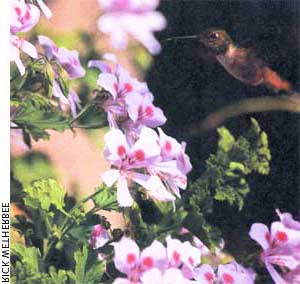
Occasionally here in my horizontal observation post I am awakened — I mean surprised — by the characteristic loud buzzing of a nearby hummingbird in flight. Talk about busy. The hummer that hovers about our home does enough work for both of us, a thought I find enormously pleasing.
There’s a lot of bird packed into that tiny, iridescent package. And a lot of food for wonder:
• There are 340 different kinds of hummingbirds in the world, and they all live in the Western Hemisphere. Europeans had never seen a hummingbird until a French explorer spotted one in the New World in 1558.
• The tiniest bird on Earth is the Cuban bee hummingbird. From the tip of its bill to the end of its tail, it’s only about 2 inches long.
• Even an average-size hummingbird is very small. Black-chinned and ruby-throated hummingbirds, the two most common kinds in North America, are just over 3 inches long and weigh about as much as three paperclips.
• Hummingbirds are the only birds in the world that can fly not only forward but also backward. For a quick getaway a hummer can even flip over and fly upside down.
• In the time it takes you to say the word hummingbird (about one second) a hovering hummer beats its wings 55 times. When it’s flying fast, its wings beat 200 times a second.
• The hummingbird’s heart is the largest compared to its body size of all warm-blooded animals.
• In very hot weather, hummingbirds cool themselves by panting.
• Ruby-throated hummingbirds; migrating to and from North America fly 500 miles nonstop across the Gulf of Mexico. Twice a year, rufous hummingbirds travel 2,500 miles between Central America and Alaska.
• To keep their fast-moving bodies fueled, hummingbirds eat almost constantly. Every day, a hummingbird visits between 1,000 and 2,000 flowers, and drinks more than half its weight in nectar. It also gobbles up small insects and spiders.
A Hard-Working Wildlife Habitat
The unmown grass, the ragged-looking shrubs, that pile of dead limbs and brush behind the poplar: Some would say, as my misinformed neighbors have hinted from time to time, these are symptoms of a good for-nothing homeowner. Of course, I know better I’m creating wildlife habitat.
I recommend the hobby and here’s my secret: Often, the best thing you can do to provide a hospitable home for birds and animals is to do nothing at all.
For example:
• Don’t regularly mow the outer few feet of your lawn. The resulting growth will create edge, which provides cover for many species and nesting areas for some. if you can’t let your lawn’s perimeter go natural, pick an out-of-the-way comer or a dry or swampy spot where grass already has difficulty growing.
• Don’t clear grassy areas or prune trees or shrubs until the end of nesting season. (Or better yet, maybe you should forget the job.) if you do prune, leave the lower branches intact to create ground-level cover.
• Don’t rake leaves from beneath all your deciduous trees. Let some leaf litter remain to encourage an insect population that will provide fare for insect-eating wildlife.
• Don’t keep your yard perfectly cleaned of all twigs, grass clippings, feathers and other small debris: Birds need such objects for nesting material.
• Don’t get rid of fallen limbs or pruned branches. Instead, build a brush pile to provide cover and nesting places. Don’t trim hedges or other shrubbery flat. Let vegetation assume its own natural shapes.
See what I mean? The formula for successful wildlife landscaping couldn’t be simpler or more suited to summer’s dog days: Sit back, relax and let nature do much of the work.






